
Mexico’s energy reform seeks to reverse decline in oil production
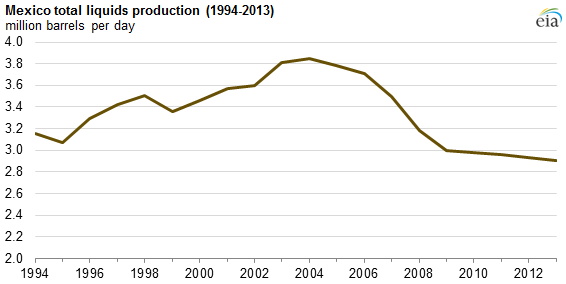
In late 2013, Mexico's congress approved historic legislation that altered the 1938 ban on private sector participation in the Mexican energy sector. These reforms, that end the 75-year monopoly of Petroleos Mexicanos (Pemex) and allow for greater foreign investment, are the first to include constitutional change, and promise to address many of the challenges that have resulted in a decade-long decline in Mexico's oil production.
Last year, Mexico produced 2.90 million barrels per day (bbl/d) of total liquids, continuing the decline from its peak of 3.85 million bbl/d in 2004. Crude oil is the most significant component of Mexico's liquid fuels production, accounting for at least 85% of production in the past two decades. Preliminary estimates indicate April 2014 production of crude oil was about 2.5 million bbl/d, the lowest monthly average since 1995.
The new reforms include the following:
- Create four oil and gas exploration and production contract models, including service contracts, production-sharing, profit-sharing, and licenses.
- Give Pemex first refusal on developing Mexican resources before private companies begin bidding rounds (round zero), in which Pemex can provide financial and technical plans to develop the resources within three years.
- Give regulatory authority over the oil and gas sectors to the Energy Regulatory Commission, the Secretary of Energy, and the National Hydrocarbon Commission, and create the new National Agency of Industrial Safety and Environmental Protection.
- Keep Pemex as state-owned but with more administrative and budgetary autonomy, and allow the company to compete for bids with other firms on new projects.
- Establish the Mexican Petroleum Fund to manage contract payments and oil revenue.
Before the reforms can take effect, Mexico's legislature must finalize the secondary laws detailing the fiscal regime, including the contract terms for the exploration and production models and local content requirements. It is expected that Mexico will finalize the secondary legislation by early August.
Unlike the contract terms and local content requirements, which require legislative action to implement, Pemex is already moving forward with its proposal to retain oil and gas assets in the deepwater oil fields in the Perdido Fold Belt and offshore gas fields in Lakach. These proposals have been submitted to the energy ministry. A final decision will be announced in September.
Principal contributor: Michael Yo