U.S. Energy Information Administration logo
Skip to sub-navigation
January 24, 2014

EIA now providing more detail on electric capacity additions and retirements
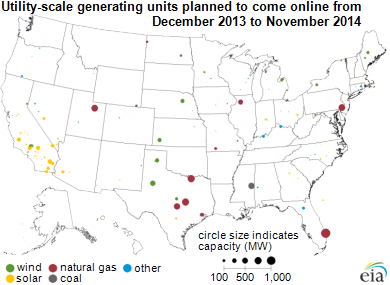
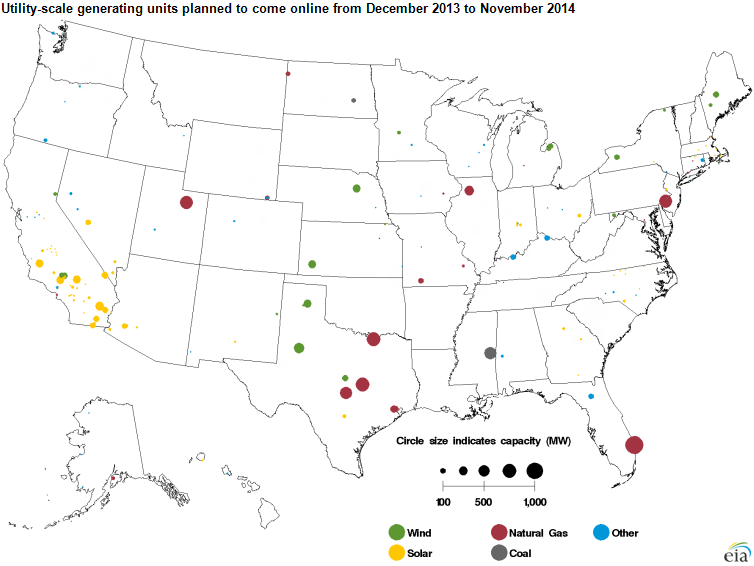
map of utility-scale generating units planned to come on line between October 2013 and September 2014, as explained in the article text
Source: U.S. Energy Information Administration, Electric Power Monthly
Note: Click for a larger version.

Beginning in December 2013, new tables and maps in the Electric Power Monthly provide detailed accounting of generator additions and retirements, as well as their effects on total capacity by fuel and technology type, on a state-by-state basis.

The state-level detail in the tables can be represented using maps like the one above. Maps make it easier to see, for example, the concentration of new solar generators in the Southwest, natural gas generators in Texas and along the Atlantic Coast, and wind generators in the Plains region that are expected to come online between December 2013 and November 2014.

Power plant owners and operators report plans to modify or retire existing generators, or build new generators, every year as part of EIA's Annual Electric Generator Report. A monthly survey prompts respondents for updates to plans for new builds, modifications, or retirements during the 12 months leading up to the expected change. EIA also follows trade press announcements and third-party tracking services to identify potential planned generators to include in the data collection process.

All generators at plants with at least one megawatt of capacity are represented in these surveys, including most large industrial and commercial generators. Smaller installations, such as residential rooftop solar, are not represented; instead, data for such installations are typically reflected in aggregate reporting from electric utilities that track the interconnection of these distributed systems to their distribution networks.

Principal contributor: Gwen Bredehoeft

Statistics
Analysis
Tools
Education
News

Petroleum & Other Liquids

Crude oil, gasoline, heating oil, diesel, propane, and other liquids including biofuels and natural gas liquids.

Natural Gas

Exploration and reserves, storage, imports and exports, production, prices, sales.

Electricity

Sales, revenue and prices, power plants, fuel use, stocks, generation, trade, demand & emissions.

Coal

Reserves, production, prices, employment and productivity, distribution, stocks, imports and exports.

Nuclear & Uranium

Uranium fuel, nuclear reactors, generation, spent fuel.

Renewable & Alternative Fuels

Includes hydropower, solar, wind, geothermal, biomass and ethanol.

EIA Survey Forms

Forms EIA uses to collect energy data including descriptions, links to survey instructions, and additional information.

Total Energy

Comprehensive data summaries, comparisons, analysis, and projections integrated across all energy sources.

U.S. States

State energy information, including overviews, rankings, data, and analyses.

International

International energy information, including overviews, rankings, data, and analyses.

Environment

Greenhouse gas data, voluntary reporting, electric power plant emissions.

Data Tools, Apps, & Maps

Tools to customize searches, view specific data sets, study detailed documentation, and access time-series data.

Open Data

EIA's free and open data available as API, Excel add-in, bulk files, and widgets

EIA Beta

Come test out some of the products still in development and let us know what you think!

Open Source Code

EIA's open source code, available on GitHub.

RSS Feeds

Subscribe to feeds for updates on EIA products including Today in Energy and What's New.