U.S. Energy Information Administration logo
Skip to sub-navigation
April 17, 2013

Abundant U.S. supply, low demand could cut dependence on liquid fuel imports
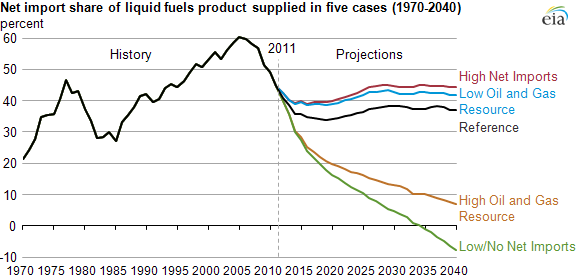
Graph of net import share of liquid fuels, as explained in the article text
Source: U.S. Energy Information Administration, Annual Energy Outlook 2013.

U.S. net imports of petroleum and other liquid fuels as a share of product supplied (used as a proxy for consumption) have been one of the most watched indicators in national and global energy analyses. The Annual Energy Outlook 2013 includes a case in which net imports of liquid fuels are eliminated by 2035 under inherently speculative assumptions that boost supply and reduce demand relative to the previously published Reference case.

The Low/No Net Imports case simulates an environment in which U.S. energy production grows rapidly while domestic consumption of liquid fuels declines. The Low/No Net Imports case assumes that more petroleum can be recovered from tight oil formations as well as from offshore, Alaska, and gas-to-liquids sources than is considered achievable using current technology and known geology. Domestic crude oil production approaches 10 million barrels per day by 2020 and is sustained near or above that level through 2040.

In the Low/No Net Imports case, assumptions limit growth in demand for liquid fuels. Projected liquid fuels demand is assumed to be lowered by technological, economic, and behavioral factors including:

  • Light-duty vehicle technology is improved
  • Vehicle fuel efficiency standards are tightened beyond the 2025 model year
  • Electric vehicle batteries are improved
  • Natural gas market penetration into the freight transport industries is expanded
  • Growth in vehicle miles traveled is significantly reduced relative to the Reference case

Additional analysis of the Low/No Net Imports case and related Import Dependence side cases can be found in the full Annual Energy Outlook 2013.

Statistics
Analysis
Tools
Education
News

Petroleum & Other Liquids

Crude oil, gasoline, heating oil, diesel, propane, and other liquids including biofuels and natural gas liquids.

Natural Gas

Exploration and reserves, storage, imports and exports, production, prices, sales.

Electricity

Sales, revenue and prices, power plants, fuel use, stocks, generation, trade, demand & emissions.

Coal

Reserves, production, prices, employment and productivity, distribution, stocks, imports and exports.

Nuclear & Uranium

Uranium fuel, nuclear reactors, generation, spent fuel.

Renewable & Alternative Fuels

Includes hydropower, solar, wind, geothermal, biomass and ethanol.

EIA Survey Forms

Forms EIA uses to collect energy data including descriptions, links to survey instructions, and additional information.

Total Energy

Comprehensive data summaries, comparisons, analysis, and projections integrated across all energy sources.

U.S. States

State energy information, including overviews, rankings, data, and analyses.

International

International energy information, including overviews, rankings, data, and analyses.

Environment

Greenhouse gas data, voluntary reporting, electric power plant emissions.

Data Tools, Apps, & Maps

Tools to customize searches, view specific data sets, study detailed documentation, and access time-series data.

Open Data

EIA's free and open data available as API, Excel add-in, bulk files, and widgets

EIA Beta

Come test out some of the products still in development and let us know what you think!

Open Source Code

EIA's open source code, available on GitHub.

RSS Feeds

Subscribe to feeds for updates on EIA products including Today in Energy and What's New.