
Catalytic reforming boosts octane for gasoline blending
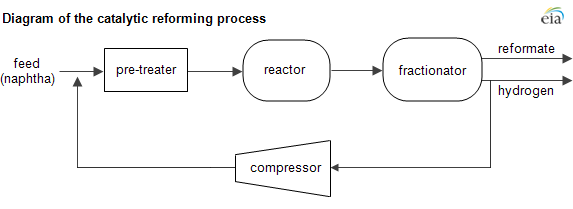
Reforming is an oil refining operation that produces reformate, a high-octane gasoline blending component. Reformate is one of several blending components in finished gasoline. EIA expects gasoline production to increase during the summer driving season.
Because reformate contains significant amounts of benzene, toluene, and xylene, it also is an important source of feedstock for the petrochemical industry. One of the byproducts of reforming is hydrogen, which can itself be used in other refining processes or sold for other industrial use.
The reforming process uses heavy naphtha, which is the second lightest liquid stream from an atmospheric distillation column, to produce reformate. (Bakken crude oil, which two new refineries in North Dakota plan to process, yields a large amount of naphtha.) Reformate is a component of finished gasoline. Other components include alkylate from the alkylation unit, naphtha and straight run gasoline from the atmospheric distillation unit, cracked gasoline from the fluid catalytic cracker and coker, and hydrocrackate, which is gasoline from the hydrocracker. The amount of each component in finished gasoline depends on the particular specifications of the gasoline blend. Important considerations in gasoline blending include octane, distillation, and volatility to meet summer and winter grade gasoline specifications.
In the reforming complex, a feed pre-treater removes sulfur from the reformer feed using hydrogen and a desulfurization catalyst. The pre-treated feed then is sent to the reformer reactor where a catalyst and heat are used to restructure or reform low octane naphtha into higher octane hydrocarbon molecules that are valuable gasoline blending components. The process turns straight-chain hydrocarbons into cyclic compounds while removing hydrogen. The cyclic compounds have a much higher octane rating than the straight-chain feedstock and enable economic production of high-octane lead-free gasoline. The process also reshapes normal butane into a mixture of isobutane and normal butane. Isobutane has a higher octane and higher vapor pressure than normal butane. Isobutane is a gasoline blending component or a feedstock to the alkylation unit used to produce alkylate, another gasoline blending component.
Tags: gasoline, liquid fuels, oil/petroleum, refining