

U.S. ENERGY INFORMATION ADMINISTRATION
WASHINGTON DC 20585
FOR IMMEDIATE RELEASE
June 30, 2015
EIA expands geographic coverage of natural gas production, with new data for 10 states
Beginning today, EIA is expanding its reporting of monthly natural gas production by 10 additional states. The addition of these states – Arkansas, California, Colorado, Kansas, Montana, North Dakota, Ohio, Pennsylvania, Utah, and West Virginia – significantly enhances EIA's monthly coverage, which was previously limited to Alaska, Louisiana, New Mexico, Oklahoma, Texas, Wyoming, and the Federal Gulf of Mexico.
Accompanying EIA's expanded coverage is a new webpage, Monthly Crude Oil and Natural Gas Production, which replaces the Monthly Natural Gas Gross Production Report. As suggested by the title of the new webpage, EIA will also be using it to report survey-based estimates for monthly crude oil production (including lease condensate) from the states covered by the new EIA-914 survey later this summer, followed by production data categorized by API gravity, an important measure of crude oil quality.
Monthly natural gas production estimates for 15 states, the Federal Gulf of Mexico, and the rest of the country (aggregated and reported as "Other States") are provided for January through April 2015. These estimates are based on data collected from a sample of U.S. operators on the expanded Form EIA-914 survey, with the exception of Alaska, which directly reports its volumes. Monthly production estimates for the expansion states, as with the original individually surveyed states and areas, are available with only a two-month lag; for example, the June release includes production estimates for April 2015. Previously, estimates for these 10 states were delayed by as much as two years.
The expanded geographic scope of the EIA-914 survey is in response to significant increases in U.S. natural gas production over the past several years, as well as important changes in production sources over this period. For example, the original EIA-914 survey, which was initiated in 2005, did not offer individual coverage for states such as Pennsylvania that have undergone transformative natural gas production growth, or for other states that may soon experience significant near-term production increases.
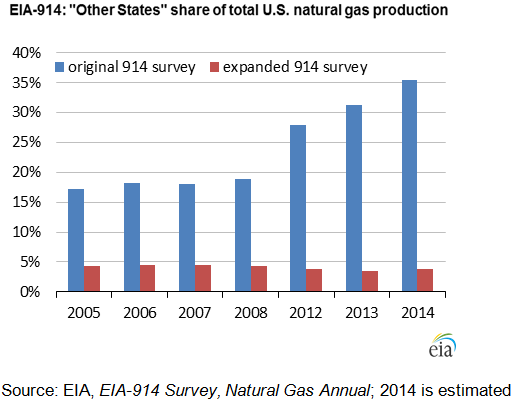
EIA is now reporting data for individual states that represented nearly 90% of total U.S. natural gas production in 2014. Previously, the survey's "Other States" grouping combined natural gas production from 27 states and the Federal Offshore Pacific. This grouping of states accounted for only 17% of total U.S. natural gas gross withdrawals in 2005. That share rose to more than a third (35%) by 2014. Within this group, the 10 expansion states represented 13% of total U.S. natural gas gross withdrawals in 2005 and more than twice that share (32%) in 2014. Production data from these 10 states will now be individually listed in the report.
The remaining 18 states/areas that now make up the aggregated "Other States" grouping (Alabama, Arizona, Florida, Illinois, Indiana, Kentucky, Maryland, Michigan, Mississippi, Missouri, Nebraska, Nevada, New York, Oregon, South Dakota, Tennessee, Virginia, and Federal Pacific) consistently accounted for less than 5% of U.S. natural gas production from 2005 through 2014.
Natural gas production data collected on the EIA-914 survey are used as inputs to several EIA products, including the Natural Gas Monthly and EIA forecasts such as the Short-Term Energy Outlook and the Annual Energy Outlook.
EIA Program Contact: Barbara Mariner-Volpe, 202-586-5878, barbara.mariner-volpe
EIA Press Contact: Jonathan Cogan, 202-586-8719, jonathan.cogan@eia.gov
EIA-2015-06