
Extension and expansion of efficiency programs could reduce U.S. total energy usage
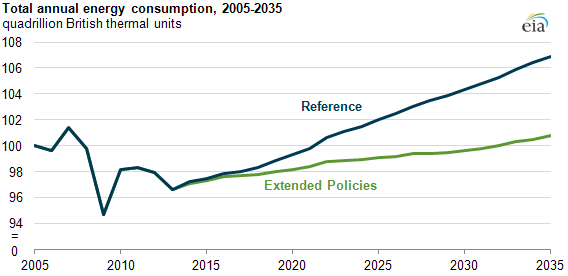
Analysis included in the U.S. Energy Information Administration's (EIA) Annual Energy Outlook 2012 shows that extending and expanding certain energy-related policies beyond the current sunset dates and current implementing regulations incorporated in the AEO2012 Reference case could reduce projected national energy consumption in 2035 by nearly 6%. Although these policies do not directly aim to reduce emissions of carbon dioxide or other greenhouse gases, they reduce the carbon intensity of the U.S. energy mix, so that projected energy-related carbon dioxide emissions in 2035 are reduced by 8% relative to the Reference case.
The AEO2012 Reference case generally reflects energy policies and regulations as legislated at the time EIA performed the analysis. Yet, some policies have had a history of being subsequently amended or revised. Amendments and revisions have extended the sunset provisions of the policy, raised efficiency standards, or expanded the scope of the policy to include new devices or uses. The Extended Policies case assumes a continuation and/or an expansion of certain energy policies, consistent with their implementation to date.
Unlike the Reference case, the Extended Policies case assumes the extension and/or expansion of several existing efficiency programs in the buildings, industry, transportation, and utility sectors.
Selected assumptions in the Extended Policies case include:
- Buildings sectors—additional residential and commercial equipment efficiency standards that cover more equipment, as well as more stringent building energy codes
- Transportation sector—more stringent fuel economy standards for light-duty vehicles
- Industrial sector—extended investment tax credit for combined heat and power equipment that also increases the capacity levels eligible for the credit
- Utility sector—extended tax credits for renewable energy technologies
Additional analysis of the Extended Policy case and other side cases can be found in the full Annual Energy Outlook 2012.