
Saudi Arabia uses largest amount of crude oil for power generation since 2010
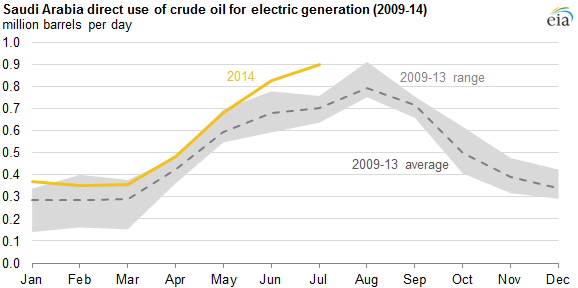
Saudi Arabia is one of a handful of countries that burn crude oil directly for power generation, according to the Joint Organizations Data Initiative (JODI). During the summer, Saudi Arabia typically experiences an increase in electricity consumption as domestic demand for air conditioning rises. Saudi Arabia burned 0.9 million barrels per day (bbl/d) of crude oil in July, the highest ever recorded in JODI data for the month of July and the highest overall since August 2010.
Saudi Arabia used an average of 0.7 million bbl/d of crude oil for power generation during the summers from 2009 to 2013. During that same period, Iraq and Kuwait, the next two largest users of crude oil for power generation in the Middle East, each averaged roughly 0.08 million bbl/d of crude burn.
Generally, countries are more likely to consume natural gas or coal to meet higher summer electricity demands. But Saudi Arabia has no domestic coal production, and most of its natural gas is associated gas, which is produced along with oil from the same wellbore. Efforts in Saudi Arabia to expand onshore nonassociated gas production have experienced difficulties in finding and extracting natural gas because of the high sulfur content of the natural gas and low domestic natural gas prices. As a result, investing in natural gas projects remains unattractive to foreign companies.
At the same time, net electricity consumption in Saudi Arabia has more than doubled since 2000, reaching an estimated 232 billion kilowatthours (kWh) in 2012 (the latest data available). Saudi Arabia's economy also continues to grow. The gross domestic product (GDP) growth in Saudi Arabia in the first quarter of 2014 was 4.7% year-over-year compared to 3.8% growth in the first quarter of 2013. In addition, Saudi Arabia's Central Department of Statistics & Information estimates that the country's population will grow 2.6% in 2014 to more than 30 million residents, further increasing electricity demand.
Saudi Arabia plans to diversify its power generation sources and improve overall energy efficiency. By 2032, Saudi Arabia is planning to more than double its available generating capacity from 58 gigawatts (GW) to 120 GW by developing solar and nuclear power generation. New and planned petroleum refineries are expected to be customized to produce larger amounts of diesel, a portion of which may be allocated for power generation to replace crude oil. The Wasit Gas Program is an initiative to develop two offshore natural gas fields and construct a plant capable of processing 2.5 billion cubic feet per day (Bcf/d) of natural gas, increasing the amount of natural gas available for electricity generation. Finally, the Saudi Energy Efficiency Center was created in 2010 and is responsible for developing energy efficiency policies.
More information is available from EIA's recently updated Saudi Arabia Country Analysis Brief.
Principal contributor: Rebecca George