
Fuel economy improvements show diminishing returns in fuel savings
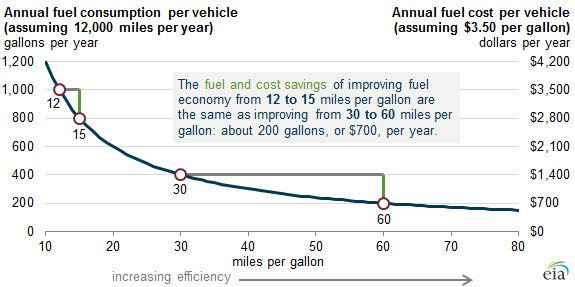
Note: Calculations in graphic assume a fuel price of $3.50 per gallon and annual travel of 12,000 miles per vehicle.
Fuel costs, which depend on vehicle fuel economy, miles driven, and fuel price, are an important factor in vehicle purchasing decisions. However, fuel economy improvement exhibits diminishing returns in fuel savings. For example, switching from a 10-mile-per-gallon (mpg) vehicle to a 15-mpg vehicle saves more fuel and results in greater fuel cost savings than switching from a 25-mpg vehicle to a 75-mpg vehicle. The fuel and cost savings of improving fuel economy from 12 mpg to 15 mpg are the same as increasing from 30 mpg to 60 mpg.
Much of the reduction in fuel consumption and fuel cost comes from incremental fuel economy improvement at the relatively low fuel economy levels. For a consumer who drives 12,000 miles per year and pays $3.50 per gallon for gasoline, increasing fuel economy from 10 mpg to 11 mpg saves $382 in annual fuel cost and from 30 mpg from 31 mpg saves $45; raising fuel economy from 40 to 41 mpg saves just $26 and from 60 to 61 saves $11.
Vehicles that use fuels other than gasoline, such as diesel or electricity, will have different fuel savings and fuel cost. Diesel vehicles often have higher fuel economy than standard gasoline vehicles, but they also must use diesel fuel, which is more expensive than gasoline. Plug-in electric vehicles, which achieve high fuel efficiency and take advantage of relatively inexpensive electricity (compared to gasoline), can accrue significant fuel cost savings, albeit at higher incremental vehicle cost.
As light-duty vehicle fuel economy continues to increase because of more stringent future greenhouse gas emission and Corporate Average Fuel Economy (CAFE) standards through model year 2025, standard gasoline vehicles are expected to achieve compliance fuel economy levels of around 50 mpg for passenger cars and around 40 mpg for light-duty trucks. Diminishing returns to improved fuel economy make standard gasoline vehicles a highly fuel-efficient competitor relative to other vehicle fuel types such as diesels, hybrids, and plug-in vehicles, especially given the relatively higher vehicle prices projected for these other vehicle types.
Principal contributor: Nicholas Chase
Tags: diesel, efficiency, gasoline, transportation, vehicles