U.S. Energy Information Administration logo
Skip to sub-navigation
September 9, 2013

Cooler-than-normal August relieves strain on Texas electricity market
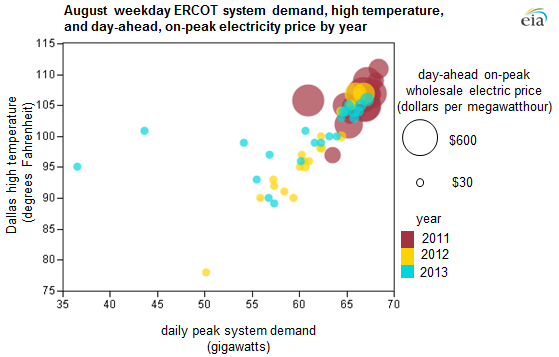
graph of ERCOT weekday demand, high temperature, and day ahead on peak electricity price, as explained in the article text
Source: U.S. Energy Information Administration based on Bloomberg, Energy Velocity, and SNL Energy
Note: Electricity price is ERCOT's North Zone day-ahead, on-peak wholesale electricity price

August is typically the peak demand month for electricity in Texas, and sustained high temperatures can lead to stress on the electric grid. Although August saw temperatures rise above 105 degrees, the prolonged heat that can stress the grid beyond its capabilities did not materialize.

During the summer when temperatures are high, demand for electricity to cool homes and businesses increases. Although electric systems are designed to meet peak demand, consecutive high-demand days can strain power plants and transmission facilities and lead to unplanned outages. Very high wholesale electricity prices are often indications of this type of system stress.

The graphic above illustrates the relationship between daily high temperatures, daily peak system demand, and wholesale power prices for the past three Augusts for most of Texas. The size of each bubble represents the wholesale electricity price in the North Zone (Dallas-Fort Worth area) of the Electric Reliability Council of Texas' (ERCOT) electric system for peak weekday hours.
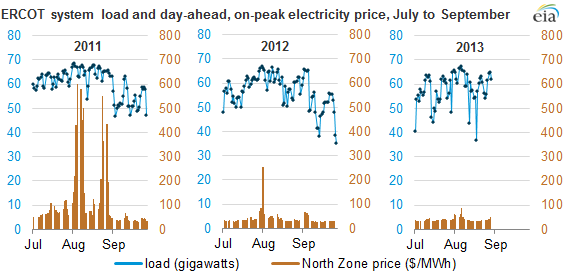
Graph of ercot system load and electricity price, as described in the article text

Source: U.S. Energy Information Administration, based on SNL Energy and Energy Velocity.
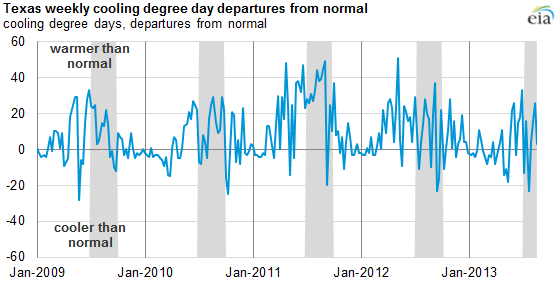

Graph of NOAA Texas-wide population weighted weekly cooling degree day departures from normal, as described in the article text

Source: U.S. Energy Information Administration based on Bloomberg, LP.
Note: Shaded areas are the dates from July to September, which correspond to the data on the graphs in the first tab.

In August 2011, a period of sustained extreme heat drove day-ahead electricity prices over $600 per megawatthour (MWh). During August 2012 there were a few days of sustained high system demand, leading to single-day spikes of about $250/MWh in the day-ahead market. August 2013 has seen single days of high temperatures and high system demand, but not a sustained period of extreme heat as in 2011 and 2012. Consequently the price in 2013 peaked at only $90/MWh.

Statistics
Analysis
Tools
Education
News

Petroleum & Other Liquids

Crude oil, gasoline, heating oil, diesel, propane, and other liquids including biofuels and natural gas liquids.

Natural Gas

Exploration and reserves, storage, imports and exports, production, prices, sales.

Electricity

Sales, revenue and prices, power plants, fuel use, stocks, generation, trade, demand & emissions.

Coal

Reserves, production, prices, employment and productivity, distribution, stocks, imports and exports.

Nuclear & Uranium

Uranium fuel, nuclear reactors, generation, spent fuel.

Renewable & Alternative Fuels

Includes hydropower, solar, wind, geothermal, biomass and ethanol.

EIA Survey Forms

Forms EIA uses to collect energy data including descriptions, links to survey instructions, and additional information.

Total Energy

Comprehensive data summaries, comparisons, analysis, and projections integrated across all energy sources.

U.S. States

State energy information, including overviews, rankings, data, and analyses.

International

International energy information, including overviews, rankings, data, and analyses.

Environment

Greenhouse gas data, voluntary reporting, electric power plant emissions.

Data Tools, Apps, & Maps

Tools to customize searches, view specific data sets, study detailed documentation, and access time-series data.

Open Data

EIA's free and open data available as API, Excel add-in, bulk files, and widgets

EIA Beta

Come test out some of the products still in development and let us know what you think!

Open Source Code

EIA's open source code, available on GitHub.

RSS Feeds

Subscribe to feeds for updates on EIA products including Today in Energy and What's New.