
EIA expects U.S. gasoline and diesel retail prices to decline in 2023 and 2024
We are working on some exciting changes to our short-term analyses, so we are no longer publishing the Today in Energy article on Fridays. We will have additional updates in the coming months.
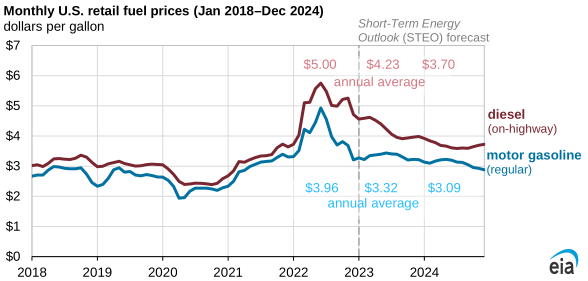
We forecast retail gasoline and diesel prices will decline in 2023 and 2024, according to our latest Short-Term Energy Outlook (STEO), after reaching multiyear highs in the first half of 2022. We forecast that retail prices for regular-grade gasoline will average $3.32 per gallon (gal) in 2023 and continue to decrease to average $3.09/gal in 2024, down from $3.96/gal in 2022. We expect on-highway diesel prices to decrease to average $4.23/gal in 2023 before decreasing further to $3.70/gal in 2024. These forecast price decreases are based on our expectation of lower demand growth for diesel and motor gasoline with continued high production of those products.
In 2023, we expect that limited growth in global demand for gasoline combined with increased gasoline production will cause gasoline inventories to rise in the United States. We estimate that annual average U.S. gasoline consumption increased by 0.3 million barrels per day (b/d) in 2022. We forecast a decrease in gasoline consumption in 2023 of 0.3 million b/d compared with 2022, and we expect gasoline consumption will remain similar to 2023 in 2024. Additional refinery capacity that came online in late 2022, combined with additional capacity expansions expected to come online in 2023, will also contribute to rising supplies of both gasoline and diesel fuel internationally, further contributing to lower prices globally in 2023 and 2024. We also estimate that U.S. refiners will continue to produce gasoline, even as prices decrease, to meet higher global demand for diesel fuel.
We expect annual U.S. consumption of gasoline will remain less than in 2019 (9.3 million b/d) through the end of 2024. However, we estimate that people drove more in the United States during 2022 than during 2019, before the pandemic. We forecast this trend of increased travel will continue in the United States during 2023 and 2024, but increased vehicle fleet fuel economy will offset the increase in fleet vehicle miles traveled. Vehicle fleet fuel economy is the number of fleet vehicle miles traveled, including hybrid or hybrid-electric vehicles, divided by all gasoline consumption, also reported in miles per gallon.
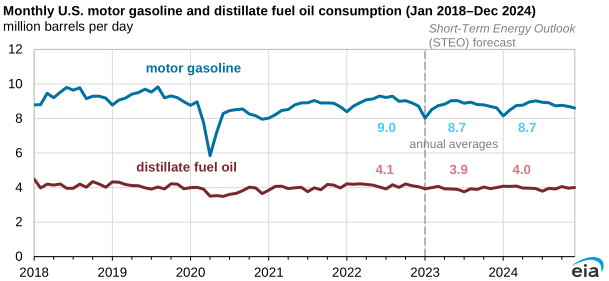
U.S. consumption of distillate fuel oil increased from 4.0 million b/d in 2021 to 4.1 million b/d in 2022. Distillate fuel oil is primarily used in the United States as diesel road fuel, but it is also used for agriculture, space heating, and industrial uses. For both gasoline and distillate, U.S. consumption in 2022 was concentrated in the first part of the year, before high prices began driving consumption down for most of the second half of 2022.
We expect U.S. demand for distillate to remain below 2022 demand through the end of our forecast in 2024. Although we forecast global demand for distillate fuel oil will remain strong, distillate demand remains a factor with significant uncertainty in our forecasts for distillate inventories and prices, especially in Europe where sanctions on Russia have disrupted historical supply patterns for the fuel. Similar to gasoline, we expect increased global refinery capacity will help lower diesel prices through 2023.
Additional information on our forecasts for petroleum consumption, production, inventories, and prices is available in our Short-Term Energy Outlook.
Principal contributor: Kevin Hack