
Refinery capacity increased slightly for the first time since the COVID-19 pandemic
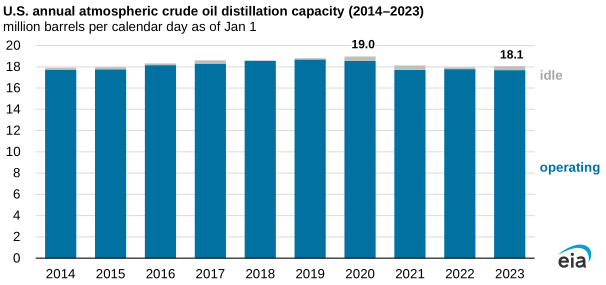
U.S. refining capacity increased slightly for the first time since the COVID-19 pandemic, as of January 1, 2023, reversing two years of decline, according to our annual Refinery Capacity Report. Operable atmospheric crude oil distillation capacity, our primary measure of refinery capacity in the United States, totaled 18.1 million barrels per calendar day (b/cd), a 1% increase from 2022.
We publish two measures of U.S. refinery capacity: barrels per calendar day (b/cd) and barrels per stream day (b/sd). Calendar-day capacity represents the operator’s estimate of the input that a distillation unit can process over a 24-hour period under usual operating conditions, and stream-day capacity reflects the maximum input that a distillation facility can process within a 24-hour period when running under ideal conditions with no allowance for downtime. Stream-day capacity is typically about 6% higher than calendar-day capacity.
The number of operable refineries in the United States decreased to 129 at the beginning of 2023, down from 130 refineries at the beginning of 2022. The single refinery closure reflects the loss of a small facility in Santa Maria, California, that had 9,500 b/cd of crude oil distillation capacity. Despite the loss of the Santa Maria plant, total U.S. capacity increased because PBF Energy reactivated a previously retired crude oil distillation unit at its refinery in Paulsboro, New Jersey. The unit’s crude oil capacity increased from 100,000 b/cd in 2022 to 160,000 b/cd in 2023.
The 2023 Refinery Capacity Report does not reflect changes in U.S. refining capacity after January 1, 2023. ExxonMobil announced the completion of a major refinery capacity addition in mid-March, boosting the facility’s total crude oil distillation capacity by 250,000 barrels per day (b/d) to 630,000 b/d, according to the announcement. This new estimated capacity is reflected in our monthly data as of our May Petroleum Supply Monthly, and we will include an exact measure in calendar-day capacity and stream-day capacity in next year’s Refinery Capacity Report.
Additional recent expansion projects include a smaller crude oil capacity expansion at Marathon’s Galveston Bay refinery and a coker expansion project at Valero’s Port Arthur refinery, which are also not reflected in this year’s report. Phillips 66 has announced plans to stop refining petroleum at its 120,200-b/cd Rodeo refinery in California while the facility transitions to refining biofuel, but it had still not terminated its refining operations as of January 1, 2023. LyondellBasell had previously announced that its 263,776-b/cd refinery in Houston would close by the end of 2023, but the company recently announced that it will delay the facility’s shutdown until 2025, according to reports in late May 2023.
Principal contributors: Kimberly Peterson, Kevin Hack