U.S. Energy Information Administration logo
Skip to sub-navigation
July 29, 2011

Japanese power companies using more LNG to generate electricity
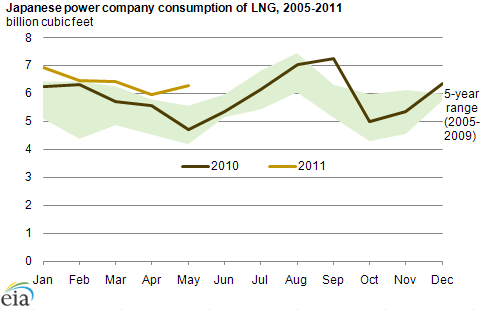
graph of Japanese power company consumption of LNG, 2005-2011, as described in the article text
Source: U.S. Energy Information Administration based on the Japan Federation of Electric Power Companies data.

Japan, the world's leading importer of liquefied natural gas (LNG), has consumed more LNG to generate electricity in January-May 2011 than over the same period in prior years. On average, Japan's electric power companies used more than six billion cubic feet per day (the tan line in the chart above) to produce electricity during the first five months of 2011.

Japan's nuclear power generation has been significantly curtailed in the aftermath of the March 11, 2011 Tohoku earthquake and accompanying tsunami, which led to the accident at Tokyo Electric Power Company's (TEPCO) Fukushima Daiichi nuclear power plant and subsequent outages at other plants. Only 19 of Japan's 54 commercial nuclear facilities — or fewer than 18 gigawatts (GW) out of a total commercial nuclear fleet of about 49 GW — are currently in operation. As a result, LNG consumption at power companies was up 30% in May 2011 compared to May in 2010.
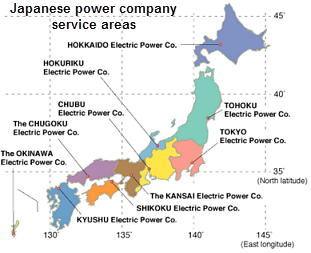
map of Japanese power company, as described in the article text
Source: U.S. Energy Information Administration based on the Japan Federation of Electric Power Companies map.

Overall imports of LNG in Japan have been trending up since 2003. As of April 2011, Japan's total LNG imports accounted for more than 10 billion cubic feet per day (see gray area in chart below) of natural gas supply, most of which is used for power generation. The average price paid for LNG in Japan now exceeds $13 per million Britsh thermal units, or about three times the current price of natural gas at the Henry Hub in the United States.
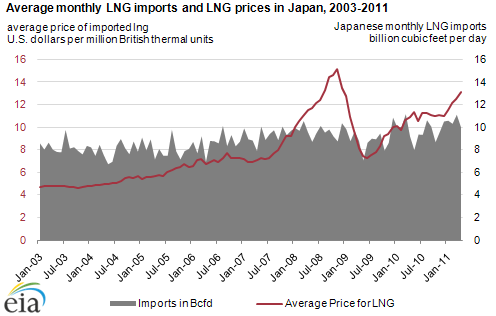
graph of average monthly LNG imports and LNG prices in Japan, 2003-2011
Source: U.S. Energy Information Administration based on Bloomberg.
Statistics
Analysis
Tools
Education
News

Petroleum & Other Liquids

Crude oil, gasoline, heating oil, diesel, propane, and other liquids including biofuels and natural gas liquids.

Natural Gas

Exploration and reserves, storage, imports and exports, production, prices, sales.

Electricity

Sales, revenue and prices, power plants, fuel use, stocks, generation, trade, demand & emissions.

Coal

Reserves, production, prices, employment and productivity, distribution, stocks, imports and exports.

Nuclear & Uranium

Uranium fuel, nuclear reactors, generation, spent fuel.

Renewable & Alternative Fuels

Includes hydropower, solar, wind, geothermal, biomass and ethanol.

EIA Survey Forms

Forms EIA uses to collect energy data including descriptions, links to survey instructions, and additional information.

Total Energy

Comprehensive data summaries, comparisons, analysis, and projections integrated across all energy sources.

U.S. States

State energy information, including overviews, rankings, data, and analyses.

International

International energy information, including overviews, rankings, data, and analyses.

Environment

Greenhouse gas data, voluntary reporting, electric power plant emissions.

Data Tools, Apps, & Maps

Tools to customize searches, view specific data sets, study detailed documentation, and access time-series data.

Open Data

EIA's free and open data available as API, Excel add-in, bulk files, and widgets

EIA Beta

Come test out some of the products still in development and let us know what you think!

Open Source Code

EIA's open source code, available on GitHub.

RSS Feeds

Subscribe to feeds for updates on EIA products including Today in Energy and What's New.