
Mexico Week: Record Mexican natural gas imports include higher flows from U.S.
This is the fourth in a series of five articles on U.S.-Mexico energy trade.
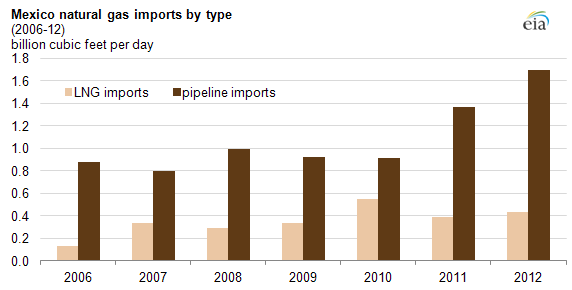
Mexico imported a record volume of natural gas in 2012, about 2.1 billion cubic feet per day (Bcf/d), which was up 21% from 2011 (see chart above). Natural gas flows from U.S. pipelines accounted for about 80% of Mexico's overall natural gas imports in 2012; U.S. natural gas exports to Mexico in 2012 were almost 1.7 Bcf/d, more than 24% higher than in 2011. Since 2006, imports of liquefied natural gas (LNG) have made up the remainder of Mexico's imported natural gas needs. Mexico's LNG imports averaged about 0.4 Bcf/d in 2012, representing about 20% of its overall natural gas imports.
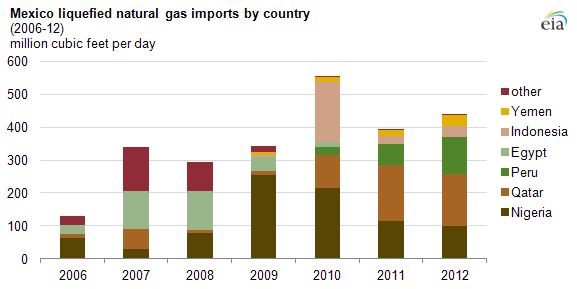
Imports of LNG became a part of Mexico's gas supply starting in 2006. Mexico imports most of the LNG from Nigeria, Qatar, and Peru (see chart below). LNG imports accounted for 38% of Mexico's total natural gas imports in 2010, or more than 0.5 Bcf/d. LNG's share of Mexico's imports has declined since then because of growing natural gas imports via pipelines from the United States, which have been more economically attractive given the recent decline in U.S. natural gas prices.
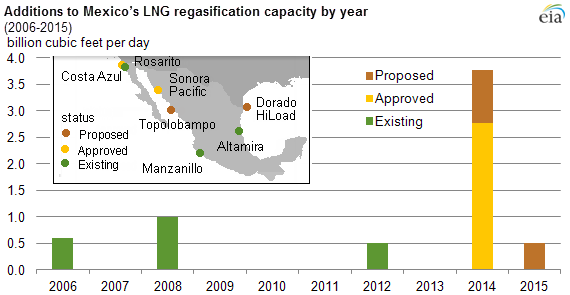
The future role LNG imports may play in meeting Mexico's need to provide natural gas reliability depends mostly on the relative economics and constraints of importing natural gas from the United States by pipeline versus the price and availability of importing LNG; production trends in Mexico; and the development of additional natural gas infrastructure in Mexico. Mexico's LNG import capabilities (see chart and inset map below) are as follows:
- Altamira. Altamira, Mexico's first LNG regasification facility, has a capacity of 0.6 Bcf/d and began commercial operations in 2006. In its first year of operation, Altamira imported on average 0.1 Bcf/d of LNG from Trinidad and Tobago, Qatar, Egypt, and Nigeria.
- Energia Costa Azul. Starting in 2008, Sempra placed into service the Energia Costa Azul LNG terminal with a capacity of 1 Bcf/d on Mexico's west coast in Ensenada, Baja California. The Costa Azul terminal, however, has been underused because expected shipments of LNG were diverted to Asian markets with higher prices. In addition, potential demand for shipments of regasified LNG from Mexico to the western United States has decreased because expansions of the Kern River and Ruby pipelines now flow U.S.-sourced gas into that area.
- Manzanillo. The 0.5 Bcf/d Manzanillo LNG regasification terminal was placed into service in 2012.
- Potential new projects. Construction of up to five LNG regasification projects over the next several years could add more than 4 Bcf/d of incremental regasification capacity.
On Friday, Today in Energy will address electricity trade between the United States and Mexico.
For more information, see EIA's Country Analysis Brief for Mexico.