
-
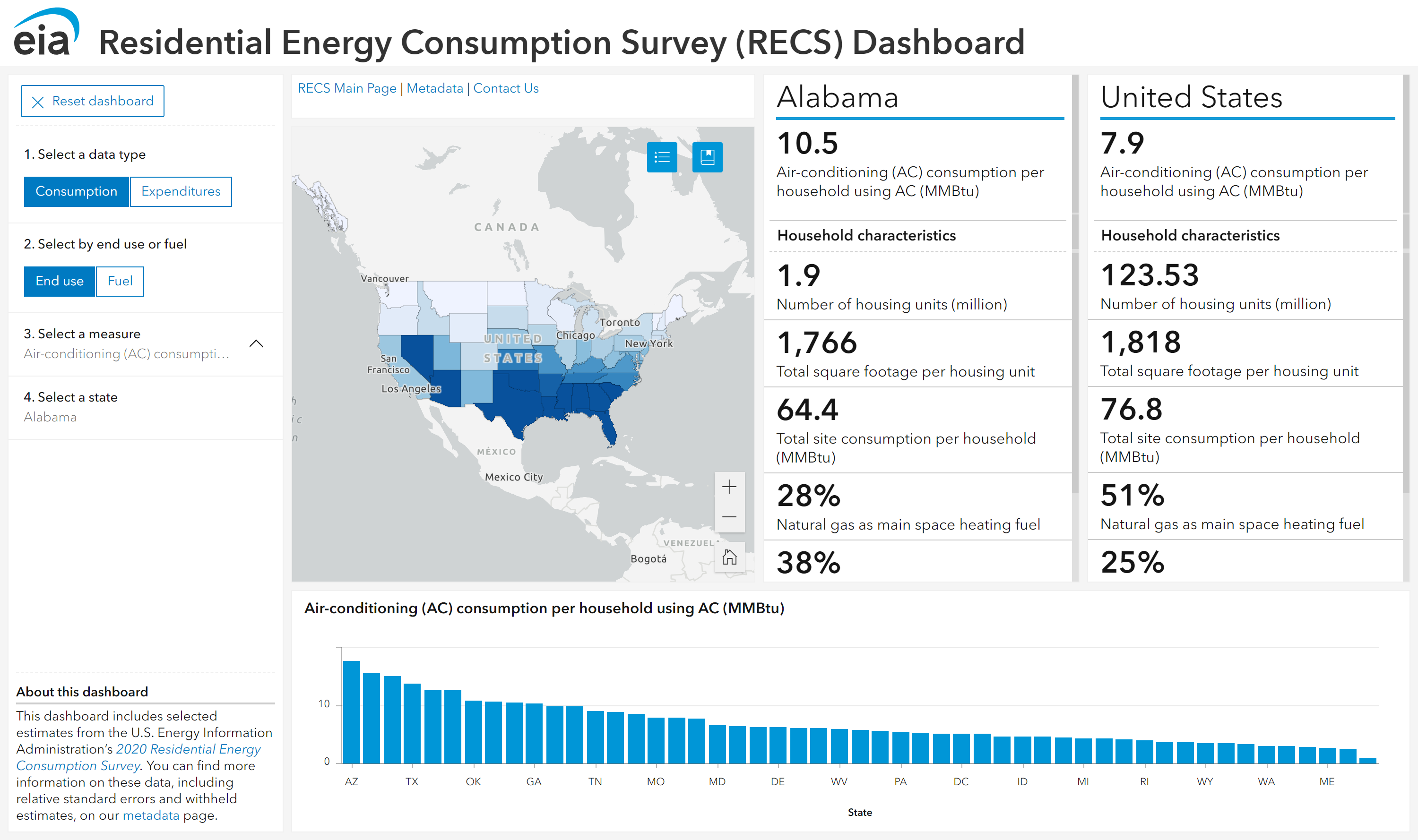
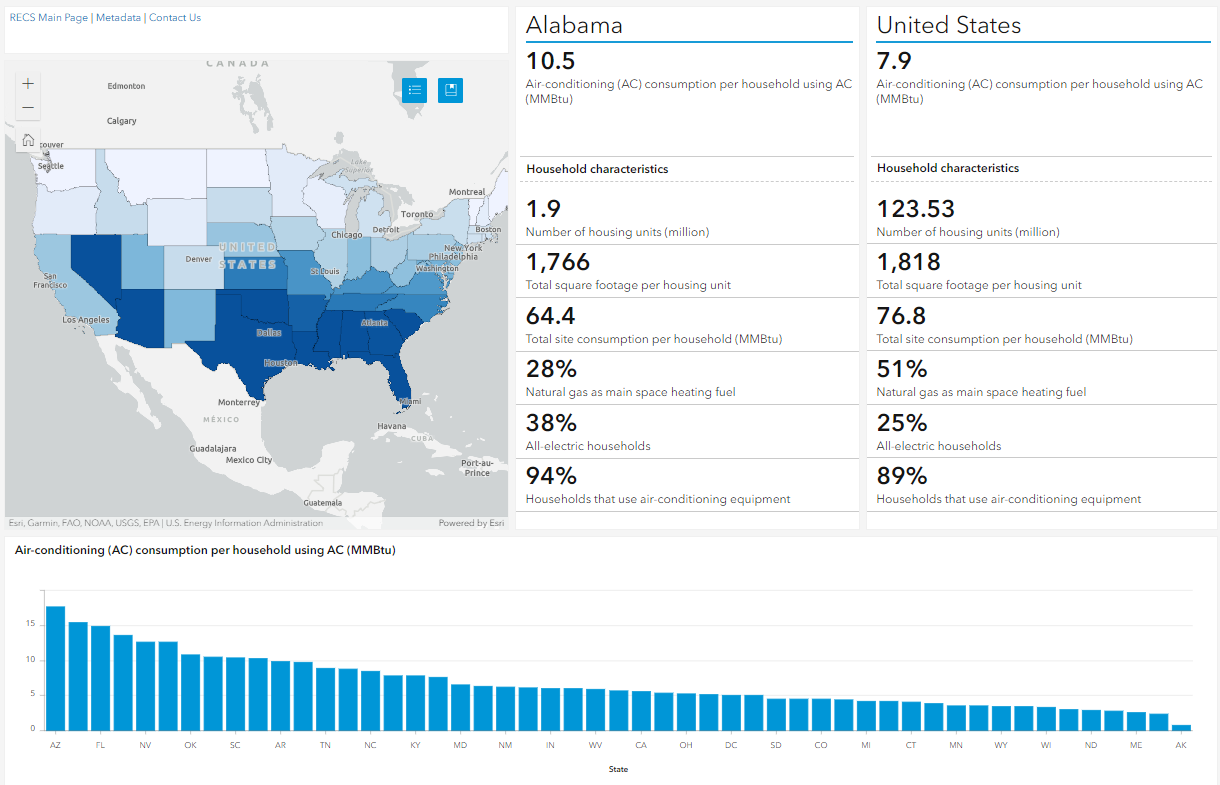
Check out our new interactive dashboard displaying data from the 2020 RECS
-
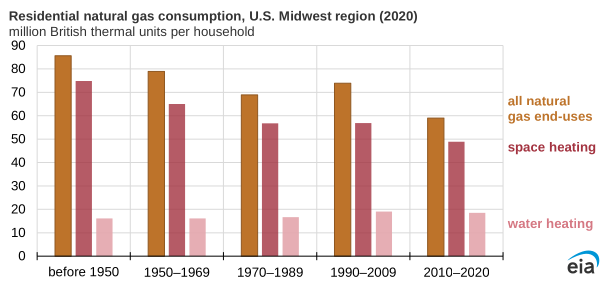
Midwest homes, notably older homes, consume more natural gas than most other U.S. homes
-
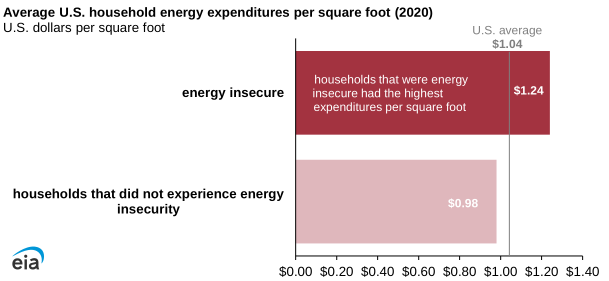
U.S. energy insecure households were billed more for energy than other households
-
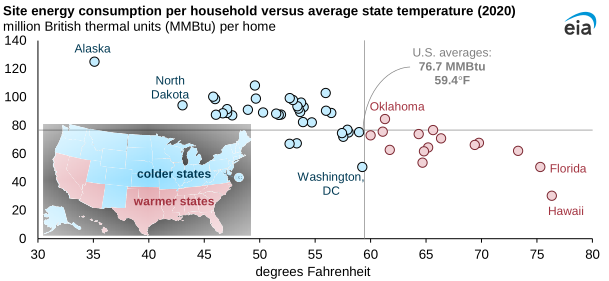
U.S. households in warmer states consume less site energy than households in colder states
-
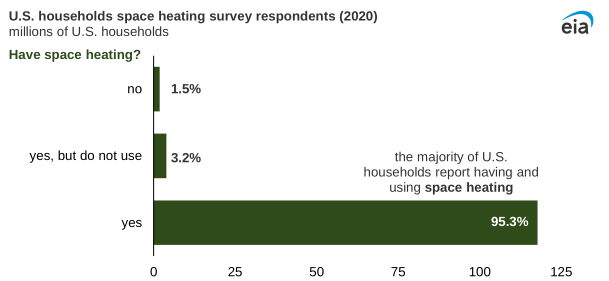
Nearly 5% of U.S. households did not use space heating in 2020, especially in warm regions
-
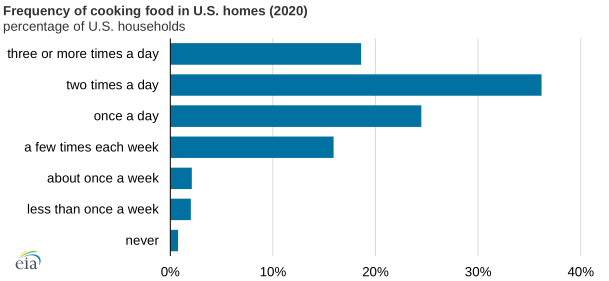
In 2020, most U.S. households prepared at least one hot meal a day at home
-
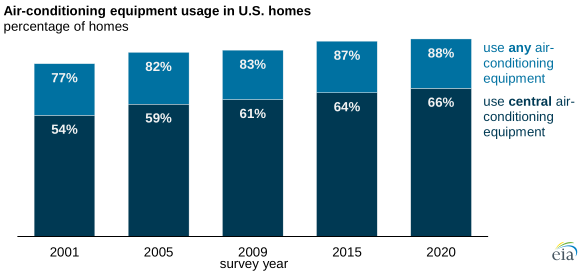
Nearly 90% of U.S. households used air conditioning in 2020
Features
Webinar: 2020 Residential Energy Consumption Survey Webinar - Estimating heating and other end uses
Release Date: September 5, 2023
EIA hosted a webinar on August 29, 2023 to discuss 2020 Residential Energy Consumption Survey (RECS) household consumption and expenditure results. The webinar featured data highlights, a demonstration of the new RECS state-data dashboard, a summary of end-use estimation methods, and an audience Q&A. The webinar presentation slides are also available.
Presentation: 2020 RECS Webinar August 29
2020 RECS Data Visualizations: Dashboard displaying state-level estimates for selected data is now available
Release Date: August 15, 2023
We recently released a new interactive dashboard that includes state-level estimates for selected residential site energy consumption, expenditures, and household characteristics information from the 2020 RECS. These visualizations include U.S. maps, charts, and data for 20 different estimates, providing both a national view of energy usage and state-specific data. Please contact us with any feedback.
2020 RECS Consumption and Expenditures Data: 2020 RECS end-use consumption and expenditures tables are now available
Release Date: June 15, 2023
The final set of consumption and expenditures tables are now available. These tables include estimates of energy consumption and expenditures by end use (for example, air conditioning and water heating). This final data release also includes a final version of the public-use microdata file containing consumption, expenditures, and end-use data as well as additional technical documentation.
2020 RECS Consumption and Expenditures Data: 2020 RECS consumption and expenditures tables are now available
Release Date: March 29, 2023
Our first set of consumption and expenditures tables are now available. This release features, for the first time ever, household consumption and expenditures estimates for all 50 states and the District of Columbia. The 18 tables in this release include total consumption, total expenditures, and energy-intensity estimates for electricity, natural gas, propane, and fuel oil.
Additional tables with estimates of energy consumption and expenditures by end use (for example, air conditioning and water heating); a final public-use microdata file containing consumption, expenditures, and end-use data; and additional documentation will be released in June 2023.
2020 RECS Final Housing Characteristics and Square Footage data are now available
Release Date: March 8, 2023
The final public-use housing characteristics microdata file and tables are available. This release includes data on square footage. The microdata file and tables contain results from nearly 18,500 households, the largest responding sample in program history. You can find the revised, final housing characteristics tables and square footage tables on our housing characteristics page. A new state-level square footage table is on our state data page. You can find the final housing characteristics data file, codebook, and information on how to work with RECS microdata on the RECS microdata page. You can find more information on the survey processes and methodology we used for the 2020 RECS Household Survey, in to the detailed housing characteristics and square footage technical documentation on our methodology page. Appendix A of the Housing Characteristics documentation contains details on differences between the preliminary and final estimates.
Multifamily Building Study (MBS) Pilot: Report on methods, findings, and lessons learned
Release Date: December 7, 2022
From July through October 2021, we fielded a multifamily building study pilot to assess the feasibility of collecting data on the characteristics of multiunit residential buildings, such as apartments, condominiums, and co-ops. The target population was multifamily and multifamily mixed-use buildings that were more than 50% residential by floorspace or square footage and that contained five or more residential units. This report outlines the pilot objectives, design, results, and analysis and shares lessons learned for a potential future study.
Multifamily Building Study (MBS) Pilot: Report on methods, findings, and lessons learned
Webinar: 2020 Residential Energy Consumption Survey (RECS) Housing Characteristics Webinar
Release Date: September 21, 2022
EIA's Office of Energy Demand and Integrated Statistics held a webinar to present highlights from the housing characteristics data from the 2020 Residential Energy Consumption Survey (RECS) on September 14, 2022. Learn more about improvements to the 2020 RECS, including data on all 50 states and the District of Columbia, as well as an overview of key methodological information on our study design. The recording of the webinar includes a Q&A session with RECS Survey Manager Carolyn Hronis and members of the RECS team. The webinar presentation slides are also available.
Presentation: 2020 RECS Housing Characteristics Webinar September 14
2020 RECS Housing Characteristics Data: 2020 RECS state-level housing characteristics tables are now available
Release Date: July 6, 2022
The third set of 2020 RECS housing characteristics tables are now available. The third data release contains data highlights for housing characteristics at the state-level. This is the first time in program history that data have been released for all 50 states and the District of Columbia. Previous 2020 RECS releases contained data for housing characteristics at the national, regional, and division level.
2020 RECS Housing Characteristics: Public Use Microdata file and documentation are now available
Release Date: July 6, 2022
The preliminary public use microdata file for the 2020 RECS is now available. The file contains records of survey responses from more 18,500 households, the largest responding sample in program history. In addition to the data file, a codebook, and information on working with the RECS microdata can be found on the 2020 RECS microdata page (link). For more information on survey processes and methodology utilized for the 2020 RECS Household Survey, please refer to the detailed technical documentation.
Webinar: 2020 RECS Planning Webinar
Release Date: August 12, 2019
EIA’s household energy consumption experts held a discussion with stakeholders about the 2020 Residential Energy Consumption Survey (RECS) on Thursday, July 11, 2019. The presentation included an outline for the upcoming RECS, including the reintroduction of state-level estimates and anticipated changes to the Household Questionnaire. Annual Energy Outlook modeler Kevin Jarzomski provided insights on how the RECS data are used in EIA’s residential energy consumption projections. The webinar concluded with a Q&A period.
Presentation: RECS Webinar July 11
Webinar: Highlights from the 2015 RECS: energy consumption, expenditures and end-use modeling
Release Date: July 31, 2018
EIA's Office of Energy Consumption and Efficiency Statistics held a webinar reviewing consumption and expenditures data from the 2015 Residential Energy Consumption Survey (RECS) on July 31, 2018. Learn more about new consumption and expenditures (C&E) data from the 2015 RECS and improvements to the methods used for modeling end-use consumption. The recording of the webinar includes a Q&A session with RECS Survey Manager Chip Berry and members of the RECS team. The webinar presentation slides are also available.
Presentation: RECS webinar slides
 View the dashboard ›