
The energy mix
The United States uses and produces many different types and sources of energy, which can be grouped into general categories:
- Primary energy sources include fossil fuels (petroleum, natural gas, and coal), nuclear energy, and renewables.
- Secondary energy sources, such as electricity or hydrogen, are produced from primary energy.
- Renewable energy sources are naturally replenished sources, such as solar energy.
- Nonrenewable energy sources are mined or extracted from the earth, such as crude oil.
- Fossil fuels formed underground from decayed organic material.
Measuring consumption and production
Energy sources are measured in different physical units:
- Liquid fuels in barrels or gallons
- Natural gas in cubic feet
- Coal in short tons
- Electricity in kilowatts and kilowatthours
In the United States, the British thermal unit (Btu), a measure of heat energy, is commonly used for comparing different types of energy to each other. We measure total U.S. primary energy consumption in Btus.
Energy-use sectors
We break energy consumption down into five energy-use sectors:1
- Electric power
- Transportation
- Industrial
- Residential
- Commercial
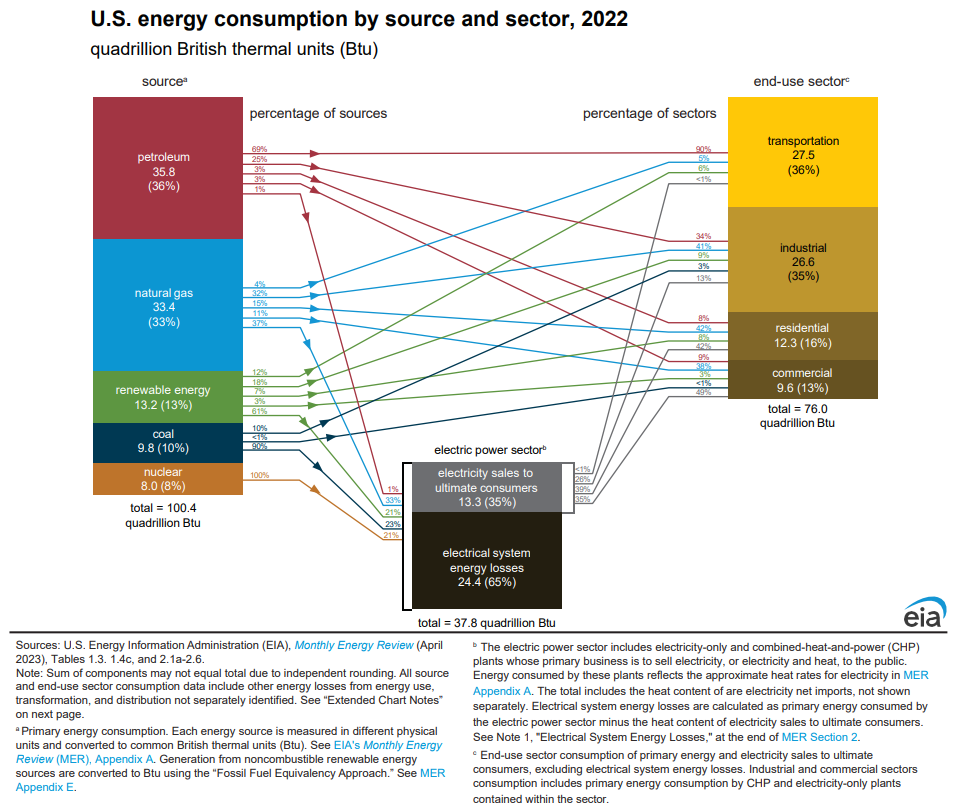
The electric power sector generally accounts for most U.S. utility-scale electricity generation, which it sells to the other end-use sectors. Utility-scale electricity generation includes generation from power plants with at least one megawatt of electric generation capacity.
End-use sectors
The transportation, industrial, residential, and commercial sectors are called end-use sectors because they consume primary energy and electricity produced by and purchased from the electric power sector. We collect data on how much energy each sector uses every year.
Total energy consumption by the end-use sectors includes:
- Primary energy use
- Purchased electricity
- Electrical system energy losses (energy conversion and other losses associated with generating, transmitting, and distributing purchased electricity)
- Other energy losses
Energy consumption by sector
The energy sources each sector primarily uses vary widely. For example, petroleum is the primary fuel in the transportation sector's energy consumption mix, but petroleum accounts for almost none of the electric power sector's primary energy consumption. You can find more information in our Monthly Energy Review on related topics, such as:
- The types and amounts of primary energy sources consumed in the United States
- The amounts of primary energy consumed by the electric power sector and the energy end-use sectors
- Sales of electricity by the electric power sector to the energy end-use sectors
U.S. energy production and consumption
In the 1950s, U.S. total annual energy production and total annual energy consumption were similar. In the following decades, total primary consumption exceeded total primary energy production, particularly from 1990–2010. However, since 2019 total energy production has been greater than consumption in the United States.
Fossil fuels—petroleum, natural gas, and coal—account for most total U.S. primary energy production. Renewable energy and nuclear electric power generally have similar shares of total energy production.
Historical U.S. energy consumption and production
Fossil fuels have dominated the U.S. energy mix for more than 100 years, but the mix has changed over time.2
Petroleum
Petroleum's share of total U.S. energy consumption peaked in the 1970s. In 1978, total petroleum consumption was about 49%, or 37.9 quadrillion British thermal units (quads) of total U.S. energy consumption. U.S. petroleum consumption decreased in 2020 during the COVID-19 pandemic and increased in subsequent years as the economy returned to pre-pandemic activity. In 2025, petroleum's share of total U.S. energy consumption was about 38% (35.9 quads).
Crude oil
Annual crude oil production generally decreased between 1970 and 2008. The trend reversed in 2009, and crude oil production reached a record high in 2025. More cost-effective oil well drilling and production technologies, notably in tight oil and shale deposits, have helped to drive increases in annual crude oil production. U.S. total annual crude oil production was lower in 2020 and 2021, in part, because of the COVID-19 pandemic’s effect on U.S. petroleum product demand. Total annual U.S. crude oil production increased post-pandemic as U.S. oil producers responded to increased U.S. and world petroleum demand and oil prices.
Natural gas
Natural gas consumption has increased both in amount and share of U.S. energy consumption. In 1950, natural gas consumption was about 18% (5.97 quads) of total U.S. primary energy consumption, and in 2025, natural gas consumption was about 36% (34.6 quads) of total U.S. primary energy consumption. U.S. annual dry natural gas production has exceeded U.S. annual natural gas consumption in both volume and heat content since 2017. More efficient natural gas and oil well drilling and production techniques have resulted in increased natural gas production from shale and tight geologic formations. The higher production generally contributed to lower U.S. natural gas prices through 2020, which, in turn, contributed to higher natural gas consumption by the electric power and industrial sectors.
Natural gas liquids
Annual natural gas plant liquids (NGPL) production has generally increased since 2005—coinciding with increases in natural gas production—and reached a record high in 2025. Of all U.S. hydrocarbon gas liquid (HGL) production, NGPLs are produced the most. Annual increases in HGL production since 2008 have contributed to lower HGL prices and to increased U.S. HGL consumption and exports.
Renewable energy
Renewable energy production and consumption both reached record highs in 2025: production was about 9% (9.2 quads) of total primary energy production, and consumption was about 9% (8.8 quads) of total primary energy consumption. These increases have primarily been driven by large increases in solar and wind energy production.
Coal
Coal’s share of total U.S. energy consumption declined from about 37% in 1950 to 9% in 2025, largely because the U.S. electric power sector increased its use of other energy sources in place of coal. In terms of coal's total primary energy content, annual U.S. coal consumption peaked in 2005 at about 22.8 quads and production peaked in 1998 at about 24.1 quads. The energy content of total annual coal consumption has declined largely because the electric power sector has been shifting to lower-heat-content coal.
Nuclear energy
Nuclear energy production in commercial nuclear power plants in the United States began in 1957, grew each year through 1990 as the number of nuclear power plants and nuclear electricity generation capacity increased, and generally leveled off from 2001 through 2019. Since the 1990s, reactor upgrades and shorter refueling and maintenance cycles at nuclear power plants helped offset some plant retirements. However, from 2013 to 2021, 10 nuclear plants were retired because of economic reasons and competition from other electric-generating technologies (such as natural gas-fired plants) and renewables (such as wind and solar). More recently, the outlook for existing and future nuclear reactors has changed due to significant financial support from the federal government. Nuclear electricity generation has increased as a result of two new, large reactors that went into operation in 2023 and 2024.
1 U.S. Energy Information Administration, Monthly Energy Review, Energy consumption by sector, Tables 2.1.a and 2.1.b, April 2025, preliminary data.
2 U.S. Energy Information Administration, Monthly Energy Review, Energy Overview, Table 1.2, April 2025, preliminary data.