

Oil (petroleum) basics
What is crude oil and what are petroleum products?
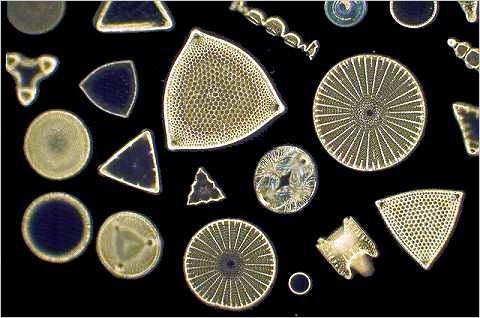
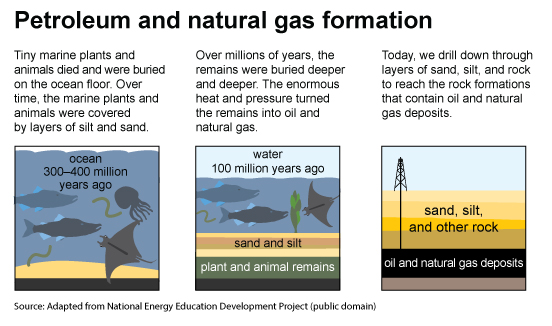
We call crude oil and petroleum fossil fuels because they are mixtures of hydrocarbons that formed from the remains of animals and plants (diatoms) that lived millions of years ago in a marine environment before dinosaurs existed. Over millions of years, the remains of these animals and plants were covered by layers of sand, silt, and rock. Heat and pressure from these layers turned the remains into what we now call crude oil or petroleum. The word petroleum means rock oil or oil from the earth.
Crude oil and other hydrocarbons exist in liquid or gaseous form in underground pools, or reservoirs, in tiny spaces within sedimentary rocks and near the earth's surface in tar (or oil) sands. Petroleum products are fuels made from crude oil and the hydrocarbons contained in natural gas. Petroleum products can also be made from coal, natural gas, and biomass.
Source: U.S. Energy Information Administration (public domain)
What petroleum products are made from crude oil?
After crude oil is removed from the ground, it is sent to a refinery where different parts of the crude oil are separated into useable petroleum products.
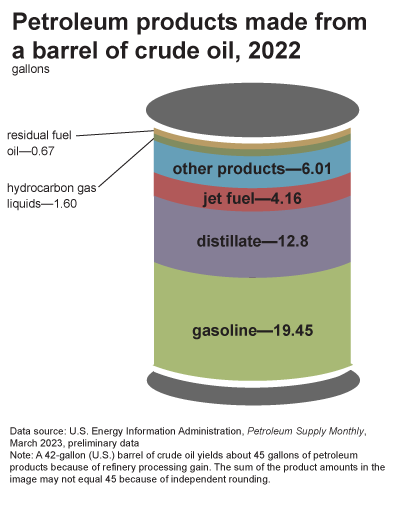
A U.S. 42-gallon barrel of crude oil yields about 45 gallons of petroleum products in U.S. refineries because of refinery processing gain. This increase in volume is similar to what happens to popcorn when it is popped. A corn kernel is smaller and more dense than a popped kernel. The amount of individual products produced varies from month-to-month and year-to-year as refineries adjust production to meet market demand and to maximize profitability.
Getting (producing) oil
The United States is one of the largest crude oil producing countries
About 100 countries produce crude oil. The United States was the top crude oil producing country in 2018 through 2022. U.S. oil refineries obtain crude oil produced in the United States and in other countries.
Where is U.S. crude oil produced?
Crude oil is produced in 32 U.S. states and in U.S. coastal waters. In 2022, five states combined accounted for about 72% of total U.S. crude oil production.
- The top five crude oil-producing states and their percentage shares of total U.S. crude oil production in 2022 were:
- Texas42.5%
- New Mexico13.3%
- North Dakota8.9%
- Colorado3.7%
- Alaska3.7%
In 2022, about 14.5% of U.S. crude oil was produced from wells located offshore in the federally administered waters of the Gulf of America and about 0.1% was produced in federal waters off the coast of California.
Although U.S. crude oil production went down in most years between 1985 and 2008, annual oil production went up in nearly every year from 2009 through 2019, reaching the highest amount on record in 2019. Less expensive ways of drilling for and producing crude oil helped to increase production, especially in Texas, North Dakota, Oklahoma, New Mexico, and Colorado. U.S crude oil production declined in 2020 and 2021 mainly because of the effects of the COVID-19 pandemic on the economy.
Many countries produce crude oil
In 2022, 98 countries produced about 80.75 million barrels of crude oil and five countries combined accounted for about 52% of the total.
- The top five crude oil producing countries and their percentage shares of total world crude oil production in 2022 were:
- United States14.7%
- Saudi Arabia13.2%
- Russia12.7%
- Canada5.6%
- Iraq5.5%
Offshore drilling
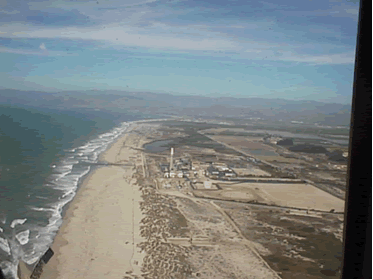
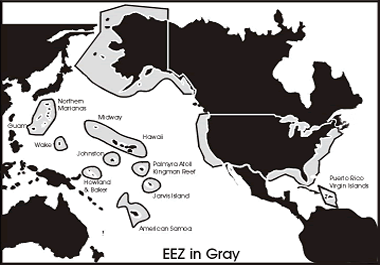
The coastlines of the United States are not borders of the United States
Source: Stock photography (copyrighted)
Source: National Energy Education Development Project (public domain)
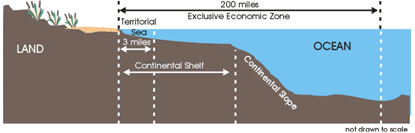
The U.S. border is actually 200 miles away from the U.S. coastline. This area around the country is called the Exclusive Economic Zone (EEZ), and energy production in the area is called offshore production. In 1983, President Ronald Reagan claimed the EEZ in the name of the United States. In 1994, all countries were granted an EEZ of 200 miles from their coastlines under the International Law of the Sea.
The ocean floor gradually descends from the shoreline into the ocean on a continental shelf. The width of the U.S. continental shelf varies from 10 miles to 250 miles (16 kilometers to 400 kilometers). The water on the continental shelf is relatively shallow, rarely more than 500 feet to 650 feet (150 meters to 200 meters) deep. The ocean floor drops sharply from the shelf down a continental slope to abyssal plains that are 2 miles to 3 miles (3 kilometers to 5 kilometers) below sea level. Many of the plains are flat, but others have jagged mountain ridges, deep canyons, and valleys. The tops of some of these mountain ridges form islands where they extend above the water.
Source: National Energy Education Development Project (public domain)
Several federal government agencies manage the natural resources in the EEZ. The U.S. Department of the Interior's Bureau of Ocean Energy Management and Bureau of Safety and Environmental Enforcement manage the development of offshore energy resources by private companies. These companies lease some offshore areas for energy development from the federal government. These companies pay royalties to the government on the energy resources they produce from the leased areas in the ocean. Most states control the 3-mile area that extends off their coasts, but Florida, Texas, and some other states control the waters for as much as 9 miles to 12 miles off their coasts.
Refining oil
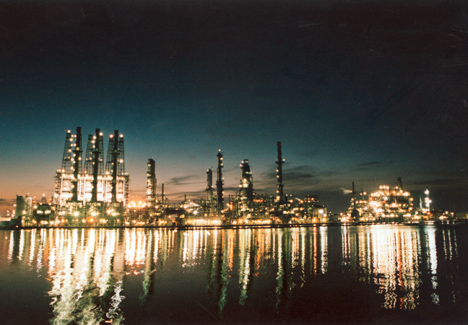
What is a refinery?
Source: Stock photography (copyrighted)
Petroleum refineries convert crude oil and other liquids into many petroleum products that people use every day. Most refineries focus on producing transportation fuels. On average, U.S. refineries produce, from a 42-gallon barrel of crude oil:
- About 19 to 20 gallons of motor gasoline
- 11 to 13 gallons of distillate fuel, most of which is sold as diesel fuel
- 3 to 5 gallons of jet fuel
More than a dozen other petroleum products are also produced in refineries, including liquids the petrochemical industry uses to make a variety of chemicals and plastics. The amount (volume) of individual products produced varies from month to month and year to year as refineries adjust production to meet market demand and to maximize profitability.
A refinery runs 24 hours a day, 365 days a year and requires a large number of employees. A refinery can occupy as much land as several hundred football fields.
Refining process
How crude oil is refined into petroleum products
Petroleum refineries convert crude oil into petroleum products for use as feedstocks for making chemicals and as fuels for:
- Transportation
- Heating
- Paving roads
- Generating electricity
Refining breaks crude oil down into its various components, which are selectively reconfigured into new products. Petroleum refineries are complex and expensive industrial facilities. All refineries follow three basic steps:
Separation
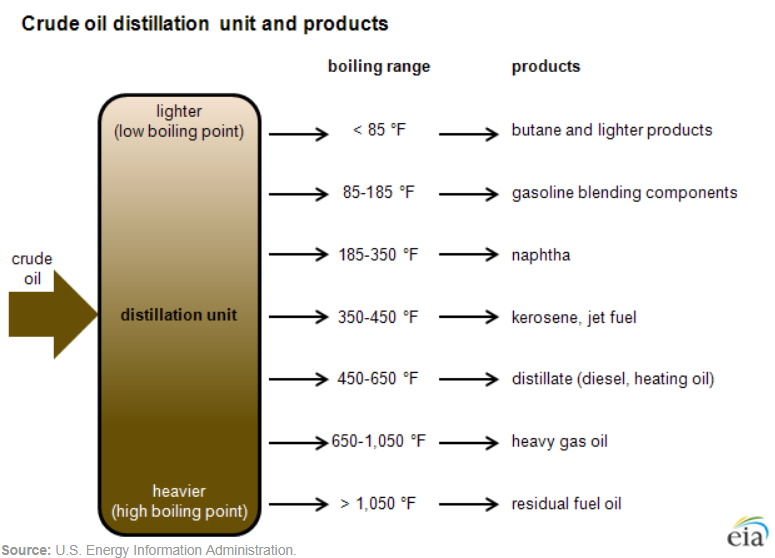
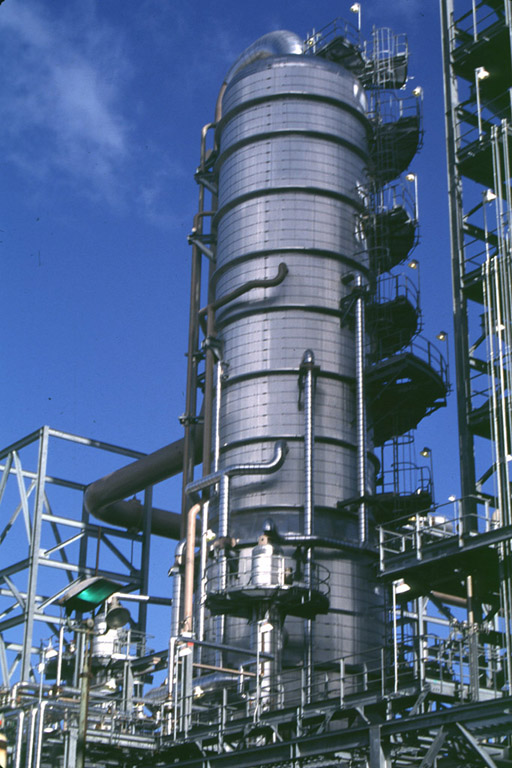
Modern separation involves piping crude oil through hot furnaces. The resulting liquids and vapors are discharged into distillation units. All refineries have atmospheric distillation units, but more complex refineries may have vacuum distillation units.
Source: Chevron (copyrighted)
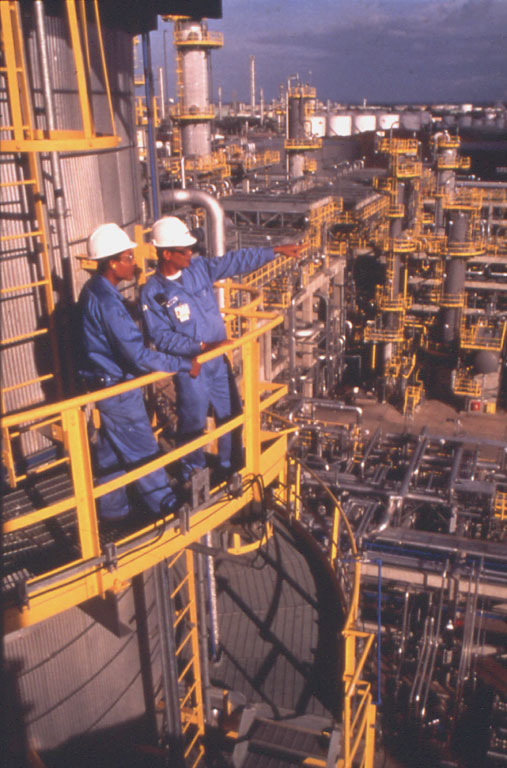
Inside the distillation units, the liquids and vapors separate into petroleum components called fractions according to their boiling points. Heavy fractions are on the bottom and light fractions are on the top.
The lightest fractions, including gasoline and liquefied refinery gases, vaporize and rise to the top of the distillation tower, where they condense back to liquids.
Medium-weight liquids, including kerosene and distillates, stay in the middle of the distillation tower.
Heavier liquids, called gas oils, separate lower down in the distillation tower, and the heaviest fractions with the highest boiling points settle at the bottom of the tower.
Source: Chevron (copyrighted)
Conversion
After distillation, heavy, low-value distillation fractions can be processed further into lighter, high-value products such as gasoline. At this point in the process, fractions from the distillation units are transformed into streams (intermediate components) that eventually become finished products.
The most widely used conversion method is called cracking because it uses heat, pressure, catalysts, and sometimes hydrogen to crack heavy hydrocarbon molecules into lighter ones. A cracking unit consists of one or more tall, thick-walled, rocket-shaped reactors and a network of furnaces, heat exchangers, and other vessels. Complex refineries may have one or more types of crackers, including fluid catalytic cracking units and hydrocracking/hydrocracker units.
Cracking is not the only form of crude oil conversion. Other refinery processes rearrange molecules rather than splitting them to add value.
Alkylation, for example, makes gasoline components by combining some of the gaseous byproducts of cracking. The process, which essentially is cracking in reverse, takes place in a series of large, horizontal vessels and tall, skinny towers.
Reforming uses heat, moderate pressure, and catalysts to turn naphtha, a light, relatively low-value fraction, into high-octane gasoline components.
Treatment
The finishing touches occur during the final treatment. To make gasoline, refinery technicians carefully combine a variety of streams from the processing units. Octane level, vapor pressure ratings, and other special considerations determine the gasoline blend.
Storage
Both incoming crude oil and the outgoing final products are stored temporarily in large tanks on a tank farm near the refinery. Pipelines, trains, and trucks carry the final products from the storage tanks to locations across the country.
Oil & the environment
How does oil affect the environment?
Crude oil is used to make the petroleum products we use to:
- Fuel airplanes, cars, and trucks
- Heat homes
- Make products such as medicines and plastics
Although petroleum products make life easier, finding, producing, and moving crude oil may have negative effects on the environment. Technological advances in oil exploration, production, and transportation and enforcing safety and environmental laws and regulations help to avoid and reduce these effects.
How does technology help reduce the impact of drilling for and producing oil?
Exploring and drilling for oil may disturb land and marine ecosystems. Seismic techniques used to explore for oil under the ocean floor may harm fish and marine mammals. Drilling an oil well on land often requires clearing vegetation. However, technologies that significantly increase the efficiency of exploring and drilling activities also reduce their effect on the environment. Satellites, global positioning systems, remote sensing devices, and 3-D and 4-D seismic technologies make it possible to discover oil reserves with fewer exploratory wells. Mobile and smaller slimhole drilling rigs reduce the size of the area that drilling activities affect. Using horizontal and directional drilling makes it possible for a single well to produce oil from a much larger area, which reduces the number of wells necessary to develop an oil resource.
What is hydraulic fracturing?
Hydraulic fracturing, or fracking, is used to produce oil from shale and other tight geologic formations (underground rock layers). This technique has helped the United States to significantly increase oil production and reduce oil imports. Fracking can affect the environment. Fracturing rock requires large amounts of water, and it uses potentially hazardous chemicals to release the oil from the rock strata. In some areas of the country, significant water use for oil production may affect the availability of water for other uses and could affect aquatic habitats. Faulty well construction or improper handling may result in leaks and spills of fracturing fluids.
Fracking also produces large amounts of wastewater that contain harmful compounds. Because treating the wastewater can be difficult and expensive, in some places it is pumped (injected) deep underground; however, this disposal method may cause earthquakes that are large enough to damage buildings.
How do we prevent oil spills?
Most oil spills are the result of accidents at oil wells or on the pipelines, ships, trains, and trucks that move oil from wells to refineries. Oil spills contaminate soil and water and may cause devastating explosions and fires. The federal government and oil industry work together to reduce the potential for accidents and spills and to clean up spills when they occur.
After the Exxon Valdez oil spill in Prince William Sound, Alaska, in 1989, the U.S. Congress passed the Oil Pollution Act of 1990. This law requires all new oil tankers built for transport between U.S. ports to have a full double hull. In 1992, the International Maritime Organization also established double-hull standards for new oil tankers in the International Convention for the Prevention of Pollution from Ships (MARPOL). The amount of oil spilled from ships dropped significantly during the 1990s partly because of these double-hull standards.
The Deep Horizon drilling rig explosion and oil spill in the Gulf of America in 2010 prompted the U.S. government and the oil industry to review drilling technologies, procedures, and regulations to help avoid similar accidents in the future. The U.S. government also replaced the Minerals Management Service (MMS), which administered offshore oil and natural gas leases, with the Bureau of Ocean Energy Management (BOEM) and the Bureau of Safety and Environmental Enforcement (BSEE) to provide more effective oversight and enforcement of environmental regulations for offshore energy development.
Source: Courtesy of the Mississippi Department of Marine Resources
In response to several major accidents involving trains carrying crude oil, the U.S. Department of Transportation and the Federal Railroad Administration set new standards for railroad tank cars, braking controls, and speed restrictions to reduce the potential for railroad accidents and oil spills.
How do old well sites become artificial reefs?
When oil and natural gas wells become uneconomic, they must be properly plugged and abandoned under state and federal regulations, and the area around the well must be restored. These procedures properly seal off subsurface rock formations and remediate (restore) well sites to their original condition. Wells that are not properly plugged and abandoned are potentially hazardous, and leaking fluids and gases could interfere with future surface development. The U.S. Environmental Protection Agency is working to address this issue.
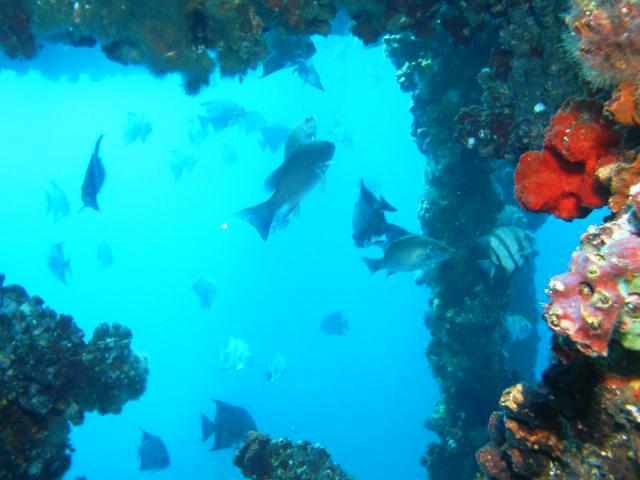
Some old offshore oil rigs are tipped over and left on the sea floor in a Rigs-to-Reefs program. Within a year after a rig is toppled, barnacles, coral, sponges, clams, and other sea creatures cover the rig. These artificial reefs attract fish and other marine life, and they increase fish populations and recreational fishing and diving opportunities.
