
Crude oil and other liquids produced from fossil fuels are refined into petroleum products that people use for many different purposes. Biofuels are also used as petroleum products, mostly in mixtures with gasoline and diesel fuel.
Petroleum has historically been the most-consumed energy source in terms of total annual U.S. energy consumption. We use petroleum products to propel vehicles, to heat buildings, and to produce electricity. In the industrial sector, the petrochemical industry uses petroleum as a raw material (a feedstock) to make products such as plastics, polyurethane, solvents, and hundreds of other intermediate and end-user goods.
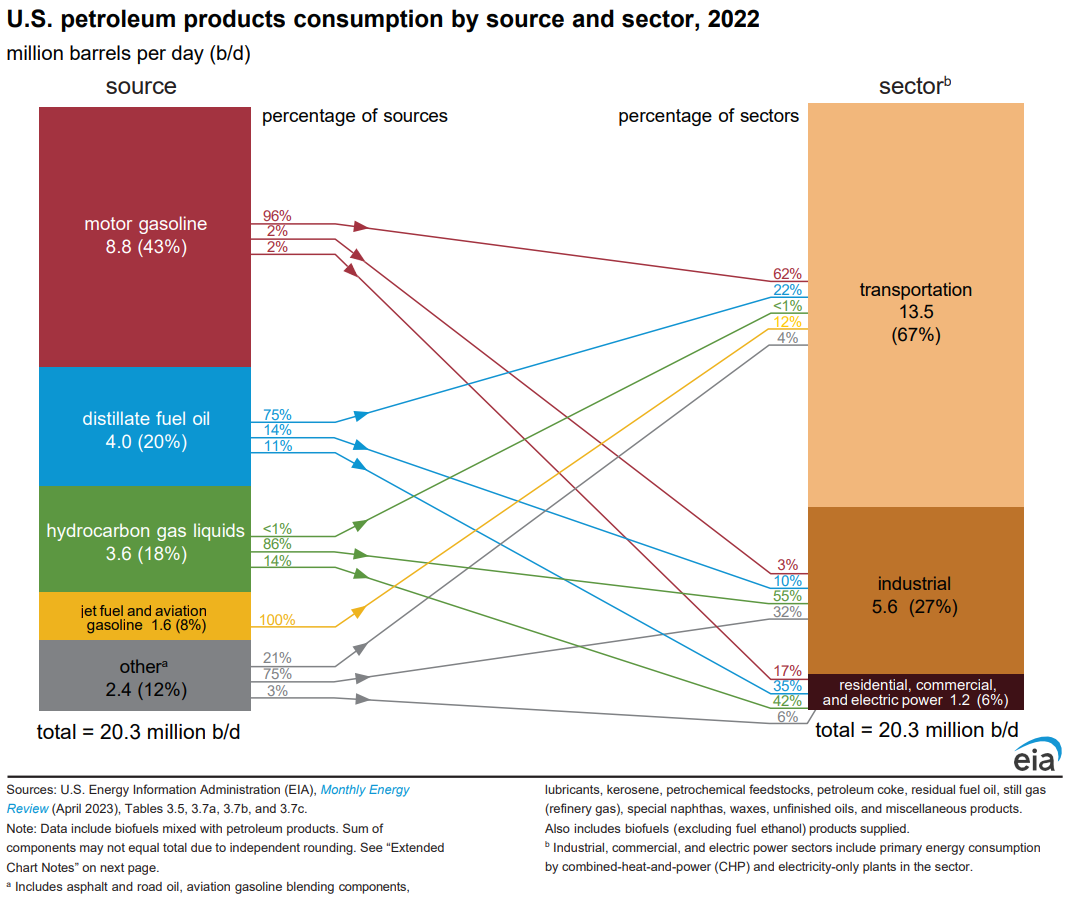
In 2022, U.S. total petroleum consumption averaged about 20.28 million barrels per day (b/d), which included about 1.17 million b/d of biofuels (1.002 b/d of fuel ethanol and 0.164 b/d of biodiesel, renewable diesel, and other biofuels combined).1 U.S. total petroleum consumption was about 2% higher in 2022 than in 2021 and about 12% higher than in 2020, largely because the U.S. economy was returning to pre-COVID-19 pandemic activity levels. Consumption of nearly all petroleum products in 2022 was higher than in 2021.
- The percentage share of total U.S. petroleum consumption by major end-use sectors in 2022 was:
- transportation 66.6%
- industrial 27.5%
- residential 2.8%
- commercial 2.5%
- electric power 0.6%
What petroleum products do people consume most?
Gasoline is the most-consumed petroleum product in the United States. In 2022, consumption of finished motor gasoline averaged about 8.78 million b/d (369 million gallons per day), which was about 43% of total U.S. petroleum consumption. Finished motor gasoline includes fuel ethanol.
Distillate fuel oil is the second-most-consumed petroleum product in the United States. Distillate fuel oil includes diesel fuel and heating oil. Diesel fuel is used in diesel engines, which are often in heavy construction equipment, trucks, buses, tractors, boats, trains, some automobiles, and electricity generators. Heating oil, also called fuel oil, is used for heating homes and buildings in boilers and furnaces, for industrial heating, and for producing electricity in power plants. In 2022, total distillate fuel oil consumption averaged about 3.96 million b/d (166 million gallons per day), which was 20% of total U.S. petroleum consumption.
Hydrocarbon gas liquids (HGLs), the third-most-used category of petroleum in the United States, include propane, ethane, butane, and other HGLs that are produced at natural gas processing plants and oil refineries. HGLs have many uses. Total consumption of HGLs in 2022 averaged about 3.59 million b/d, accounting for about 18% of total petroleum consumption.
Jet fuel is the fourth-most-used petroleum product in the United States. Jet fuel consumption averaged about 1.56 million b/d (65 million gallons per day) in 2022, accounting for about 8% of total petroleum consumption.
| Product | Annual consumption (million barrels per day) |
|---|---|
| Finished motor gasoline | 8.777 |
| Distillate fuel oil (diesel fuel and heating oil) | 3.962 |
| Hydrocarbon gas liquids (HGLs) | 3.588 |
| Kerosene-type jet fuel | 1.558 |
| Still gas | 0.661 |
| Asphalt and road oil | 0.373 |
| Residual fuel oil | 0.343 |
| Petroleum coke | 0.255 |
| Petrochemical feedstocks | 0.237 |
| Biofuels | 0.164 |
| Lubricants | 0.112 |
| Unfinished oils | 0.094 |
| Miscellaneous other products | 0.087 |
| Special naphthas | 0.046 |
| Aviation gasoline | 0.012 |
| Waxes | 0.006 |
| Kerosene | 0.004 |
| Total petroleum products | 20.279 |
|
Data source: U.S. Energy Information Administration, Petroleum and Other Liquids—Product Supplied, as of June 2023 |
|
How much petroleum does the world consume?
In 2021, total world petroleum consumption was about 97.26 million b/d.
- The five top petroleum-consuming countries, and their percentage shares of total world petroleum consumption in 2021, were:
- United States20.4%
- China15.7%
- India4.8%
- Russia3.8%
- Japan3.5%
What is the outlook for U.S. petroleum consumption?
In the Annual Energy Outlook 2023 Reference case, the U.S. Energy Information Administration projects U.S. total consumption of petroleum and other liquids in 2050 to be nearly equal to the projection for 2023. Petroleum and other liquid fuels will decline from about 37% of total U.S. energy consumption in 2023 to about 34% of total annual U.S. energy consumption in 2050.
Also in the Reference case, liquid fuels continue as the main energy source for the transportation sector, but transportation sector liquid fuels consumption on an energy-content basis is projected to be about 10% lower in 2050 than in 2023.
Last updated: August 22, 2023, with data available from source reports as indicated; data for 2022 are preliminary.