
What are greenhouse gases?
Many of the chemical compounds in the earth's atmosphere act as greenhouse gases. When sunlight strikes the earth's surface, some of it radiates back toward space as infrared radiation (heat). Greenhouse gases absorb this infrared radiation and trap its heat in the atmosphere, creating a greenhouse effect that results in global warming and climate change.
Many gases exhibit these greenhouse properties. Some gases occur naturally and are also produced by human activities. Some, such as industrial gases, are exclusively human made.
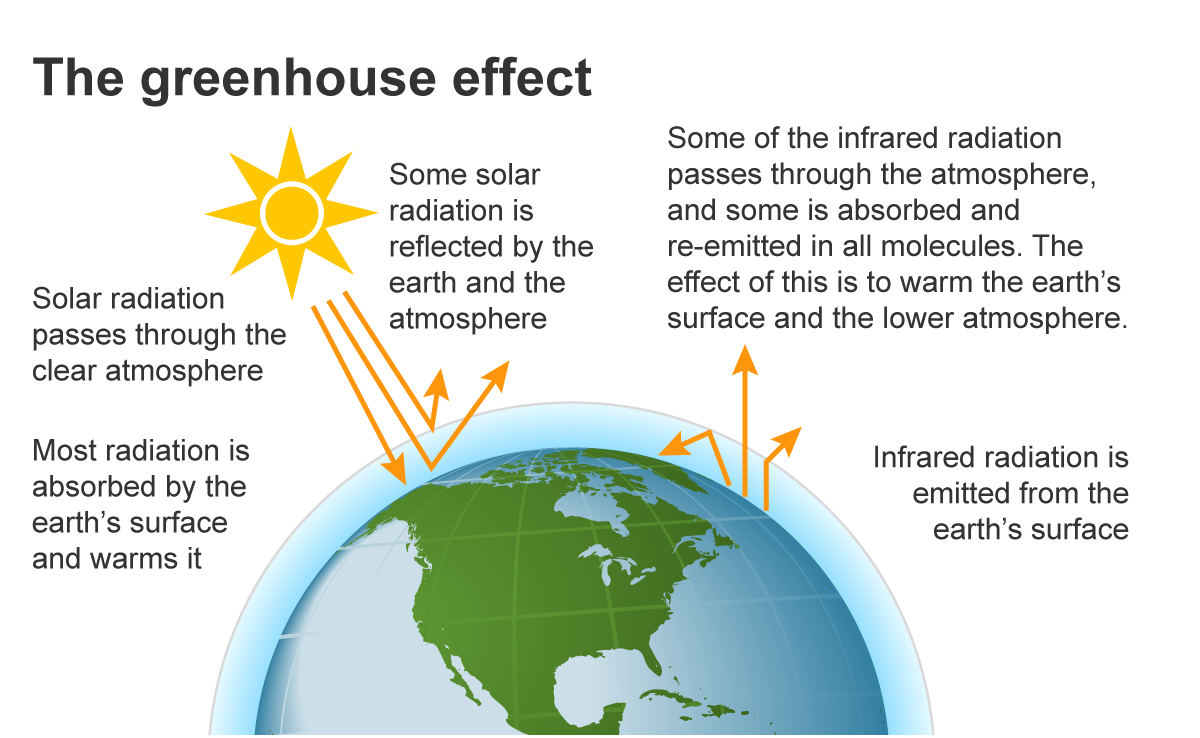
Source: Adapted from U.S. Environmental Protection Agency (public domain)
What are the types of greenhouse gases?
Several major greenhouse gases that result from human activity are included in U.S. and international estimates of greenhouse gas emissions:
- Carbon dioxide (CO2)
- Methane (CH4)
- Nitrous oxide (N2O)
- Industrial gases:
- Hydrofluorocarbons (HFCs)
- Perfluorocarbons (PFCs)
- Sulfur hexafluoride (SF6)
- Nitrogen trifluoride (NF3)
Other greenhouse gases not counted in U.S. or international greenhouse gas inventories are water vapor and ozone.
Water vapor is the most abundant greenhouse gas, but most scientists believe that water vapor produced directly by human activity contributes very little to the amount of water vapor in the atmosphere. Therefore, we do not estimate water vapor emissions.
Ozone is technically a greenhouse gas, but ozone can be helpful or harmful, depending on where it is in the earth's atmosphere. Ozone occurs naturally at higher elevations in the atmosphere (the stratosphere), where it blocks ultraviolet (UV) light, which is harmful to plant and animal life, from reaching the earth's surface. The protective benefits of stratospheric ozone outweigh its contribution to the greenhouse effect. The United States and countries all around the world ban and control production and use of several industrial gases that destroy atmospheric ozone and create holes in the ozone layer. You can learn more about ozone layer protection on the U.S Environmental Protection Agency's (EPA) website. At lower elevations of the atmosphere (the troposphere), ozone is harmful to human health. The EPA also has information about ground-level ozone pollution and what is being done to reduce ozone pollution.