

Science of electricity basics
Everything is made of atoms
To understand electricity, it helps to know a little about atoms. Atoms are the tiny building blocks that make up everything in the universe—every star, every tree, every animal, and humans, too. Air and water are also made of atoms. Atoms are incredibly small; millions of them could fit on the head of a pin.
Atoms are made of even smaller particles
Each atom has a center called the nucleus. The nucleus contains particles called protons and neutrons. Even smaller particles called electrons spin around the nucleus in layers, or shells.
Imagine if the nucleus of an atom was the size of a tennis ball, the entire atom would be about the size of a large sports stadium (about 1,450 feet across). Atoms are mostly empty space.
Parts of an atom
- Nucleus: The center of the atom, containing protons and neutrons
- Protons: Particles with a positive (+) electrical charge
- Neutrons: Particles with no electrical charge
- Electrons: Particles with a negative (-) electrical charge that orbit the nucleus
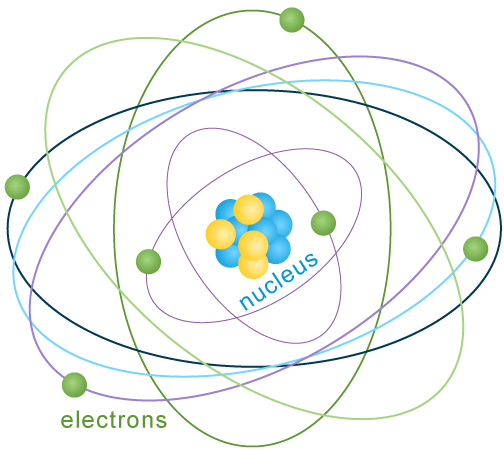
Protons and electrons are attracted to each other because they have opposite charges (positive attracts negative). Generally, an atom has the same number of protons and electrons, so the positive charge of the protons balances out the negative charge of the electrons, making the atom stable. The neutrons carry no charge, and their number can vary.
Electrons stay in their shells because of this electrical force. They constantly move and try to stay as far apart as possible within their shell.
Protons determine the type of atom
The number of protons in an atom determines the kind of atom, or element, it is. An element is a substance consisting of one type of atom. The Periodic Table of Elements shows elements with their atomic numbers—the number of protons each has. For example, every atom of hydrogen (H) has one proton and every atom of carbon (C) has six protons.
Electricity is the movement of electrons between atoms
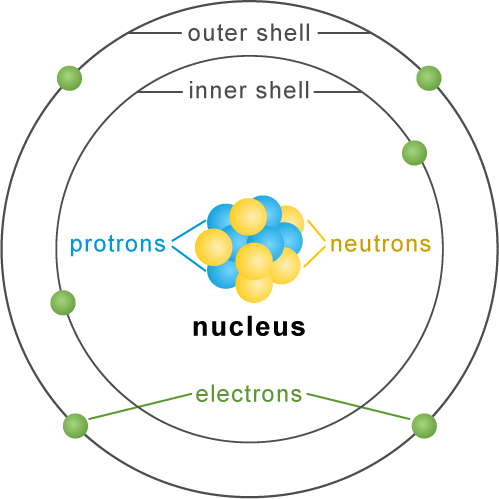
Electrons usually remain a constant distance from the atom's nucleus in precise shells. The shell closest to the nucleus can hold two electrons, the next shell can hold up to eight, and the outer shells can hold even more.
The electrons in the shells closest to the nucleus are pulled strongly toward the protons. Sometimes, the electrons in an atom's outermost shells have a weaker pull toward the protons. These outer electrons can be pushed out of their orbits and move from one atom to another. These shifting electrons are what we call electricity.
Static electricity exists in nature
You’ve probably experienced static electricity. Have you ever felt a shock when you touched an object after walking across a carpet? You felt a stream of electrons jumping to you from that object, which we call static electricity.
Have you ever made your hair stand straight up by rubbing a balloon on it? If so, you moved electrons into your hair from the balloon. The electrons all have the same electrical charge and push away from each other (like charges repel like), making your hair stand on end.
Lightning is also a form of electricity. Lightning is electrons moving from one cloud to another or electrons jumping from a cloud to the ground.
Magnets and electricity
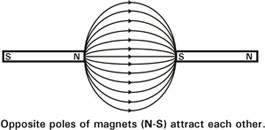
Source: National Energy Education Development Project (public domain)
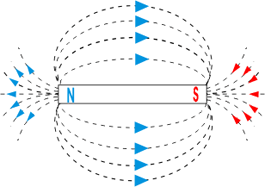
Electrons spinning around an atom's center (the nucleus) create a tiny magnetic field. In most objects, the electrons spin in random directions, and their magnetic forces cancel each other out, which is why most things aren’t magnetic.
Magnet structure
Magnets are different because their electrons all spin in the same direction. This organized movement creates a larger magnetic force that flows out from one end, the north-seeking pole, and returns through the other end, the south-seeking pole. This force creates a magnetic field around the magnet.
Magnetic fields
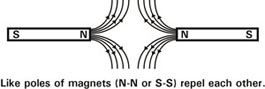
Have you ever played with two magnets? They don't act like most objects. If you push two north poles or two south poles together, they push each other away (repel). But, if you put a north pole and a south pole together, they will snap together (attract). Just like protons and electrons—opposites attract in magnets.
Magnets and electricity
The special properties of magnets are the key to making electricity. Magnetic fields pull and push electrons. Metals such as copper and aluminum have electrons that are loosely held. Moving a magnet around a coil of wire, or moving a coil of wire around a magnet, pushes out the electrons in the wire and creates an electrical current. Electricity generators essentially convert kinetic energy (the energy of motion) into electrical energy.
Batteries, circuits, & transformers
Batteries produce electricity
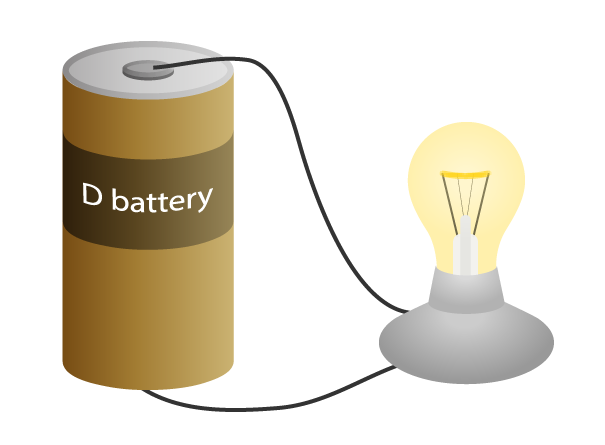
Source: Adapted from National Energy Education Development Project (public domain)
Batteries generate electricity using two different metals submerged in a chemical solution called an electrolyte. One end of the battery is attached to one of the metals, and the other end is attached to the other metal. A chemical reaction occurs between the metals and the electrolyte. This reaction causes one metal to release more electrons than the other.
The metal that releases more electrons develops a positive (+) charge, and the other metal develops a negative (-) charge. When a wire or an electrical conductor, connects one end of the battery to the other, electrons flow through the wire to balance the electrical charge.
An electrical load is any device that uses electricity to do perform work, such as a light bulb. If a light bulb is placed along the wire, the flowing electricity will power it on. Electrons flow from the negative end of the battery, through the wire and the light bulb, and back through the positive end, creating a continuous flow.
Electricity travels in circuits
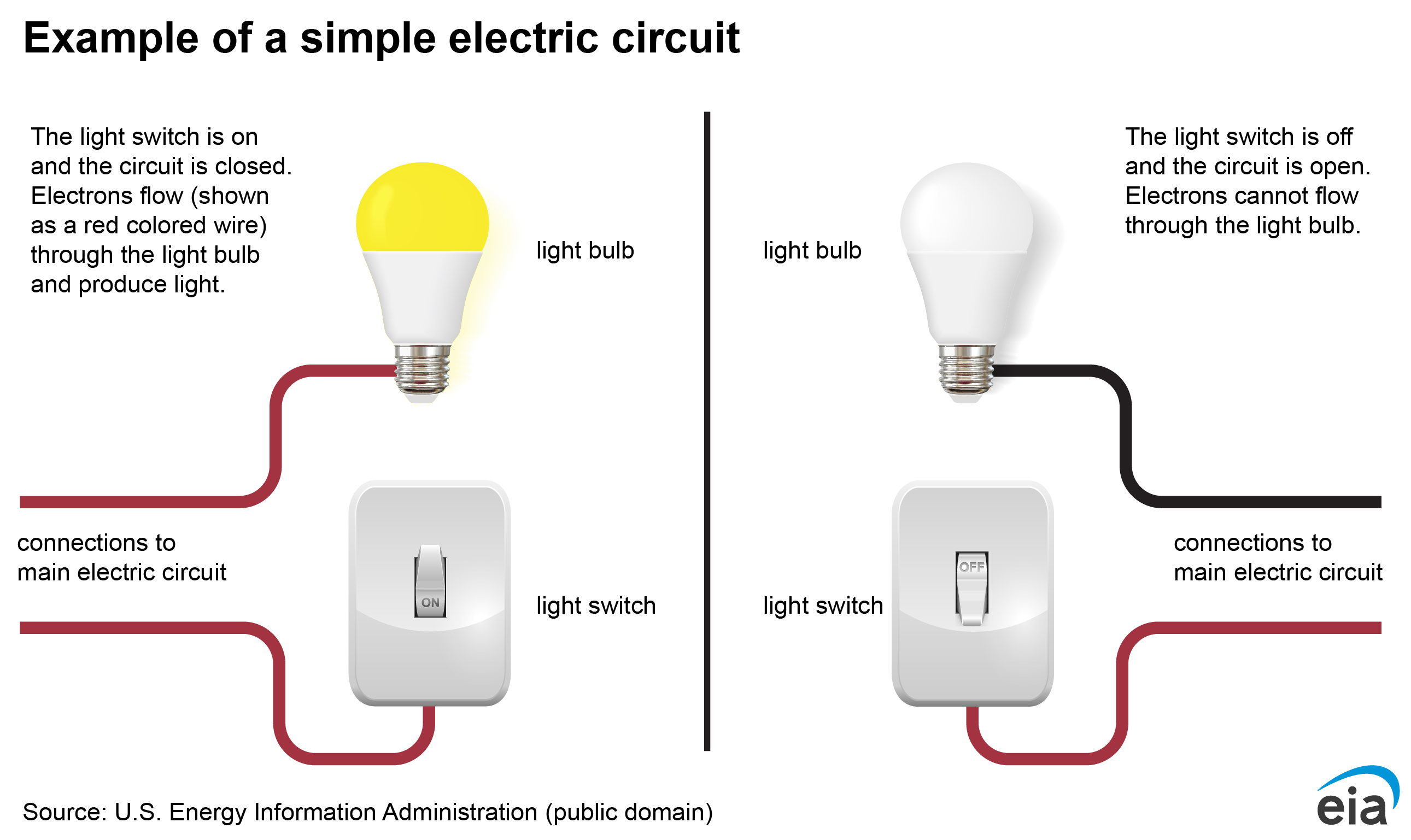
For electricity to flow, it needs a complete path, or electrical circuit. The on-off switch on electrical devices either closes (turns on) or opens (turns off) this circuit:
- Turning off a light or device opens the circuit and stops electrons from flowing.
- Turning on a light closes the circuit, allowing electricity to flow from one wire, through the light bulb, and then through the other wire to complete the circuit.
Transformers help move electricity efficiently
To overcome the challenge of sending electricity over long distances, William Stanley invented the transformer. A transformer adjusts the voltage (electrical pressure) of electricity in power lines.
High-voltage transmission lines (the ones you see hanging between tall metal towers) carry electricity over long distances. Higher voltage electricity is more efficient and less expensive for long distance travel. Lower voltage electricity is safer to use in homes and businesses. Transformers play a crucial role by either increasing (stepping up) or reducing (stepping down) voltages as electricity travels from power plants to homes and businesses.
Measuring electricity
Electricity is measured in Watts and kilowatts
Source: Stock photography (copyrighted)
Source: Stock photography (copyrighted)
Electricity is measured in units of power called Watts, named after James Watt, the inventor of the steam engine. One Watt is a very small amount of power. Some devices need only a few Watts to operate, but other devices require larger amounts, and their consumption is measured in kilowatts (kW). One kilowatt is equal to 1,000 Watts.
For very large amounts of electricity, like what power plants generate, we use even larger units:
- Megawatts (MW): One MW is 1,000 kW, or 1,000,000 Watts.
- Gigawatts (GW): One GW is 1,000 MW, or 1,000,000,000 Watts.
Electricity use over time is measured in Watthours
Watts measure power at a specific moment, but we use Watthours (Wh) to measure how much electricity is used over a period of time. One Watthour is the energy of one Watt used for one hour.
Electric utilities and power plants generally measure electricity in kilowatthours (kWh). One kWh is one kilowatt generated for one hour. For example, if you use a 40-Watt (0.04 kW) light bulb for five hours, you have used 200 Wh, or 0.2 kWh, of electrical energy.
Utility companies measure and monitor electricity use with meters
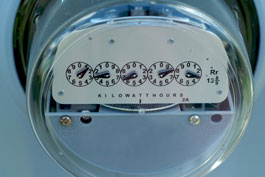
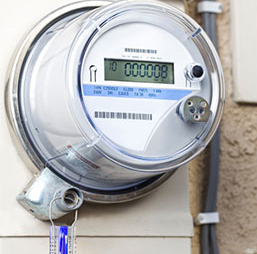
Electric utility companies use meters to measure how much electricity their customers use. These meters are usually located on the outside of the building or home where the power line connects. In the past, electricity meters were mechanical devices that a utility employee had to read manually. Eventually, automated meters could periodically report electricity use to the utility. Today, many utilities use electronic smart meters. These meters wirelessly send power usage data in real time. Some advanced smart meters can even track the electricity use of individual devices and allow the utility or customer to control electricity use remotely.
How electricity is generated
An electric generator is a device that converts a form of energy into electricity. There are many different types of electricity generators. Most of world electricity generation is from generators that are based on scientist Michael Faraday’s discovery in 1831 that moving a magnet inside a coil of wire makes (induces) an electric current to flow in the wire. He made the first electricity generator called a Faraday disk, which operates on this relationship between magnetism and electricity and which led to the design of the electromagnetic generators that we use today.
Electromagnetic generators use an electromagnet—a magnet produced by electricity—not a traditional magnet. A basic electromagnetic generator has a series of insulated coils of wire that form a stationary cylinder—called a stator—surrounding an electromagnetic shaft—called a rotor. Turning the rotor makes an electric current flow in each section of the wire coil, which becomes a separate electric conductor. The currents in the individual sections combine to form one large current. This current is the electricity that moves from generators through power lines to consumers. Electromagnetic generators driven by kinetic (mechanical) prime movers account for nearly all of U.S. electricity generation.
Turbine driven generators
Most of U.S. and world electricity generation is from electric power plants that use a turbine to drive electricity generators. In a turbine generator, a moving fluid—water, steam, combustion gases, or air—pushes a series of blades mounted on a rotor shaft. The force of the fluid on the blades spins/rotates the rotor shaft of a generator. The generator, in turn, converts the mechanical (kinetic) energy of the rotor to electrical energy. Different types of turbines include steam turbines, combustion (gas) turbines, hydroelectric turbines, and wind turbines.
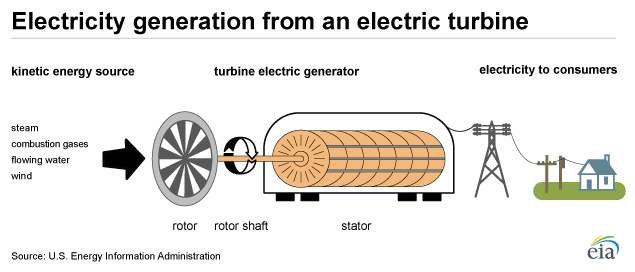
Steam turbines are used to generate the majority of the world’s electricity and they accounted for about 48% of U.S. electricity generation in 2019. Most steam turbines have a boiler in which a fuel is burned to produce hot water and steam in a heat exchanger, and the steam powers a turbine that drives a generator. Nuclear power reactors use nuclear fuel rods to produce steam. Solar thermal power plants use solar energy to produce steam. Of the top 10 U.S. electric power plants in 2019, 9 have steam turbines powered by nuclear energy, coal, and natural gas.
Combustion gas turbines, which are similar to jet engines, burn gaseous or liquid fuels to produce hot gases to turn the blades in the turbine.
Steam and combustion turbines can be operated as stand-alone generators in a single-cycle or combined in a sequential combined-cycle. Combined-cycle systems use combustion gases from one turbine to generate more electricity in another turbine. Most combined-cycle systems have separate generators for each turbine. In single-shaft combined cycle systems, both turbines may drive a single generator. Learn more about different types of combined-cycle power plants. In 2019, combined-cycle power plants supplied about 33% of U.S. electricity generation.
Combined-heat-and-power (CHP) plants, which may be referred to as cogenerators, use the heat that is not directly converted to electricity in a steam turbine, combustion turbine, or an internal combustion engine generator for industrial process heat or for space and water heating. Most of the largest CHP plants in the United States are at industrial facilities such as pulp and paper mills, but they are also used at many colleges, universities, and government facilities. CHP and combined-cycle power plants are the most efficient ways to convert a single fuel into useful energy.
Hydroelectric turbines use the force of moving water to spin turbine blades to power a generator. Most hydroelectric power plants use water stored in a reservoir or diverted from a river or stream. These conventional hydroelectric power plants accounted for about 7% of U.S. electricity generation in 2019. Pumped-storage hydropower plants use the same types of hydro turbines that conventional hydropower plants use, but they are considered electricity storage systems (see below). Other types of hydroelectric turbines called hydrokinetic turbines are used in tidal power and wave power systems. Learn more about different types of hydropower turbines.
Wind turbines use the power in wind to move the blades of a rotor to power a generator. There are two general types of wind turbines: horizontal axis (the most common) and vertical-axis turbines. Wind turbines were the source of about 7% of U.S. electricity generation in 2019.
Geothermal power plants use geothermal resources to drive electrical generators.
Ocean thermal energy conversion (OTEC) systems use a temperature difference between ocean water at different depths to power a turbine to produce electricity. There is a demonstration OTEC system in Hawaii.
Other types of generators
There are many different types of electricity generators that do not use turbines to generate electricity. The most common in use today are solar photovoltaic (PV) systems and internal combustion engines.
Solar photovoltaic cells convert sunlight directly into electricity. They are used to power devices as small as wrist watches and can be connected together in panels that are connected together in arrays to power individual homes or form large power plants. PV power plants are now one of the fastest growing sources of electricity generation around the world.
Internal combustion engines, such as diesel engines, are used all around the world for electricity generation including in many remote villages in Alaska. They are also widely used for mobile power supply at construction sites and for emergency or backup power supply for buildings and power plants. Diesel-engine generators can use a variety of fuels including petroleum diesel, biomass-based liquid fuels and biogas, natural gas, and propane. Small internal combustion engine generators fueled with gasoline, natural gas, or propane are commonly used by construction crews and tradespeople and for emergency power supply for homes.
Other types of electricity generators include fuel cells, Stirling engines (used in solar thermal parabolic-dish generators), and thermoelectric generators.
- The share of total U.S. utility-scale electricity generation in 2019 by major types of electricity generators
- steam turbines58%
- combustion turbines24%
- hydroelectric turbines7%
- wind turbines7%
- solar photovoltaic systems2%
- all other types2%
