
Use of electricity in houses to grow more quickly in developing economies
Note: OECD=Organization for Economic Cooperation and Development
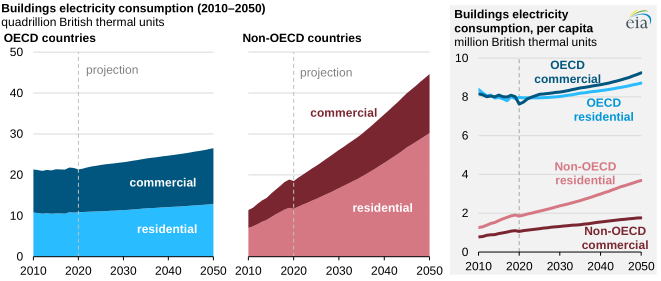
In our International Energy Outlook (IEO2021) Reference case, we project that residential buildings outside the Organization for Economic Cooperation and Development (OECD) will consume more electricity than all residential and commercial buildings combined in OECD countries by 2050. However, people in non-OECD countries will, on average, still consume less than half as much residential electricity as in OECD countries. Our Reference case assumes current laws and regulations do not change in the future, and we use it as the basis for examining alternative cases that change these base assumptions.
Population and household income are key drivers of residential electricity consumption. Over the next 30 years, we expect the populations in non-OECD countries to grow three times faster than the populations in OECD countries. As standards of living rise in non-OECD countries, as reflected in increases in household income, we also project increased demand for electricity to power new household electronic devices and appliances, such as air conditioners and electric cooking ranges. In OECD countries, electricity consumption will grow more slowly because of less population growth, gains in energy efficiency, and slower increases in household income.
We project residential electricity consumption to grow fastest in India, a non-OECD country. In 2020, India accounted for 11% of non-OECD residential electricity consumption; we project that share to reach 25% by 2050. We expect the average household income per person in India to rise faster over the next 30 years than in any other region or country analyzed in our IEO2021. In 2050, we project that residential electricity consumption per capita in India will be five times higher than it was in 2020.
As of 2020, 82% of the world’s population, or 6.4 billion people, lived in non-OECD countries. Even though population growth supports higher electricity consumption in non-OECD countries, we project household electricity use per person will grow at a faster rate than population in these countries. By 2050, we project that 8.2 billion people will live in non-OECD countries. Residential electricity consumption per person will grow nearly six times as fast in non-OECD countries as in OECD countries, although from a smaller, less electricity-intensive base in 2020.
In addition to electricity, buildings use natural gas, coal, liquid fuels such as propane, and renewables as energy sources. In 2020, electricity accounted for 45% of the energy consumption in OECD buildings and 38% in non-OECD buildings. By 2050, we project that electricity will account for 51% of energy consumption in OECD buildings and 55% in non-OECD buildings.
Principal contributor: Courtney Sourmehi