
Industrial onsite generation increasingly relies on natural gas
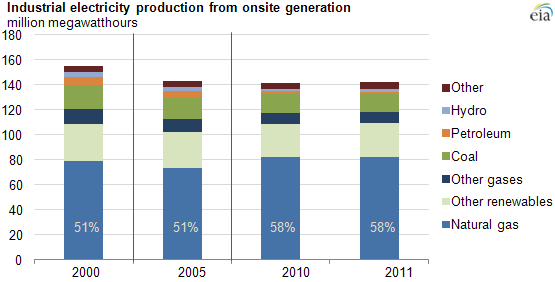
Note: The 'other gases' category includes blast furnace gas and propane gas, among others. 'Other' includes tire-derived fuels and non-biogenic municipal solid waste, among others.
Onsite generating capacity in the industrial sector produced 142 million megawatthours of electricity in 2011. Of that, 58% was from natural gas, up from 51% in 2000. Onsite generation is used when some or all of an industrial plant's electricity needs can be provided more economically onsite than by purchasing power from the electric grid.
While many commercial and industrial facilities purchase electricity from the grid, some install their own equipment to generate electricity at their facility. Onsite generation includes both generation-only facilities and combined heat and power (CHP) facilities. For example, an industrial plant may be located on a river and have its own hydroelectric plant. Or a factory can use thermal technologies to provide both process heat and electric power at a CHP facility at a higher efficiency than producing heat and electricity separately. A previous Today in Energy article described CHP in the United States.
Industrial onsite generation capacity, including both generation-only and CHP facilities, was approximately 28 gigawatts in 2011, 3% of total U.S. generating capacity. CHP accounts for most of that capacity.
Many fuels are used in onsite generation-only and CHP facilities (see chart). While hydroelectric power is used only in generation-only facilities, other fuels can be used in either type. Natural gas constitutes an increasing share of fuel used in industrial generation, and, further, has been the only fuel consistently increasing its share of generation in the industrial sector since 2000.
Waste products and industrial byproducts are burned in CHP facilities. Examples of renewable industrial byproducts used in the United States include wood and wood waste and animal waste; some but not all states consider landfill gas to be renewable. Less typical sources include process waste heat. Using waste and byproducts (nonpremium fuels) in CHP provides useful heat and power, while lowering disposal costs. Coal, petroleum products, and petroleum coke are also used in the industrial sector.
Tags: commercial, efficiency, electricity, industrial, natural gas, renewables