U.S. Energy Information Administration logo
Skip to sub-navigation
June 26, 2013

Metallurgical industries are key parts of energy-intensive manufacturing
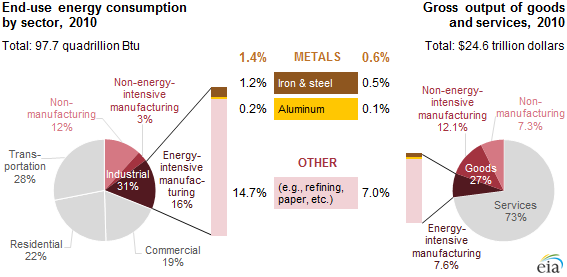
graph of contribution of energy-intensive metals manufacturing to energy consumpion, as explained in the article text
Source: U.S. Energy Information Administration MECS and AER, and Bureau of Economic Analysis.

In 2010, metals manufacturing used 1.4% of the nation's energy and was estimated by the Commerce Department's Bureau of Economic Analysis to provide 0.6% of the nation's gross output of goods and services. The metals industry includes both primary production of aluminum, iron, and steel, as well as the manufacture of commodity products, such as metal sheets or tubes, and specialty products. Overall, the industrial sector consumed an estimated 31 quadrillion Btu in 2012, nearly a third of energy consumed in the United States.

Energy consumption in the aluminum industry has declined in recent years while consumption in iron and steel has remained relatively flat. Output for these two industries was flat over the last decade, except 2008-09 when the recession caused a sharp output decline.

Because of links within the supply chain, changes in the metals industries can have broad economic effects. EIA projections show a declining share of both energy use and output in the overall economy from the metals industries in the next 20 to 30 years. However, for the next 10 to 20 years, energy use and output should accelerate in both aluminum and iron and steel, driven by low energy costs and increasing demand for key products.
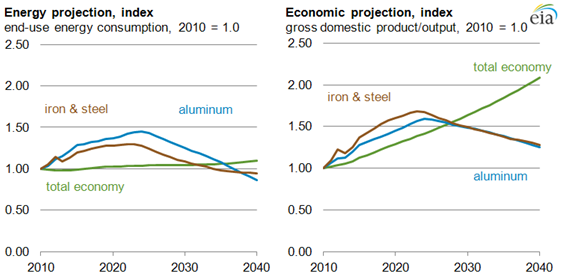
graph of energy and economic projections, as explained in the article text
Source: U.S. Energy Information Administration AEO2013.

The most recent EIA data for the manufacturing sector are available in the Manufacturing Energy Consumption Survey (MECS2010). For more discussion of the industrial sector and individual industries, see EIA's Industry Analysis Briefs and the Annual Energy Outlook 2013 (AEO2013).

Statistics
Analysis
Tools
Education
News

Petroleum & Other Liquids

Crude oil, gasoline, heating oil, diesel, propane, and other liquids including biofuels and natural gas liquids.

Natural Gas

Exploration and reserves, storage, imports and exports, production, prices, sales.

Electricity

Sales, revenue and prices, power plants, fuel use, stocks, generation, trade, demand & emissions.

Coal

Reserves, production, prices, employment and productivity, distribution, stocks, imports and exports.

Nuclear & Uranium

Uranium fuel, nuclear reactors, generation, spent fuel.

Renewable & Alternative Fuels

Includes hydropower, solar, wind, geothermal, biomass and ethanol.

EIA Survey Forms

Forms EIA uses to collect energy data including descriptions, links to survey instructions, and additional information.

Total Energy

Comprehensive data summaries, comparisons, analysis, and projections integrated across all energy sources.

U.S. States

State energy information, including overviews, rankings, data, and analyses.

International

International energy information, including overviews, rankings, data, and analyses.

Environment

Greenhouse gas data, voluntary reporting, electric power plant emissions.

Data Tools, Apps, & Maps

Tools to customize searches, view specific data sets, study detailed documentation, and access time-series data.

Open Data

EIA's free and open data available as API, Excel add-in, bulk files, and widgets

EIA Beta

Come test out some of the products still in development and let us know what you think!

Open Source Code

EIA's open source code, available on GitHub.

RSS Feeds

Subscribe to feeds for updates on EIA products including Today in Energy and What's New.