There are several measures of how much coal is left, based on various degrees of geologic certainty and economic feasibility. Published data range from how much is left at currently producing mines to total coal resources, which is an estimate of how much coal is likely to exist, both currently known and that which is postulated based on geological principles. The major measures are described below.

Did You Know?

As the easier-to-mine coal is used up, the remaining coal reserves will be harder to mine.

In the past, advancements in mining technologies have tended to compensate for these impacts, so that mining costs have typically not increased despite the progression to more difficult to mine coal deposits.

Coal Reserves at Producing Mines

Each year the U.S. Energy Information Administration (EIA) obtains the amount of “recoverable reserves at active mines” from its annual Coal Production and Preparation survey. These are the amounts of coal that can be recovered from reserves at active U.S. coal mines that produced at least 10,000 short tons of coal during the reporting year.

As of January 1, 2011, the recoverable reserves at producing mines were 17.9 billion short tons. (One short ton is 2,000 pounds.)

The amount of coal reserves at producing mines, however, is a small part of the total amount of coal that exists in the United States.

So How Much Coal Is There?

It is impossible to know exactly how much coal there is, because it is buried underground. But we can make estimates.

  • "Total resources" is our best estimate of the total amount of coal, including undiscovered in the United States. Currently, total resources are estimated to be about 4 trillion short tons.1 Total Resources includes several categories of coal with various degrees of geologic assurance and data reliability.
  • But not all coal is feasible to mine. The Demonstrated Reserve Base2 is the sum of coal in both measured and indicated resource categories of reliability, representing 100% of the in-place coal that could be mined commercially at a given time. EIA estimates the Demonstrated Reserve Base to measure 484.5 billion short tons.
  • "Estimated Recoverable Reserves" include only the coal that can be mined with today’s mining technology, after accessibility constraints and recovery factors are considered. EIA estimates there are 259.5 billion short tons of U.S. recoverable coal reserves, about 54% of the Demonstrated Reserve Base.

Based on U.S. coal production for 2010, the U.S. recoverable coal reserves represent enough coal to last 239 years. However, EIA projects in the most recent Annual Energy Outlook (January 2012) that U.S. coal production will increase at about 0.4% per year for the period 2009-2035. If that growth rate continues into the future, U.S. recoverable coal reserves would be exhausted in about 168 years if no new reserves are added.

There Are Different Types of Coal

There are four major ranks (types) of coal. In the United States, coal rank is classified according to its heating value, its fixed carbon and volatile matter content, and, to some extent, its caking properties during combustion. The coal ranks from highest to lowest in heating value are:

  • Anthracite
  • Bituminous
  • Subbituminous
  • Lignite

Types of Coal in the Demonstrated Reserve Base

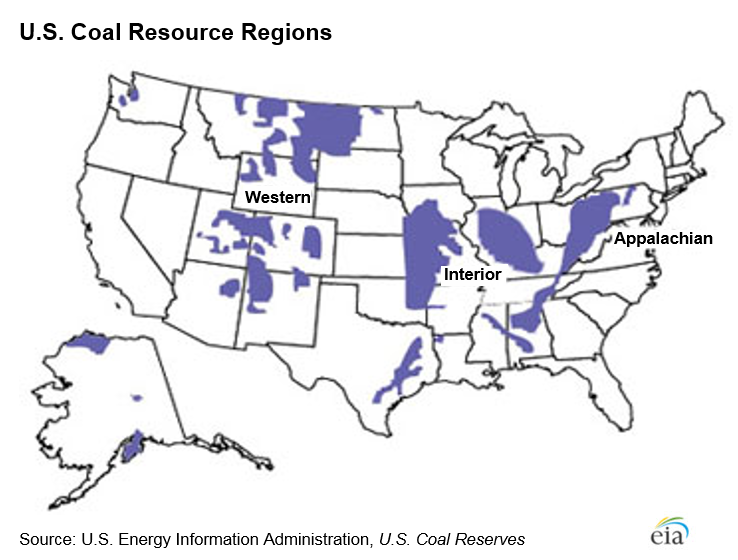
Of the four ranks, bituminous coal accounts for over half (53%) of the Demonstrated Reserve Base. Bituminous coal is concentrated primarily east of the Mississippi River, with the greatest amounts in Illinois, Kentucky, and West Virginia.

All subbituminous coal (37% of the reserve base) is west of the Mississippi River, mostly in Montana and Wyoming.

Lignite, the lowest-rank coal, accounts for about 9% of the reserve base. Lignite is found mostly in Montana, Texas, and North Dakota.

Anthracite, the highest-rank coal, makes up only 1.5% of the reserve base. Anthracite is concentrated almost entirely in northeastern Pennsylvania.

U.S. Coal Resources
map showing U.S. Coal Resources
Click to enlarge »

Source: U.S. Energy Information Administration, U.S. Coal Reserves: 1997 Update.

What Are International Coal Resources?

Worldwide, compared to all other fossil fuels, coal is the most abundant and is widely distributed across the continents. The estimate for the world's total recoverable reserves of coal as of January 1, 2009 was 948 billion short tons. The resulting ratio of coal reserves to consumption is approximately 129 years, meaning that at current rates of consumption, current coal reserves could last that long.

The Distribution of World Coal Reserves Varies From That of Oil and Gas

Significant coal reserves are found in the United States and Russia, but not in the Middle East. In fact, the United States and Russia account for nearly half of global coal reserves as shown in the table below. In contrast, oil reserves are predominantly found in the Middle East and Canada, while Russia, Iran, and Qatar own more than half of the world’s natural gas reserves.

Estimated World Energy Reserves by Country

Coal Oil Gas
United States 27.5% Saudi Arabia 17.7% Russia 25.2%
Russia 18.3% Venezuala 14.4% Iran 15.7%
China 13.3% Canada 11.9% Qatar 13.4%
Other Non-OECD Europe and Eurasia 10.7% Iran 9.3% Saudi Arabia 4.1%
Australia and New Zealand 8.9% Iraq 7.8% United States 4.1%
India 7.0% Kuwait 6.9% Turkenistan 4.0%
OECD Europe 6.5% United Arab Emirates 6.7% United Arab Emirates 3.4%
Africa 3.7% Russia 4.1% Nigeria 2.8%
Other Central and South America 0.9% Libya 3.2% Venezuela 2.7%
Rest of World 3.2% Rest of World 18.2% Rest of World 24.7%
  Total 100.0%   Total 100.0%   Total 100.0%

Source: U.S. Energy Information Administration, International Energy Outlook, September 2011, Tables 5, 7, and 10.

1. The most comprehensive national assessment of U.S. coal resources was that published by the U.S. Geological Survey (USGS) in 1975, which indicated that as of January 1, 1974 coal resources in the United States totaled 4 trillion short tons. While more recent regional assessments of U.S. coal resources have been conducted by the U.S. Geological Survey, a new national level assessment of U.S. coal resources has not been conducted.

2. The U.S. Bureau of Mines made an assessment of what portion of demonstrated resources were suitable for mining with existing technologies. As of January 1, 1971, the U.S. Bureau of Mines estimated that 434 billion short tons of coal within the demonstrated resource categories lied within what they deemed to be minable coal deposits. Their estimate, published in the 1975 USGS report on U.S. coal resources, was referred to as the Demonstrated Reserve Base (DRB) of coal. However, it was estimated for 1971, so subsequent updates to the DRB reflecting downward adjustments for production begin with data reported for 1971.

The U.S. Energy Information Administration (EIA) now has responsibility for the DRB. EIA’s most recent estimate indicated that there were 484.5 billion short tons of in-place coal reserves in the DRB as of January 1, 2011. This is 51 billion short tons higher than the original estimate provided by the U.S. Bureau of Mines in 1971 and is primarily due to new regional assessments of coal resources over the years which have added additional resource tonnage.