Renewable & Alternative Fuels
Trends in Renewable Energy Consumption and Electricity, 2009
Release Date: March 31, 2011 | Next Release Date: May 2012 | full report
Summary
Despite an economic recession and a significant fall in overall energy demand/consumption, the use of renewable fuels grew strongly in 2009. This growth has been supported by Federal and State programs, including federal tax credits, state renewable portfolio standards, and a federal renewable fuels standard. This chapter details renewable energy consumption in 2009 after explaining the unusual decrease in total energy consumption over the past two years.
Total U.S. Energy Consumption
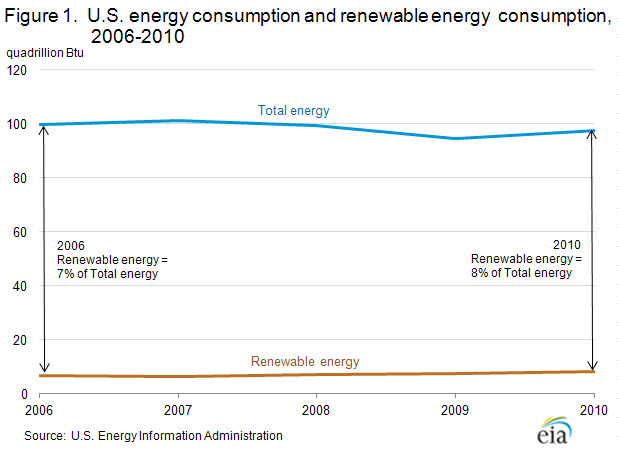
U.S. energy consumption declined for the second year in a row in 2009, falling 4.8 percent between 2008 and 2009 to 94.6 quadrillion British Thermal Units (Btus) (Table 1, Figure 1.1). This follows a 2.1-percent decline between 2007 and 2008. As a result, total energy consumption in 2009 dropped to its lowest level since 1996.1
This is just the third time since 1949 that energy consumption has declined for two or more consecutive years. It declined between 1973 and 1974 and again in 1975. However, consumption rebounded in 1976 above the 1973 level. The longest and steepest decline occurred between 1979 and 1983, when total energy consumption dropped 9.7 percent and it did not reach the 1979 level again until 1988.
In both of these earlier periods, oil prices that rose steeply and remained at high levels were a major factor in slowing down the economy and hence reducing energy consumption. This time, there has been no steep oil price increase that resulted in permanently higher oil prices; the average annual price per barrel of crude oil was $60 in 2006, $67 in 2007, $94 in 2008, and $56 in 2009.2 Instead, the economy slowed down mainly due to factors outside the energy sector.
Consumption of all major fuels declined between 2008 and 2009, except for renewables. Coal dropped the most, falling 12 percent, while petroleum consumption fell nearly 5 percent, and natural gas consumption fell 2 percent. Even nuclear fuel consumption fell by nearly 1 percent. The decline in all of these sources of energy masks the switching of coal to natural gas for electricity generation due to low natural gas prices.
By sector, energy consumption dropped most in the industrial area (10.1 percent), followed by electric power (4.5 percent) and then transportation (3.5 percent).3 The residential and commercial sectors each experienced declines of under 2 percent.
U.S Renewable Energy Consumption
Total Consumption
Against this backdrop, it is noteworthy that renewable energy consumption increased by 5.4 percent in 2009 to 7.8 quadrillion Btus (Figure 1.2). This follows a 9.6-percent increase between 2007 and 2008. These two increases, coupled with the consecutive year decreases in total energy consumption, boosted renewable energy's share of total consumption from 6.6 percent in 2007 to 8.2 percent in 2009. This is renewable energy's greatest share of the U.S. energy pie since 1984 when there were near record levels of hydropower.4
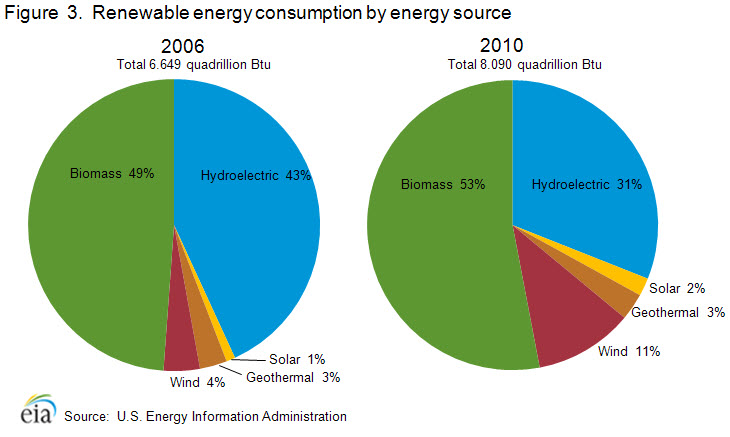
Wind energy grew 32 percent and has more than doubled since 2007, standing at 0.7 quadrillion Btus in 2009. While the gain in 2009 was strong, capacity additions and output might have been greater still except for the collapse of natural gas prices, which made lower capital cost natural gas-fired capacity more attractive than wind. Solar energy followed a pattern similar to that of wind energy for similar reasons. Consumption in 2009 jumped by 10 percent from 2008, about 60 percent of the rate of increase for the prior year. Biomass also grew just 1 percent between 2008 and 2009, when there was a 14 percent gain in biofuels (ethanol and biodiesel) consumption and an 8 percent decrease n wood and derived fuels consumption.
Hydropower consumption grew 6.3 percent in 2009, but even with the growth over the past 2 years, at 2.7 quadrillion Btus in 2009 hydropower energy consumption is still under the 30-year average of 2.9 quadrillion Btus.5 This reflects the extended drought in the western United States.6
The transformation in the mix of renewable energy provided between 2005 and 2009 is quite remarkable. Wind has come from a relatively minor renewable energy source to accounting for nearly 10 percent of total renewable energy consumption (Figure 1.3). Hydropower has dropped considerably, from 42 percent of renewable energy consumption in 2005 to 34 percent today, and biomass now represents over half of renewable energy consumption, the result of increased biofuel production.7 Solar and geothermal shares remain relatively unchanged.
The continued growth of renewable energy is linked to various financial incentives and mandates.8 Currently, 37 states and the District of Columbia have some sort of renewable mandates or "renewable portfolio standard," which requires electricity providers to produce or acquire a certain share of electricity from renewable energy sources (Table 1.28).9 In 6 states, however, these standards are voluntary.
Consumption by End-Use Sector
By sector, the greatest change in recent composition of renewable energy has occurred in transportation. Due to the growth in biofuels, transportation now consumes nearly 12 percent of renewable energy, compared with just over 5 percent in 2005 (Table 1.2). The shares of renewables in all other sectors have declined. It may seem strange that the electric power sector's share of renewable energy has decreased from 56 to 53 percent between 2005 and 2009, given the emphasis on renewables and the surge in wind generation. However, the energy source with the largest contribution to renewable electricity is hydropower—accounting for over 60 percent of renewable energy used to generate electricity. Its output fell slightly between 2005 and 2009, while most other renewable energy sources increased (Table 1.3). As a result its share of increasing renewable energy consumption has declined, thus decreasing the electric power sector's contribution to total renewable energy. Other relevant factors contributing to the electric power sector's decreased contribution to total renewable energy probably include low natural gas prices and the focus on investment in wind plants with low (about 35%) capacity factors. Nonetheless, the electric power sector still consumed the majority--53 percent--of total renewable energy in 2009.
The industrial sector's share of renewable energy consumption has also declined. Consumption of wood and derived fuels, the largest renewable fuel in the industrial sector (about 60 percent in 2009), has declined since 2005. In 2009, the industrial sector consumed 26 percent of total renewable energy.
The residential and commercial sectors used 7.1 and 1.7 percent of total renewable energy in 2009, respectively. Geothermal energy consumed by the residential sector, though small, continues to grow, reflecting the increased use of geothermal heat pumps. Although commercial sector renewable energy consumption appears to be static, there have been many commercial photovoltaic rooftop projects of 1 megawatt (MW) or more placed into service over the past two years (especially in California).10 Beginning with data collected for 2010, the Energy Information Administration's (EIA's) electricity data forms will collect information to enable EIA to estimate commercial sector solar consumption.
Consumption by Use
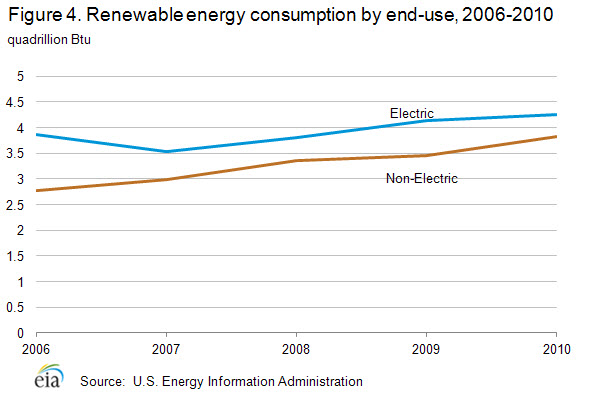
Electricity generation accounted for 56 percent of renewable energy consumed in 2009, compared with 59 percent in 2005 (Table 1.2 and Table 1.3). The decreased share is due to the rapid increase in biomass used to produce biofuels (Figure 1.4).
Even though the electric power sector has always consumed the vast majority of renewable energy for electricity, that percentage has increased in recent years, rising from 93 percent of renewable energy for electricity generation in 2005 to 95 percent in 2009. This is due to wind energy's rapid rise and use almost entirely within the electric power sector, coupled with slowly decreased electrical output in the industrial sector using biomass. Older paper and pulp plants are sometimes closing rather than refurbishing due to environmental regulations.11 Others have chosen to upgrade, while still others are converting to merchant biomass facilities.12 While some are refurbishing to produce electricity, others plan to become bio- refineries with no electricity output.13
Renewable energy for non-electric purposes increased by a net of 0.8 quadrillion Btus between 2005 and 2009. All of the increase was due to biofuels; the energy content of ethanol produced rose 0.6 quadrillion Btus, and another 0.4-quadrillion Btus increase was required by the industrial sector to produce biofuels. Biomass consumed for other non-electric purposes, principally process heat at paper and pulp plants, actually decreased by 0.2 quadrillion Btus between 2005 and 2009. Residential solar energy, though small, has increased consistently since 2005 but still represents less than 0.1 quadrillion Btus.
Long-term Historical View of Renewable Energy Consumption
Tables 1.5a and 1.5b present renewable energy consumption from 1989 through 2009. The beginning year 1989 was chosen because that was the first year that EIA began surveying "non-utilities" for electricity information. Some points worth noting are:
- Waste energy appears to have declined substantially in 2001.14 This is an artifact of EIA’s decision to split municipal solid waste (MSW) data into two components beginning in 2001, biogenic (renewable) and nonbiogenic (non-renewable), as well as remove tire-derived fuels from renewables. If non-biogenic MSW data is added to the 2002 waste values shown in Table 1.5b, the waste series increases between 2001 and 2002 (Table 1.A1).15 Waste energy increased steadily except during 1996-2000. During that period, some mass-burn MSW plants ceased operating, and landfill gas (LFG) use for energy was minimal.
- Residential renewable energy decreased from 1.0 quadrillion Btus in 1989 to 0.4 quadrillion Btu in 2002 before beginning to increase steadily through 2009. This reflects decreased wood use throughout the time period and increased photovoltaic rooftop installations during the past decade.16
- Increases in biomass for biofuels have essentially offset decreases in wood and derived fuel use in the industrial sector.
- Hydropower average output from 1989-1999 was over 0.5 quadrillion Btus greater than from 2001-2009.
- Wind increased seven-fold from less than 0.1 quadrillion Btus in 1989 to 0.7 quadrillion Btus in 2009.
Biomass Overview
Biofuels
The total energy consumed in producing ethanol and biodiesel during 2009 was 1.6 quadrillion Btus (Table 1.6). Of that amount,1.0 quadrillion Btus represents the energy value of biofuels consumed.17 The remaining 0.6 quadrillion Btus represents the energy used to produce biofuels, losses and coproducts, and the denaturant added to ethanol. The apparent major decrease between 2008 and 2009 in biofuels consumed for biodiesel is due to counting "splash and dash" biodiesel "production" as U.S. consumption in 2008 rather than as exports.18
Waste Energy
Most biomass waste was consumed by the industrial sector and by independent power producers (IPPs) in 2009 (Table 1.7). IPPs operate almost all of the MSW energy facilities, while the industrial sector and IPPs operate most LFG facilities. Other biomass waste (mostly food waste and wastewater treatment facilities) are largely in the industrial sector.
Industrial Biomass Energy
The industrial sector used 2.0 quadrillion Btus of biomass in 2009 to produce 25 billion kilowatt-hours (kWh) of electricity (Table 1.8). Around 90 percent of biomass energy went for useful thermal output (e.g., process heat and steam, space heating). Paper and allied products companies consumed about half of industrial sector biomass and generated 94 percent of its electricity. A decade ago, this sector consumed nearly 70 percent of industrial biomass. The main reason for the decline has been the introduction of bio-refineries, whose consumption has surged during the past 5 years.
Biomass/Coal Cofiring
Sixty-seven plants reported in 2009 that they had the capability to cofire biomass with coal. These plants had a cofiring capacity of over 4,400 MW (Table 1.9). This is a substantial jump from 3,800 MW in 2008. Wisconsin led the nation with the most plants—13--having 448 MW capacity.19
Renewable Electricity
U.S. Generation
Renewable electricity generation increased 9.7 percent in 2009, led by a one-third increase in wind and a 7.3 percent increase in hydropower (Table 1.11). Even in absolute terms, wind-generated electricity accounted for almost as many kWh of increased generation as did hydropower. Generation from LFG increased 10.7 percent, while electricity from wood and derived fuels dropped 3.4 percent.
The decline in biomass power is consistent with the decrease in consumption data, owing to the status of the domestic pulp and paper business discussed earlier. Wind power appeared in the commercial sector for the first time in 2009 at a wastewater treatment plant in Massachusetts.20
U.S. Capacity21
Renewable electricity capacity rose by 10.7 gigawatts (GW) in 2009 to 127.1 GW, up 9.2 percent from 2008 (Table 1.12).22 By comparison, total U.S. electricity capacity rose only 1.5 percent, or 15.2 GW. Of the 10.7 GW renewable capacity increase, 9.6 GW came from wind.
Regional Electricity Generation
The Pacific Contiguous Census Division (PC), California, Washington, and Oregon, leads the Nation in producing renewable electricity, with 40 percent of the total in 2009 (Table 1.13 and Figure 1.5). Nearly 80 percent of the PC Census Division's 169 billion kilowatthours of renewable electricity generation came from hydropower electricity. Also, the PC division produced over 85 percent of the Nation's geothermal power and provided 8 percent of the PC division's renewable energy. Nonhydroelectric generation increased almost as much as hydroelectric generation between 2008 and 2009, but from a smaller base.23 The largest increases were for wind generation in the West North Central and West South Central Census Divisions.
Excluding hydropower, the distribution of renewable generation was much more even. While the PC division still led, its share was only 24 percent, and several regions were close behind: West South Central (WSC, 19 percent) and West North Central (WNC, 15 percent). The latter two regions have substantial wind power. In fact, WSC led among all regions in wind power during 2009 (23 gWh), followed by WNC (20 gWh).
Generation from wood and derived fuels is fairly well spread out across many regions. LFG and MSW, however, are largely concentrated in 3 regions each. Both fuels have substantial generation in the Middle Atlantic region, while LFG has sizable generation in the East North Central and PC regions, and MSW has sizable output in New England and the South Atlantic. The concentration of MSW and LFG in these regions probably has more to do with state policies regarding trash management and trash disposal cost than with resource availability. State renewables data shown in Table 1.20, discussed later, indicates that MSW/LFG generation in 4 of the above-mentioned regions is highly concentrated in a single state—California (PC), Massachusetts (New England), New York (Middle Atlantic), and Florida (South Atlantic).
Table 1.14 shows biomass electricity generation by energy source and Census Division. Black liquor and wood waste solids, primarily in the South, provided 66 percent of biomass electricity generation.
State Electricity Generation
Washington, California, and Oregon were the three leading states generating renewable electricity within the electric power sector in 2009 (Table 1.18). Combined, they produced 43 percent of the Nation's renewable electric power sector generation. This is a decreased concentration from 2008, when these 3 states produced 47 percent of the electric power sector's renewable electricity (Table 1.15). The states with the greatest increases in hydropower between 2008 and 2009 were 3 southern states—Alabama, Tennessee, and North Carolina—as well as California.
Excluding hydropower, however, the picture changes. California, Texas, and Minnesota were the leading states for electric power sector non-hydro renewable generation, accounting for 47 percent in 2008. In 2009, however, Iowa replaced Minnesota as the third-largest non-hydro renewable generator in the electric power sector, due to a major increase in wind generation. The 3 largest states' share of non-hydro renewables declined to 45 percent. The decreased 2009 share represents an increase in the diversity of wind power, dominated by Texas, Iowa, California, and Minnesota (50 percent). Generation from wood and derived fuels continues to be diverse state-wise, but the southern United States accounts for nearly half of generation from these sources.24
Generation from the industrial and commercial sectors is tiny compared to the electric power sector--about 8 percent in 2008 and 7 percent in 2009 (Tables 1.16 and 1.19, respectively). While no state dominates generation in these sectors, six of the top seven States are in the southeastern region of the United States. The other state, Maine, consumed a relatively large amount of wood for industrial and commercial electricity generation. It also has a large portion of the Nation's commercial hydropower generation (39 percent in 2009).
All sectors combined, the generation picture is quite similar to the dominant electric power sector, except that the concentration of non-hydro renewables is not quite as great (35 percent in 2009, Table 1.20).
State Electricity Capacity
Tables 1.21 through 1.23 present renewable energy capacity by sector and state for 2008, while Tables 1.24 through 1.26 do so for 2009. Texas led the Nation in increased renewables capacity, adding 1,974 MW between 2008 and 2009. Most of this was increased wind capacity, 1,951 MW, which led all states by a wide margin. The data indicates that Idaho added 336 MW of hydropower, but this was an up-rating of existing capacity due to increased water levels.
Renewable Electricity Market Share
Idaho, Washington, Oregon, and South Dakota had the greatest market share of total renewable electricity generation in 2009 (Table 1.27). All generated over half of total electricity from renewables. In each case, the vast majority of renewable generation came from hydropower. Excluding hydropower, Maine, Iowa, California, and Minnesota had the greatest renewable electricity market shares, all exceeding 10 percent. Maine's renewable electricity is largely wood-based. Iowa and Minnesota rely mainly on wind, while California has a diversity of non-hydro renewable sources. The shares for Iowa and, to a lesser extent, Minnesota, rose sizably from 2008 due to increased wind penetration.
Other Non-Renewable Energy: Classification Change for Certain Biomass Fuels
Until 2007, EIA included classified all MSW energy as renewable, as well as tire-derived fuel (TDF). Beginning with EIA's 2006 data reporting, however, renewables include only the biogenic portion of MSW and categorize TDF as non-renewable. Appendix Tables 1. A1 and 1.A2 show the energy consumption and electricity generation associated with non-biogenic MSW, TDF, and other minor fuels specified in those tables.25
Data Revisions
Residential solar energy consumption was revised downward for 1989-2009 to account for losses in roof top PV installations when converting from DC to AC electric power. Geothermal energy in the electric power sector was revised downward due to a misclassification of some geothermal facilities in Montana as geothermal when they were consuming waste heat. As a result, geothermal electric capacity was revised downward slightly for 2008 and 2009. Geothermal electric generation and consumption were revised downwards for 2008, while electric power sector other non-biogenic generation and consumption were revised upwards.
Notes
Data Tables
More Renewable Annuals
- Solar Photovoltaic Cell/Module Manufacturing Activities
- Solar Thermal Collector Manufacturing Activities
- State Renewable Electricity Profiles
- Green Pricing and Net Metering Programs
- Renewable Energy Annual
- Alternatives to Traditional Transportation Fuels