U.S. Energy Information Administration logo
Skip to sub-navigation
October 16, 2015

Norway’s oil production increases, but new investment is declining
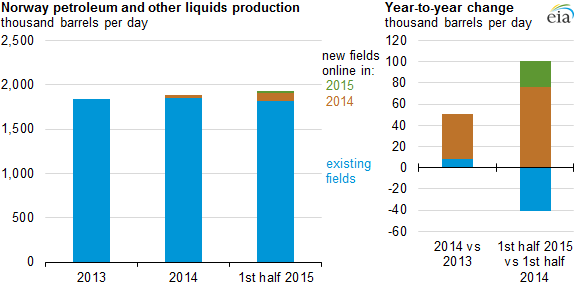
graph of Norway petroleum and other liquids production, as explained in the article text
Source: U.S. Energy Information Administration, based on Norwegian Petroleum Directorate

Norwegian petroleum and other liquids production, which had been declining since 2001, increased in 2014 and will likely continue increasing in 2015. The production growth in 2014 was mainly the result of new fields coming online, but also included a small increase in output from existing fields. Production has continued to grow in the first half of 2015 and is expected to remain relatively stable over the next few years as growth from new fields balances declines from older fields.

Petroleum development projects in the North Sea generally have long lead times, meaning that production from a new field occurs several years after the decision to develop that field. These lead times often increase for projects that are farther north or far from existing infrastructure. The decisions to develop many of the fields now coming online in Norway occurred around 2012, when Brent crude oil prices averaged more than $100 per barrel. The current price is about half that level. In 2014 and the first half of 2015, four new fields with significant volumes of liquids production came online. Another four fields are scheduled to come online in the second half of 2015 and in 2016.

Although production in Norway has not yet responded to lower oil prices, investment in Norway's oil and natural gas industry is declining. This decline will likely lead to lower production in the future. Annual growth in total investment slowed to 1% in 2014 after being more than 15% in each of the preceding three years, and investment is expected to decrease in 2015. Currently, funding is being diverted toward the shutdown and removal of equipment at old fields and away from finding and developing new fields. Spending on exploration and field development in the first half of 2015 was 18% lower than in the first half of 2014, while spending on shutdown and removal was more than 70% higher.
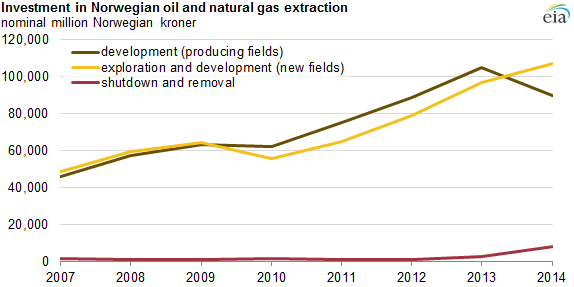
graph of investment in Norwegian oil and gas extraction, as explained in the article text
Source: U.S. Energy Information Administration, based on Statistics Norway

For more analysis of Norway's energy sector, see EIA's recently released Country Analysis Brief on Norway.

Principal contributor: Justine Barden

Statistics
Analysis
Tools
Education
News

Petroleum & Other Liquids

Crude oil, gasoline, heating oil, diesel, propane, and other liquids including biofuels and natural gas liquids.

Natural Gas

Exploration and reserves, storage, imports and exports, production, prices, sales.

Electricity

Sales, revenue and prices, power plants, fuel use, stocks, generation, trade, demand & emissions.

Coal

Reserves, production, prices, employment and productivity, distribution, stocks, imports and exports.

Nuclear & Uranium

Uranium fuel, nuclear reactors, generation, spent fuel.

Renewable & Alternative Fuels

Includes hydropower, solar, wind, geothermal, biomass and ethanol.

EIA Survey Forms

Forms EIA uses to collect energy data including descriptions, links to survey instructions, and additional information.

Total Energy

Comprehensive data summaries, comparisons, analysis, and projections integrated across all energy sources.

U.S. States

State energy information, including overviews, rankings, data, and analyses.

International

International energy information, including overviews, rankings, data, and analyses.

Environment

Greenhouse gas data, voluntary reporting, electric power plant emissions.

Data Tools, Apps, & Maps

Tools to customize searches, view specific data sets, study detailed documentation, and access time-series data.

Open Data

EIA's free and open data available as API, Excel add-in, bulk files, and widgets

EIA Beta

Come test out some of the products still in development and let us know what you think!

Open Source Code

EIA's open source code, available on GitHub.

RSS Feeds

Subscribe to feeds for updates on EIA products including Today in Energy and What's New.