
Voluntary agreement continues to reduce energy consumption of television set-top boxes
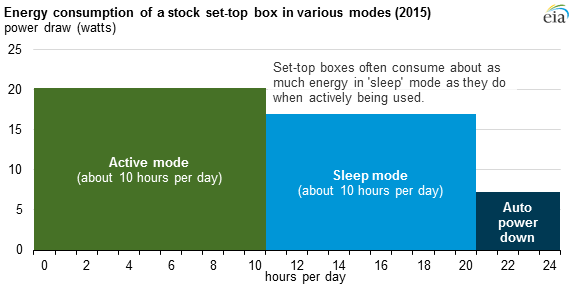
Note: Assumes set-top box has automatic power down enabled.
About 85% of U.S. households have at least one set-top box (STB) designed to deliver subscription-based television service by cable, satellite, or other telecommunication signals, according to 2013 data from the National Cable & Telecommunications Association and the Consumer Electronics Association. In most cases, these STBs operate at almost full power whether they're actively being used or inactive. Energy efficiency advocates, set-top box manufacturers, service providers, and the federal government have voluntarily agreed to improve energy efficiency of set-top boxes, generally based on the ENERGY STAR® program's product specifications.
Some STBs consume about half of the electricity a typical new refrigerator uses in a year, and households may have multiple STBs per household, making them a target for efficiency improvements. These devices are essentially never off, even when no one in the household is watching television or recording a program. Instead, they remain in a standby mode drawing nearly full power, often around 15-20 watts. Energy saving modes such as deep sleep are present on ENERGY STAR models but may or may not be enabled.
Because STBs are typically supplied by service providers, consumers have little choice on what model of energy-consuming device is used. The increasing use of more-efficient thin client devices does help to offset some of the consumption for multiple STBs in a home. Similarly, video streaming devices such as the Apple TV and Roku consume only a fraction of the energy used by typical STBs.
No federal appliance standard currently exists for STBs. The federal rulemaking process requires years of extensive market analysis, which can prove cumbersome for some electronics, as their features evolve much faster than, for example, water heaters or freezers. The voluntary agreement among industry and efficiency advocates allows for greater flexibility and shorter development times than the federal rulemaking process, while still working to reduce energy consumption of a device now well saturated in U.S. households.
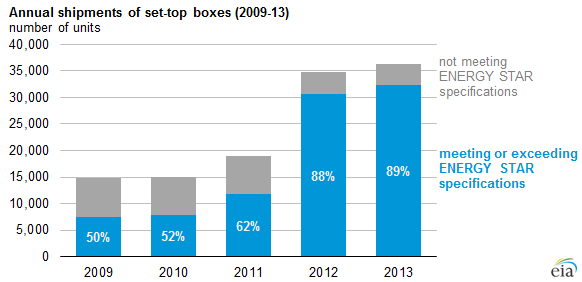
The voluntary agreement was made effective January 1, 2014, and states that 90% of all new STBs purchased by service providers for delivery to customers should meet the current ENERGY STAR specification, with a more stringent specification going into effect January 1, 2017. Some service providers have participated in the ENERGY STAR program since the initial specification was released in 2008. Even prior to the agreement, almost 90% of set-top boxes shipped in 2012 and 2013 met earlier, less stringent ENERGY STAR specifications.
Because this agreement does not require service providers to switch out existing STBs with more efficient alternatives—or discard less efficient devices rather than refurbish them—it may take years for the more efficient devices to make up a significant portion of the installed base. However, some existing STBs may be able to incorporate energy-saving features through firmware updates without replacing equipment. The ENERGY STAR program maintains a list of qualified products currently available, with information about each STB's power-saving features and power draws in active and inactive modes.
STBs are among a group of devices whose use is considered a miscellaneous electric load in the residential and commercial sectors. In the residential sector, this group includes other electronics such as televisions, computers and related electronics, as well as small but pervasive appliances such as microwave ovens, dehumidifiers, and rechargeable devices. A recent report on miscellaneous electric loads commissioned by EIA provides details on the current and anticipated energy consumption of some of these devices, based on changes in technology, efficiency, and market saturation.
Principal contributor: Kevin Jarzomski
Tags: consumption/demand, residential