
Permian Basin drives first-quarter growth in oil-directed horizontal drilling rigs
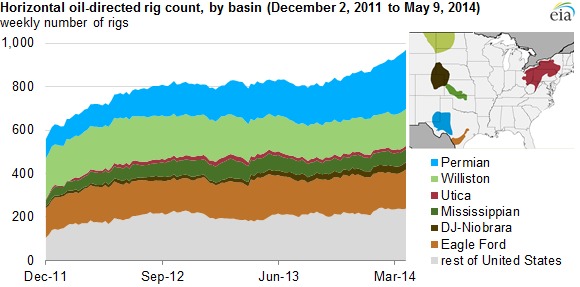
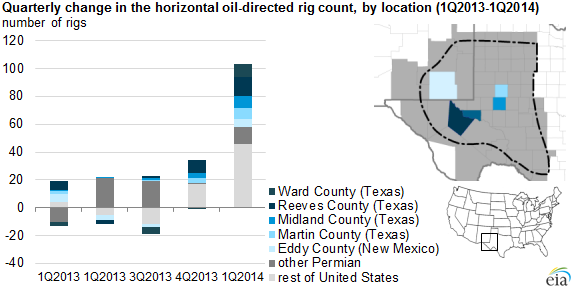
The Permian Basin, a long time oil- and natural gas-producing region in West Texas and southeastern New Mexico, has seen a significant increase in horizontal oil-directed drilling activity over the past five months. This trend began at the start of 2013, and accelerated from the week ending on December 27, 2013, to the week ending on May 9, 2014. During this time, the number of horizontal, oil-directed rigs in the Permian Basin rose by 63 rigs, 50% of the total increase in the United States. This growth was heavily concentrated in counties in the Permian Basin containing formations with high production potential.
Horizontal oil-directed drilling rigs are primarily used to drill wells that produce oil from tight, low-permeability formations. The change in the number of oil-directed horizontal rigs in the Permian Basin does not necessarily mean that it will have a commensurate change in overall oil production. However, it does demonstrate that producers have been drawn to the potential for new production from its tight oil formations, which are stacked in multiple layers.
During the first quarter of 2014, almost 80% of all new horizontal, oil-directed drilling in the Permian Basin took place in just five counties that contained such formations. These counties were Reeves County, Texas (14 rig increase); Ward County, Texas (9 rig increase); Martin and Midland County, Texas (8 rigs each); and Eddy County, New Mexico (6 rig increase). The high-growth formations in these counties include the Spraberry, Wolfcamp, and Bone Spring formations.
Changes to a formation's rig count are not a perfect indicator of its future production growth because of a number of factors, including:
- Changes in rig efficiency, which can include longer horizontal lateral lengths, greater proppant injection, and reduced drilling and completion time.
- The decline rate of production from legacy wells, which is particularly relevant in the Permian Basin, where development began in the early 1940s.
- The fact that in recent years, oil production has increasingly come from wells that also produce natural gas, and vice-versa.
A change in the horizontal, oil-directed rig count of the scale seen in the Permian indicates a significant rise in activity in its tight oil plays relative to recent developments in other major production areas. At the beginning of 2013, both the Eagle Ford Shale in South Texas and the Williston Basin in North Dakota and Montana, which contains the Bakken Shale, exceeded the Permian Basin in the number of oil-directed horizontal drilling rigs. By the end of 2013, the Permian Basin's 215 rigs surpassed both the Eagle Ford and Williston Basin, which had 173 and 164 rigs, respectively. During the first quarter of 2014, the increase in oil-directed horizontal rigs in the Permian Basin was more than four times the combined increase in the Eagle Ford and Williston Basin.
Principal contributors: Philip Budzik, Michael Ford
Tags: Bakken, drilling, Eagle Ford, liquid fuels, natural gas, oil/petroleum