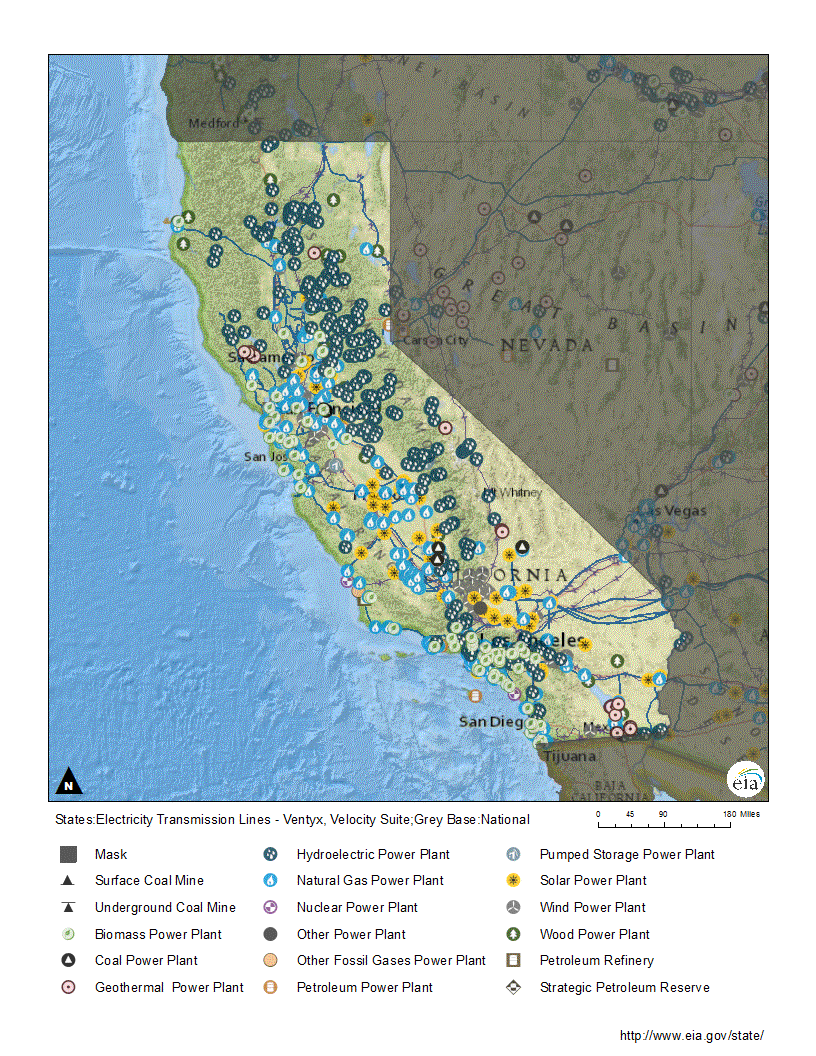
California Quick Facts
- In 2023, California was the seventh-largest producer of crude oil among the 50 states, and the state ranked third in crude oil refining capacity.
- California is the largest consumer of jet fuel and second-largest consumer of motor gasoline among the 50 states.
- California is the second-largest total energy consumer among the states, after Texas, but its per capita energy consumption is the fourth-lowest in the nation.
- In 2023, renewable resources, including hydroelectric power and small-scale solar power, supplied 54% of California's in-state electricity generation. Natural gas fueled another 39% and nuclear power provided almost all the rest.
- In 2023, California was the fourth-largest electricity producer in the nation. It is also the nation’s third-largest electricity consumer and imports more electricity than any other state.
Last Updated: May 16, 2024
Data
Last Update: September 19, 2024 | Next Update: October 17, 2024
| Prices | |||||
|---|---|---|---|---|---|
| Petroleum | California | U.S. Average | Period | find more | |
| Domestic Crude Oil First Purchase | $ 79.92 /barrel | $ 77.45 /barrel | Jun-24 | ||
| Natural Gas | California | U.S. Average | Period | find more | |
| City Gate | $ 2.63 /thousand cu ft | $ 4.36 /thousand cu ft | Jun-24 | find more | |
| Residential | $ 17.13 /thousand cu ft | $ 21.10 /thousand cu ft | Jun-24 | find more | |
| Coal | California | U.S. Average | Period | find more | |
| Average Sales Price | -- | $ 54.46 /short ton | 2022 | ||
| Delivered to Electric Power Sector | -- | $ 2.51 /million Btu | Jun-24 | ||
| Electricity | California | U.S. Average | Period | find more | |
| Residential | 32.99 cents/kWh | 16.41 cents/kWh | Jun-24 | find more | |
| Commercial | 26.11 cents/kWh | 13.10 cents/kWh | Jun-24 | find more | |
| Industrial | 22.54 cents/kWh | 8.44 cents/kWh | Jun-24 | find more | |
| Reserves | |||||
|---|---|---|---|---|---|
| Reserves | California | Share of U.S. | Period | find more | |
| Crude Oil (as of Dec. 31) | 1,492 million barrels | 3.1% | 2022 | find more | |
| Expected Future Production of Dry Natural Gas (as of Dec. 31) | 1,070 billion cu ft | 0.2% | 2022 | find more | |
| Expected Future Production of Natural Gas Plant Liquids | 54 million barrels | 0.2% | 2022 | find more | |
| Recoverable Coal at Producing Mines | -- | -- | 2022 | find more | |
| Rotary Rigs & Wells | California | Share of U.S. | Period | find more | |
| Natural Gas Producing Wells | 3,583 wells | 0.7% | 2020 | find more | |
| Capacity | California | Share of U.S. | Period | ||
| Crude Oil Refinery Capacity (as of Jan. 1) | 1,740,371 barrels/calendar day | 9.6% | 2023 | ||
| Electric Power Industry Net Summer Capacity | 93,151 MW | 7.7% | Jun-24 | ||
| Supply & Distribution | |||||
|---|---|---|---|---|---|
| Production | California | Share of U.S. | Period | find more | |
| Total Energy | 1,591 trillion Btu | 1.6% | 2022 | find more | |
| Crude Oil | 285 thousand barrels per day | 2.2% | Jun-24 | find more | |
| Natural Gas - Marketed | 136,220 million cu ft | 0.3% | 2022 | find more | |
| Coal | -- | -- | 2022 | find more | |
| Total Utility-Scale Net Electricity Generation | California | Share of U.S. | Period | find more | |
| Total Net Electricity Generation | 18,642 thousand MWh | 4.8% | Jun-24 | ||
| Utility-Scale Net Electricity Generation (share of total) | California | U.S. Average | Period | ||
| Petroleum-Fired | NM | 0.4 % | Jun-24 | find more | |
| Natural Gas-Fired | 30.3 % | 43.3 % | Jun-24 | find more | |
| Coal-Fired | 0.1 % | 15.8 % | Jun-24 | find more | |
| Nuclear | 8.8 % | 17.5 % | Jun-24 | find more | |
| Renewables | 60.8 % | 22.7 % | Jun-24 | ||
| Stocks | California | Share of U.S. | Period | find more | |
| Motor Gasoline (Excludes Pipelines) | 534 thousand barrels | 4.6% | Jun-24 | ||
| Distillate Fuel Oil (Excludes Pipelines) | 4,577 thousand barrels | 4.9% | Jun-24 | find more | |
| Natural Gas in Underground Storage | 526,818 million cu ft | 6.9% | Jun-24 | find more | |
| Petroleum Stocks at Electric Power Producers | 158 thousand barrels | 0.7% | Jun-24 | find more | |
| Coal Stocks at Electric Power Producers | 0 thousand tons | 0.0% | Jun-24 | find more | |
| Fueling Stations | California | Share of U.S. | Period | ||
| Motor Gasoline | 7,826 stations | 7.2% | 2022 | ||
| Propane | 213 stations | 8.8% | Aug-24 | ||
| Electric Vehicle Charging Locations | 15,601 stations | 24.2% | Aug-24 | ||
| E85 | 468 stations | 10.6% | Aug-24 | ||
| Biodiesel, Compressed Natural Gas, and Other Alternative Fuels | 914 stations | 31.3% | Aug-24 | ||
| Consumption & Expenditures | |||||
|---|---|---|---|---|---|
| Summary | California | U.S. Rank | Period | ||
| Total Consumption | 6,882 trillion Btu | 2 | 2022 | find more | |
| Total Consumption per Capita | 176 million Btu | 49 | 2022 | find more | |
| Total Expenditures | $ 200,008 million | 2 | 2022 | find more | |
| Total Expenditures per Capita | $ 5,123 | 26 | 2022 | find more | |
| by End-Use Sector | California | Share of U.S. | Period | ||
| Consumption | |||||
| » Residential | 1,204 trillion Btu | 6.2% | 2022 | find more | |
| » Commercial | 1,193 trillion Btu | 7.2% | 2022 | find more | |
| » Industrial | 1,539 trillion Btu | 5.0% | 2022 | find more | |
| » Transportation | 2,916 trillion Btu | 10.6% | 2022 | find more | |
| Expenditures | |||||
| » Residential | $ 32,779 million | 9.9% | 2022 | find more | |
| » Commercial | $ 32,185 million | 13.2% | 2022 | find more | |
| » Industrial | $ 21,493 million | 7.5% | 2022 | find more | |
| » Transportation | $ 113,551 million | 13.2% | 2022 | find more | |
| by Source | California | Share of U.S. | Period | ||
| Consumption | |||||
| » Petroleum | 628 million barrels | 8.6% | 2022 | find more | |
| » Natural Gas | 2,059 billion cu ft | 6.4% | 2022 | find more | |
| » Coal | 1,322 thousand short tons | 0.3% | 2022 | find more | |
| Expenditures | |||||
| » Petroleum | $ 123,820 million | 11.8% | 2022 | find more | |
| » Natural Gas | $ 26,496 million | 9.8% | 2022 | find more | |
| » Coal | $ 121 million | 0.5% | 2022 | find more | |
| Consumption for Electricity Generation | California | Share of U.S. | Period | find more | |
| Petroleum | NM | NM | Jun-24 | find more | |
| Natural Gas | 40,959 million cu ft | 3.3% | Jun-24 | find more | |
| Coal | 5 thousand tons | * | Jun-24 | find more | |
| Energy Source Used for Home Heating (share of households) | California | U.S. Average | Period | ||
| Natural Gas | 60.2 % | 46.2 % | 2022 | ||
| Fuel Oil | 0.2 % | 3.9 % | 2022 | ||
| Electricity | 30.0 % | 41.3 % | 2022 | ||
| Propane | 3.5 % | 5.0 % | 2022 | ||
| Other/None | 6.0 % | 3.5 % | 2022 | ||
| Environment | |||||
|---|---|---|---|---|---|
| Renewable Energy Capacity | California | Share of U.S. | Period | find more | |
| Total Renewable Energy Electricity Net Summer Capacity | 40,415 MW | 11.6% | Jun-24 | ||
| Ethanol Plant Nameplate Capacity | 128 million gal/year | 0.7% | 2024 | ||
| Renewable Energy Production | California | Share of U.S. | Period | find more | |
| Utility-Scale Hydroelectric Net Electricity Generation | 3,083 thousand MWh | 14.5% | Jun-24 | ||
| Utility-Scale Solar, Wind, and Geothermal Net Electricity Generation | 7,588 thousand MWh | 12.0% | Jun-24 | ||
| Utility-Scale Biomass Net Electricity Generation | 385 thousand MWh | 9.9% | Jun-24 | ||
| Small-Scale Solar Photovoltaic Generation | 3,236 thousand MWh | 37.5% | Jun-24 | ||
| Fuel Ethanol Production | 1,960 thousand barrels | 0.5% | 2022 | ||
| Renewable Energy Consumption | California | U.S. Rank | Period | find more | |
| Renewable Energy Consumption as a Share of State Total | 12.8 % | 14 | 2022 | ||
| Fuel Ethanol Consumption | 33,863 thousand barrels | 2 | 2022 | ||
| Total Emissions | California | Share of U.S. | Period | find more | |
| Carbon Dioxide | 324.0 million metric tons | 6.6% | 2021 | ||
| Electric Power Industry Emissions | California | Share of U.S. | Period | find more | |
| Carbon Dioxide | 44,448 thousand metric tons | 2.7% | 2022 | ||
| Sulfur Dioxide | 1 thousand metric tons | 0.1% | 2022 | ||
| Nitrogen Oxide | 63 thousand metric tons | 5.1% | 2022 | ||
Analysis
Last Updated: May 16, 2024
Overview
California has the largest economy in the nation, with a nearly $3.9 trillion GDP in 2023, and the fifth-largest in the world for the seventh year in a row.1,2 About one in nine U.S. residents live in California, and it is the most populous state in the nation.3 California also uses more energy than any other state except Texas.4 However, energy efficiency efforts have helped make California's per capita energy use the fourth lowest in the nation.5,6 California has abundant renewable energy resources, including solar energy, hydroelectric power, geothermal energy, and biomass, and the state produces more electricity using renewable energy than every other state but Texas.7 California is also rich in mineral resources. Long known for gold and other precious minerals, the state has the nation's only rare earths mine.8 Additionally, California has significant crude oil reserves, and the state's petroleum refineries have one-tenth of the nation's total crude oil refining capacity.9,10
Per capita residential and commercial sector energy use in California is lower than in all other states except Hawaii.
California stretches two-thirds of the way up the U.S. West Coast. At its greatest distances, it is more than 1,000 miles long and 500 miles wide.11 With such great distances to travel, transportation accounts for the largest share of the state's energy consumption.12 Californians have more registered motor vehicles and travel more vehicle miles than residents in any other state.13 California accounts for one-tenth of U.S. motor gasoline consumption and about one-seventh of the nation's jet fuel consumption.14,15 Overall, the state's transportation sector accounts for nearly two-fifths of California's total energy consumption. The industrial sector uses about one-fourth of the state's total energy, the residential sector accounts for one-fifth, and the commercial sector uses slightly less than one-fifth.16 However, per capita energy consumption in both the residential and commercial sectors is lower than in all other states except Hawaii.17 Although California has a varied climate, most of the state's more densely populated areas are relatively mild for much of the year.18,19 Changes in weather patterns and climate have resulted in an increased use of cooling and almost three-fourths of California households have air conditioning.20,21
Electricity
California is the nation’s fourth-largest electricity producer.
In 2023, California was the nation's fourth-largest electricity producer and accounted for about 5% of all U.S. utility-scale (1-megawatt and larger) power generation.22 Renewable resources, including hydropower and small-scale (less than 1-megawatt) customer-sited solar photovoltaic (PV) systems, supplied 54% of California's total in-state electricity generation in 2023. Natural gas-fired power plants provided 39% of the state's total net generation.23 Nuclear power's share of California's total electricity generation was about 7%. The state has one operating commercial nuclear power plant—the two-reactor Diablo Canyon facility.24,25
In 2023, California was the nation's second-largest conventional hydroelectric power producer after Washington, and it is consistently among the nation's top four hydropower producers.26,27 Hydropower's contribution is highly variable and is dependent on rain and snowfall. After a very wet year in California in 2023, led in part by the highest mountain snowpack since the mid-1980s, the state's annual hydropower generation increased by more than 80% from 2022.28,29,30 Nonhydroelectric renewable resources, mainly solar and wind energy, provided 41% of California's total in-state electricity generation in 2023. Coal fuels only a small amount of California's in-state net generation, all of it from one 57-megawatt industrial cogeneration plant.31,32
California imports more electricity than any other state and typically receives between one-fifth and one-third of its electricity supply from outside of the state.33 However, in 2023, in-state utility-scale electricity generation equaled about 90% of California's electricity sales, and the rest of the state's power supply came from out of state.34 Wildfires in California and surrounding states threaten both imports of electricity and transmission within the state.35
Although California consumes more electricity than all other states except Texas and Florida, it uses less electricity per capita than any other state but Hawaii.36,37 In 2023, California had the nation's second-highest average price of electricity, after Hawaii.38 The commercial sector accounted for 47% of California's electricity sales in 2023. The residential sector, where three in ten California households use electricity for home heating, accounted for 35% of sales.39 About 18% of the state's electricity sales went to the industrial sector. Light rail, subways, and the iconic cable cars in California's transportation sector accounted for less than 0.3% of electricity use.40
California has led the states in the most electric vehicles (EVs) and EV charging locations every year since 2016.41 California is part of the West Coast Green Highway, an extensive network of electric vehicle DC fast charging locations located along Interstate 5. The state has about 15,300 public charging locations.42,43 In 2022, California had about 783,000 registered battery electric vehicles, the most of any state.44 California also requires all public transit agencies to gradually transition to 100% zero-emission bus (ZEB) fleets. Beginning in 2029, all transit agency new bus purchases must be ZEBs.45
Renewable energy
California is the nation’s top producer of electricity from solar and geothermal energy.
California is second in the nation, after Texas, in total electricity generation from renewable resources. The state is the nation's top producer of electricity from solar energy and geothermal resources. In 2023, California was the nation's second-largest producer of electricity from biomass, after Georgia, and also the second-largest producer of conventional hydroelectric power, after Washington.46
Solar energy is the largest source of California's renewable electricity generation.47 The state's greatest solar resources are in California's southeastern deserts, where all of its solar thermal facilities and several of its largest solar PV plants are located. However, there are solar PV facilities throughout the state.48 In 2023, utility-scale solar energy supplied 16% of the state's total electricity net generation. When small-scale solar generation is included, solar energy provided 28% of the state's total electricity generation.49 At the beginning of 2024, California had nearly 20,000 megawatts of utility-scale solar power generating capacity, more than any other state. When small-scale solar panel generating systems are included, the state had almost 36,500 megawatts of total solar capacity.50
In 2023, wind accounted for 6% of California's total in-state electricity generation, and the state ranked eighth in the nation in wind-powered generation.51,52 California wind power potential exists at several areas around the state, both onshore and offshore.53 The majority of the state's wind turbines are in six major wind resource areas: Altamont, East San Diego County, Pacheco, Solano, San Gorgonio, and Tehachapi.54 At the beginning of 2024, California had about 6,200 megawatts of wind capacity.55 The first wind power farm on California's coast, with 27 turbines and 95 megawatts of capacity, came online in Santa Barbara County at the beginning of 2024.56
California is the nation's top producer of electricity from geothermal resources. In 2023, the state produced 67% of the nation's utility-scale geothermal-sourced electricity, and geothermal power accounted for about 4% of the state's total in-state generation.57,58 The state's operating geothermal power plants have a combined total capacity of nearly 1,900 megawatts.59 Four areas in California have substantial geothermal resources—the coastal mountain ranges north of San Francisco, volcanic areas of north-central California, areas near the Salton Sea in southern California, and areas along the state's eastern border with Nevada. The Geysers, located in the Mayacamas Mountains north of San Francisco, is the largest complex of geothermal power plants in the world and has about 725 megawatts of installed generating capacity.60,61
Superheated geothermal brines in the Salton Sea geothermal resource area in southern California contain lithium, a critical mineral used to manufacture rechargeable batteries.62,63 The state has the only rare earth mine in North America. The Mountain Pass mine in southern California's Mojave Desert is the largest deposit of rare earth elements in the nation. Rare earths are used in the manufacture of electric vehicles, wind turbines, and batteries, among other applications.64,65 In 2023, the Mountain Pass mine produced almost 42,000 metric tons of rare earth concentrate, accounting for about 12% of global rare earth production.66,67
California ranks second in the nation, after Georgia, in the most utility-scale electricity generation from biomass.68 In 2023, biomass fueled 2% of the state's total net generation, and more than half of that was from wood and wood-derived fuels.69 Nearly three-fifths of the state's 1,121 megawatts of utility-scale biomass generating capacity is fueled by wood and wood waste. Landfill gas, municipal solid waste, and other biomass sources fuel the remaining biomass capacity.70 California's biomass resources also provide feedstock to the two wood pellet manufacturing facilities in the state. Those plants can produce about 168,000 tons of pellets per year. Wood pellets are used for heating but can also be used for electricity generation.71 About 173,000 California households use wood as their primary fuel for space heating.72
California consumes 1.4 billion gallons of fuel ethanol annually, which is one-tenth of the nation's fuel ethanol supply and 11 times more than the 128 million gallons that the state's three fuel ethanol plants can produce annually.73,74 Midwestern states provide most of the additional fuel ethanol California uses.75 California can produce a combined 80 million gallons of biodiesel annually from 4 production plants, which is about one-fourth of the nearly 282 million gallons of biodiesel consumed in the state each year.76,77 Several California petroleum refineries have added renewable diesel production, derived from biomass, manufacturing capacity.78,79 California accounts for 97% of the nation's renewable diesel consumption.80
California's renewable portfolio standard (RPS), enacted in 2002 and revised several times since, required that 33% of electricity retail sales in California come from eligible renewable resources by 2020. The state met that goal three years before the target date.81 The RPS also requires that 60% of electricity sales come from renewables by 2030, and 100% by 2045.82 In 2022, the state legislature set intermediate targets of 90% renewable energy and zero-carbon electricity by the end of 2035 and 95% by the end of 2040 on the way to the eventual target of 100% by 2045.83
Petroleum
California was the seventh-largest crude oil producer among the states in 2023 and accounted for almost 2.5% of the nation's total onshore and offshore oil production.84 Although California's annual crude oil production has steadily declined from its peak of 394 million barrels in 1985, the state produced 112 million barrels of crude oil in 2023.85 Reservoirs along California's Pacific Coast, including in the Los Angeles basin, and those in the state's Central Valley contain major crude oil reserves, and the state holds about 3% of the nation's total proved crude oil reserves.86,87
Assessments of California's offshore areas indicate the potential for large, undiscovered recoverable crude oil resources in the federally administered Outer Continental Shelf.88 However, in 1994, concerns about the risks of offshore crude oil and natural gas development resulted in a permanent moratorium on new offshore oil and natural gas leasing in state waters.89 Congress imposed a federal moratorium on oil and natural gas leasing in California federal waters in 1982, but it expired in 2008.90 No new California offshore federal lease sales have occurred since then, although there are 22 older crude oil and natural gas production platforms that remain active in federal waters and 11 in state waters off the coast of California.91,92,93
Foreign suppliers provide three-fifths of the crude oil refined in California.
California has one-tenth of the nation's total crude oil refining capacity and ranks third after Texas and Louisiana.94 A network of pipelines connects California crude oil production to the state's 14 operating petroleum refineries, which are located primarily in the Los Angeles area, the San Francisco Bay area, and the San Joaquin Valley.95,96,97 As crude oil production in California and Alaska declined, the state's refineries increased their supply from foreign oil imports.98,99 Led by Iraq, Saudi Arabia, and Brazil, foreign suppliers provided three-fifths of the crude oil refined in California in 2023.100,101
California requires that motorists use, at a minimum, a specific blend of motor gasoline called CaRFG (California Reformulated Gasoline) to reduce emissions from motor vehicles. California refineries produce cleaner fuels in order to meet state environmental regulations. Refineries in the state often operate at or near maximum capacity because of the high demand for those petroleum products and the lack of interstate pipelines that can deliver those cleaner fuels into the state. When unplanned refinery outages occur, the lack of CaRFG deliveries available from interstate pipelines means replacement supplies of CaRFG come in by marine tanker from out-of-state U.S. refineries or from other countries. It can take several weeks to find and bring replacement motor gasoline from overseas that meets California's unique specifications.102,103
California is the nation's second-largest consumer of refined petroleum products, after Texas, and accounts for about 9% of U.S. total consumption.104 California is the nation's largest consumer of jet fuel and the second-largest consumer of motor gasoline, after Texas.105,106 The transportation sector uses about 85% of the petroleum consumed in the state. The industrial sector accounts for about 11% of state petroleum use, and the commercial sector consumes about 3%. The residential sector, where about 500,000 California households heat with petroleum products, mostly propane, uses about 1%. A small amount of petroleum is used for electricity generation.107,108
Natural gas
Most of California's natural gas reserves and production are in fields in the northern portion of the state's Central Valley.109 California's natural gas output has declined steadily since 1985, and the state now accounts for less than 1% of the nation's total natural gas reserves and production.110,111 California's natural gas production is less than one-tenth of the state's total consumption.112,113 Several interstate natural gas pipelines enter California from Arizona, Nevada, and Oregon and bring natural gas into California from the Southwest, the Rocky Mountain region, and western Canada.114 Although a small amount of natural gas is exported to Mexico, California consumes more than four-fifths of the natural gas delivered to the state.115 Some natural gas that enters the state is placed in California's 14 underground natural gas storage fields that together can hold about 600 billion cubic feet of natural gas, which accounts for about 7% of the nation's storage capacity.116
California is the nation’s second-largest natural gas consumer, after Texas.
California is the nation's second-largest natural gas consumer. Only Texas uses more.117 In 2023, about 32% of the natural gas delivered to California consumers went to the state's electric power sector, where it fuels about two-fifths of the state's total electricity generation.118,119 The industrial sector made up 31% of the state's natural gas consumption. The residential sector, where six in ten California households use natural gas for home heating, accounted for 23% of natural gas use. The commercial sector consumed about 13%, and the transportation sector used about 1% as compressed natural gas vehicle fuel.120,121
Coal
California does not have any coal reserves or production and has very little coal-fired electricity generation. All the generation is from one industrial facility in Trona, California.122,123 Almost all the coal consumed in California arrives by rail and truck from mines in Colorado and Utah. A small amount comes from Pennsylvania.124 In 2023, some coal produced in other states was exported to other countries from California ports.125
Energy on tribal lands
California has the largest Native American population in the nation at about 535,000, and the state is home to more than 100 federally recognized tribal groups.126,127 Although tribal areas exist throughout California, they account for less than 1% of the state's land area.128,129 Many of the tribal lands are small, including the nation's smallest reservation, the 1.32-acre parcel that contains the Pit River Tribe cemetery.130 The largest is the forested Hoopa Valley Reservation, home of the Hupa people, in northern California's Humboldt County, with 102,000 acres.131,132
California's diverse climate and geography give tribes access to a variety of renewable energy resources. One of the first utility-scale wind projects on tribal land in the nation is in southern California. In 2005, the Campo Kumeyaay Nation in southern California leased some of its land in San Diego County for the development of a 50-megawatt wind project.133,134 The Ramona Band of Cahuilla became one of the first tribes to make its reservation independent of the regional electric grid in 2009.135 In 2015, the Bear River Band of the Rohnerville Rancheria in Northern California became the first California tribe to install a hybrid solar, wind, and advanced energy storage microgrid for power generation.136
Some reservations in California have abundant biomass potential. The Blue Lake Rancheria Tribe in Humboldt County has a 175-kilowatt biogas fuel cell system powered by gasified wood waste from the forestry industry.137,138 In 2019, the Rancheria extended use of its microgrid to the broader community, about 10% of the county's population, during a widespread wildfire-related utility power shutoff in northwest Humboldt County.139 In 2022, the U.S. Department of Energy (DOE) awarded the Karuk Tribe $2 million to build a nearly 1 megawatt ground-mounted solar panel system and battery energy storage in northern California.140 In addition to the tribes that have abundant solar, wind, and biomass resources, some California tribal lands have geothermal electricity generation potential, particularly in the Imperial Valley in southern California, the Geysers area in northern California, and along the state's eastern border.141
The California Energy Commission (CEC) awarded a total of $2 million in grants to 10 Native American tribes in early 2021. The grants supported climate and energy planning efforts on tribal lands and in tribal communities, including studies related to the development of renewable resources, microgrids, and energy storage systems.142 In 2022, the CEC awarded one of its largest grants, $31 million, to the Viejas Tribe of Kumeyaay Indians for a long-duration energy storage system that will provide renewable backup power for the tribe. It will support statewide grid reliability in the event of an emergency.143 Since 2010, DOE has invested more than $21 million in about 40 California tribal renewable energy and energy efficiency projects.144
Endnotes
1 U.S. Bureau of Economic Analysis, Regional Data, GDP and Personal Income, Annual Gross Domestic Product (GDP) by State, SAGDP2 GDP in current dollars, All Areas, All industry total, 2023.
2 Office of Governor Gavin Newsom, "California Remains the World's 5th Largest Economy," Press Release (April 16, 2024).
3 U.S. Census Bureau, U.S. and World Population Clock, Most Populous States, accessed April 21, 2024.
4 U.S. Energy Information Administration (EIA), State Energy Data System, Table C11, Total Energy Consumption Estimates by End-Use Sector, Ranked by State, 2021.
5 McCann, Adam, "Most & Least Energy-Efficient States," WalletHub (October 17, 2023).
6 U.S. EIA, Rankings: Total Energy Consumed per Capita, 2021.
7 U.S. EIA, Electric Power Monthly (February 2024), Tables 1.10.B, 1.11.B, 1.15.B, 1.16.B, 1.17.B, 1.18.B.
8 MP Materials, About, accessed April 21, 2024.
9 U.S. EIA, U.S. Crude Oil and Natural Gas Proved Reserves, Year-end 2022, Table 6.
10 U.S.EIA, Number and Capacity of Petroleum Refineries, Atmospheric Crude Oil Distillation Operable Capacity (B/CD), as of January 1, 2023.
11 NETSTATE, California, The Geography of California, updated February 25, 2016.
12 U.S. EIA, State Energy Data System, Table C1, Energy Consumption Overview: Estimates by Energy Source and End-Use Sector, 2021.
13 U.S. Department of Transportation, Federal Highway Administration, Highway Statistic Series: State Statistical Abstracts, California, 2022.
14 U.S. EIA, State Energy Data System, Table F3, Motor gasoline consumption, price, and expenditure estimates, 2022.
15 U.S. EIA, State Energy Data System, Table F1, Jet fuel consumption, price, and expenditure estimates, 2022.
16 U.S. EIA, State Energy Data System, Table C1, Energy Consumption Overview: Estimates by Energy Source and End-Use Sector, 2021.
17 U.S. EIA, State Energy Data System, Table C14, Total Energy Consumption Estimates per Capita by End-Use Sector, Ranked by State, 2021.
18 U.S. Census Bureau, 2020 Census: California Profile, Population Density by Census Tract, accessed April 21, 2024.
19 NETSTATE, Geography of California, Climate, updated February 25, 2016.
20 U.S. EIA, Residential Energy Consumption Survey (RECS), 2009 RECS Survey Data, Air Conditioning, in West Region, divisions, and states (HC7.11) and 2020 RECS Survey Data, State Data, Housing characteristics, Highlights for air conditioning in U.S. homes by state, 2020.
21 Bump, Phillip, "Californians may no longer be able to avoid air conditioning," The Washington Post (September 7, 2022).
22 U.S. EIA, Electric Power Monthly (February 2024), Table 1.3.B.
23 U.S. EIA, Electricity Data Browser, Net generation for all sectors, California, Annual, 2001-23.
24 U.S. EIA, Electricity Data Browser, Net generation for all sectors, California, Annual, 2001-23.
25 U.S. Nuclear Regulatory Commission, California, updated April 7, 2022.
26 U.S. EIA, Electric Power Monthly, (February 2024), Table 1.10.B.
27 U.S. EIA, Electricity Data Browser, Net generation for all sectors, California, New York, Oregon, Washington, Conventional hydroelectric, Annual, 2001-23.
28 U.S. EIA, Electricity Data Browser, Net generation for all sectors, California, Annual, 2001-23.
Jones, Zoe Christen, "California records driest year since 1924," CBS News (October 18, 2021).
29 U.S. EIA, "California's hydroelectric generation affected by historic drought," Today in Energy (July 7, 2021).
30 U.S. EIA, "U.S. hydropower generation expected to increase by 6% in 2024 following last year's lows," Today in Energy (April 18, 2024).
31 U.S. EIA, Electricity Data Browser, Net generation for all sectors, California, Annual, 2001-23.
32 U.S. EIA, Preliminary Monthly Electric Generator Inventory (based on Form EIA-860M as a supplement to Form EIA-860), Inventory of Operating Generators as of March 2024, Plant State: California, Technology: Conventional Steam Coal.
33 U.S. EIA, State Electricity Profiles, 2022, California, Table 10, Supply and disposition of electricity, 1990 through 2022.
34 U.S. EIA, Electric Power Monthly (February 2024), Tables 1.3.B, 5.4.B.
35 Mulkern, Anne C., "Soaring Temperatures and Wildfire Threaten California's Power Grid," Scientific American (July 12, 2021).
36 U.S. EIA, Electric Power Monthly (February 2024), Table 5.4.B.
37 U.S. EIA, State Energy Data System, Table C17, Electricity Retail Sales per Capita, Ranked by State, 2021.
38 U.S. EIA, Electric Power Monthly (February 2024), Table 5.6.B.
39 U.S. Census Bureau, California, B25040 House Heating Fuel, 2022 American Community Survey 1-Year Estimates.
40 U.S. EIA, Electricity Data Browser, Retail sales of electricity, California, 2001-23.
41 U.S. EIA, "California leads the United States in electric vehicles and charging locations," Today in Energy (December 14, 2023).
42 U.S. EIA, Monthly Energy Review (April 25, 2024), Appendix F monthly state file, Public ports only, Public & private ports.
43 West Coast Electric Highway, accessed April 22, 2024.
44 U.S. EIA, State Energy Data System, Table F39, Electric light-duty vehicles overview, 2022.
45 California Air Resources Board, Innovative Clean Transit (ICT) Regulation Fact Sheet (May 16, 2019).
46 U.S. EIA, Electric Power Monthly, (February 2024), Tables 1.10.B, 1.11.B, 1.14.B, 1.15.B, 1.16.B, 1.17.B, 1.18.B.
47 U.S. EIA, Electricity Data Browser, Net generation for all sectors, California, Annual, 2001-23.
48 U.S. EIA, Preliminary Monthly Electric Generator Inventory (based on Form EIA-860M as a supplement to Form EIA-860), Inventory of Operating Generators as of March 2024, Plant State: California, Technology: Solar Photovoltaic, Solar Thermal without Energy Storage.
49 U.S. EIA, Electricity Data Browser, Net generation for all sectors, California, All fuels, All solar, All utility-scale solar, Small-scale solar photovoltaic, Annual, 2001-23.
50 U.S. EIA, Electric Power Monthly (February 2024), Table 6.2.B.
51 U.S. EIA, Electricity Data Browser, Net generation for all sectors, California, Annual, 2001-23.
52 U.S. EIA, Electric Power Monthly (February 2024), Tables 1.14.B.
53 U.S. Department of Energy, Energy Efficiency and Renewable Energy, WINDExchange, Wind Energy in California, Maps & Data, accessed April 22, 2024.
54 California Energy Commission, Wind Energy in California, accessed April 22, 2024.
55 U.S. EIA, Electric Power Monthly (February 2024), Table 6.2.B.
56 Andre, Lisa, "Local leaders celebrate 'significance' of Strauss wind project in Lompoc with ribbon cutting," Lompoc Record (March 5, 2024).
57 U.S. EIA, Electric Power Monthly (February 2024), Table 1.16.B.
58 U.S. EIA, Electricity Data Browser, Net generation for all sectors, California, Annual, 2001-23.
59 U.S. EIA, Electric Power Monthly (February 2024), Table 6.2.B.
60 Calpine, The Geysers, About Geothermal Energy, Welcome to the Geysers, accessed April 22, 2024.
61 California Energy Commission, Geothermal Energy, accessed April 22, 2024.
62 California Energy Commission, Lithium Valley Commission, accessed April 22, 2024.
63 Burton, Jason, "U.S. Geological Survey releases 2022 list of critical minerals," U.S. Geological Survey, Press Release (February 22, 2022).
64 MP Materials, About, accessed April 22, 2024.
65 Xie, John, "California Mine Becomes Key Part of Push to Revive US Rare Earths Processing," VOA News (December 31, 2020).
66 MP Materials, "MP Materials Reports Fourth Quarter 2023 Results," Press Release (February 22, 2024).
67 U.S. Geological Survey, Mineral Commodity Summaries, World Mine Production and Reserves (January 2024), p. 145.
68 U.S. EIA, Electric Power Monthly (February 2024), Table 1.15.B.
69 U.S. EIA, Electricity Data Browser, Net generation for all sectors, California, Annual, 2001-23.
70 U.S. EIA, Preliminary Monthly Electric Generator Inventory (based on Form EIA-860M as a supplement to Form EIA-860), Inventory of Operating Generators as of March 2024, Plant State: California, Technology: Wood/Wood Waste Biomass, Landfill Gas, Municipal Solid Waste, Other Waste Biomass.
71 U.S. EIA, Monthly Densified Biomass Fuel Report, Table 1, Densified biomass fuel manufacturing facilities in the United States by state, region, and capacity, January 2024.
72 U.S. Census Bureau, California, B25040 House Heating Fuel, 2022 American Community Survey 1-Year Estimates.
73 U.S. EIA, U.S. Fuel Ethanol Plant Production Capacity (August 7, 2023), U.S. Nameplate Fuel Ethanol Plant Production Capacity as of January 1, 2023, Excel file.
74 U.S. EIA, State Energy Data System, Table F25, Fuel ethanol consumption estimates, 2022.
75 U.S. EIA, Movements by Pipeline, Tanker, Barge and Rail between PAD Districts, Fuel Ethanol, Annual, 2018-23.
76 U.S. EIA, U.S. Biodiesel Plant Production Capacity (August 7, 2023), Detailed annual production capacity by plant is available in XLSX format.
77 U.S. EIA, State Energy Data System, Table F26, Biodiesel Consumption Estimates, 2022.
78 Bomgardner, Melody M., "California refiners shift production to renewable diesel," Chemical and Engineering News (August 19, 2020).
79 Gerveni, Maria, et al., "Overview of the Production Capacity of U.S. Renewable Diesel Plants through December 2022," (March 8, 2023).
80 U.S. EIA, State Energy Data System, Table F27, Renewable Diesel Consumption Estimates, 2022.
81 California Energy Commission, California Clean Energy Almanac 2020, Chair's Message.
82 NC Clean Energy Technology Center, DSIRE, California Renewables Portfolio Standard, updated December 5, 2023.
83 Balaraman, Kavya, "California legislature aims for 90% clean electricity by 2035 as part of sweeping climate package," Utility Dive (September 2, 2022).
84 U.S. EIA, Crude Oil Production, Annual, Thousand Barrels, 2023.
85 U.S. EIA, California Field Production of Crude Oil, Annual, 1981-2023.
86 U.S. EIA, U.S. Crude Oil and Natural Gas Proved Reserves, Year-end 2022, Table 6.
87 U.S. EIA, Crude Oil Proved Reserves, Reserves Changes, and Production, California, CA-Coastal Region Onshore, CA-Los Angeles Basin Onshore, CA, San Joaquin Basin Onshore, and CA- State Offshore, 2021.
88 U.S. Department of the Interior, Bureau of Ocean Energy Management, Assessment of Undiscovered Oil and Gas Resources of the Nation's Outer Continental Shelf, 2021, BOEM Fact Sheet RED-2021-09.
89 Frisk, Carla, "California Coastal Sanctuary Act of 1994," Environmental Defense Center (December 22, 2017).
90 Eversheds-Sutherland, "Congress Allows Moratorium on Offshore Drilling to Expire," Legal Alert (October 1, 2008).
91 Congressional Research Service, Five-Year Offshore Oil and Gas Leasing Program: Status and Issues in Brief (May 10, 2023), p. 11.
92 U.S. Department of the Interior, Bureau of Safety and Environmental Enforcement, Pacific OCS Platforms, accessed April 23, 2024.
93 California State Lands Commission, Oil and Gas, Offshore Oil & Gas Located in California Waters, accessed April 23, 2024.
94 U.S. EIA, Number and Capacity of Petroleum Refineries, Atmospheric Crude Oil Distillation Operable Capacity (B/CD), Annual, as of January 1, 2023.
95 U.S. EIA, Number and Capacity of Petroleum Refineries, Number of Operable Refineries, as of January 1, 2023.
96 U.S. EIA, Interactive GIS Data Viewer, California, Petroleum Refineries, Crude Oil Pipelines, accessed April 23, 2024.
97 California Energy Commission, California's Oil Refineries, accessed April 23, 2024.
98 U.S. EIA, Alaska Field Production of Crude Oil, Annual, 1988-2023.
99 U.S. EIA, California Field Production of Crude Oil, Annual, 1981-2023.
100 California Energy Commission, Foreign Sources of Crude Oil Imports to California 2023, accessed April 23, 2024.
101 California Energy Commission, Annual Oil Supply Sources to California Refineries, 2023.
102 California Air Resources Board, Cleaner Burning Gasoline: An Update (January 1, 2006).
103 California Energy Commission, State of California Energy Assurance Plan, CEC‐600‐2014‐006 (June 2014), p. 64.
104 U.S. EIA, State Energy Data System, Table F16, Total Petroleum Consumption Estimates, 2022.
105 U.S. EIA, State Energy Data System, Table F1, Jet fuel consumption, price, and expenditure estimates, 2022.
106 U.S. EIA, State Energy Data System, Table F3, Motor gasoline consumption, price, and expenditure estimates, 2022.
107 U.S. EIA, State Energy Data System, Table F16, Total Petroleum Consumption Estimates, 2021.
108 U.S. Census Bureau, California, B25040 House Heating Fuel, 2022 American Community Survey 1-Year Estimates.
109 California Department of Conservation, Division of Oil, Gas, and Geothermal Resources, Oil, Gas, and Geothermal Fields in California 2001 (Map S-1).
110 U.S. EIA, California Natural Gas Gross Withdrawals, Annual, 1967-2023.
111 U.S. EIA, U.S. Crude Oil and Natural Gas Proved Reserves, Year-end 2022, Table 8.
112 U.S. EIA, Natural Gas Gross Withdrawals and Production, Gross Withdrawals, Annual, 2018-23.
113 U.S. EIA, Natural Gas Consumption by End Use, Total Consumption, Annual, 2018-23.
114 California Public Utilities Commission, Natural Gas and California, Supplies, accessed April 24, 2024.
115 U.S. EIA, International and Interstate Movements of Natural Gas by State, California, Annual, 2017-22.
116 U.S. EIA, Underground Natural Gas Storage Capacity, Total Number of Existing Fields and Total Storage Capacity, Annual, 2017-22.
117 U.S. EIA, Natural Gas Consumption by End Use, Total Consumption, Annual, 2018-23.
118 U.S. EIA, Natural Gas Consumption by End Use, California, Annual, 2018-23.
119 U.S. EIA, Electricity Data Browser, Net generation for all sectors, California, Annual, 2023.
120 U.S. Census Bureau, California, B25040 House Heating Fuel, 2022 American Community Survey 1-Year Estimates.
121 U.S. EIA, Natural Gas Consumption by End Use, California, Annual, 2018-23.
122 U.S. EIA, Annual Coal Report 2022 (October 3, 2023), Tables 7, 14, 15.
123 U.S. EIA, Preliminary Monthly Electric Generator Inventory (based on Form EIA-860M as a supplement to Form EIA-860), Inventory of Operating Generators as of March 2024, Plant State: California, Technology: Conventional Steam Coal.
124 U.S. EIA, Annual Coal Distribution Report 2022 (October 3, 2023), By Coal Destination State, California, Table DS-5, Domestic Coal Distribution, by Destination State, 2022.
125 U.S. EIA, Coal Data Browser, Export quantity from Los Angeles, CA, San Francisco, CA, and San Diego, CA, Annual, 2023.
126 "States with the biggest Native American populations," KRQE (October 18, 2023).
127 U.S. Department of the Interior, Bureau of Indian Affairs, "Indian Entities Recognized and Eligible to Receive Services from the United States Bureau of Indian Affairs," Federal Register, Vol. 88, No. 8, Thursday, January 12, 2023, Notices, p. 2012-16.
128 U.S. Environmental Protection Agency, California Tribal Lands and Reservations, updated July 21, 2023.
129 U.S. Forest Service, Forest Service National Resource Guide to American Indian and Alaska Native Relations, Appendix D: Indian Nations, The American Indian Digest (April 1997), p. D-3.
130 U.S. Department of the Interior, Bureau of Indian Affairs, What is a federal Indian reservation?, FAQ Category, accessed April 25, 2024.
131 K'ima:w Medical Center, Hoopa Valley Tribe, accessed April 25, 2024.
132 The Conservation Fund, "Hoopa Valley Tribe Regains Major Tract of Ancestral Land," Press Release (December 20, 2023).
133 Standen, Amy, "Tribal Lands Struggle to Bring Clean Power Online," National Public Radio (August 20, 2010).
134 U.S. EIA, Preliminary Monthly Electric Generator Inventory (based on Form EIA-860M as a supplement to Form EIA-860), Inventory of Operating Generators as of March 2024, Plant State: California, Technology: Onshore Wind Turbine.
135 Gomez, John Jr., Ramona Band of Cahuilla Indians (November 17, 2009).
136 "California Tribe Installs First Renewable Hybrid Microgrid," Business Wire (April 24, 2015).
137 Clarke, Chris, "Tribe to Launch Biomass-Fueled Fuel Cell Plant in Northern California," KCET Redefine (February 28, 2013).
138 Petersen, Karen, "Blue Lake Rancheria's Bold Action on the Climate Front Pays Dividends," U.S. Department of Energy, Office of Indian Energy Policy and Programs (February 27, 2015).
139 Maloney, Peter, "Life Won Thanks to the Blue Lake Rancheria Microgrid," Microgrid Knowledge (November 11, 2019).
140 U.S. Department of Energy, Office of Indian Energy, Karuk Tribe-2020 Project, accessed April 26, 2024.
141 U.S. Department of Energy, Office of Indian Energy, Developing Clean Energy Projects on Tribal Lands, DOE/IE-0012 (December 2012), p. 45.
142 California Energy Commission, "State Awards $2 Million to 10 California Native American Tribes for Climate and Clean Energy Projects," Press Release (January 14, 2021).
143 California Energy Commission, "California Energy Commission Approves $31 Million for Tribal Long-Duration Energy Storage Project," Press Release (November 3, 2022).
144 U.S. Department of Energy, Office of Indian Energy Policy and Programs, Tribal Energy Projects Database, California, accessed April 26, 2024.
Other Resources
Energy-Related Regions and Organizations
- Petroleum Administration for Defense District (PADD): 5
- Regional Transmission Organization (RTO) and Independent System Operator (ISO): California Independent System Operator (CAISO)
- North American Electric Reliability Corporation (NERC) ERO Enterprise: Regional Entities: Western Electricity Coordinating Council (WECC)
Other Websites
- California Energy Commission
- California Public Utilities Commission (CPUC), Energy
- California Department of Community Services and Development
- California Department of Conservation, Geologic Energy Management Division
- California Air Resources Board
- Energy Upgrade California
- California Energy Commission, Clean Transportation Program
- California ISO (Independent System Operator)
- California Energy Commission, California Energy Almanac
- California Energy Commission, Energy Maps of California
- Southern California Daily Energy Report
- California Department of Water Resources
- California Office of Energy Infrastructure Safety
- U.S. Nuclear Regulatory Commission, California
- EIA California Flickr Album
- Western Regional Partnership (WRP)
- Alternative Fuels Data Center, Federal and State Laws and Incentives
- West Coast Green Highway
- Usa.Gov, Get help with energy bills
- NC Clean Energy Technology Center, Database of State Incentives for Renewables and Efficiency (DSIRE)
- National Association of Regulatory Utility Commissioners (NARUC)
- National Association of State Energy Officials (NASEO)
- National Conference of State Legislatures (NCSL), Energy
- National Renewable Energy Laboratory (NREL), Geospatial Data Science Data and Tools
- U.S. Geological Survey (USGS), Publications
- Interstate Oil and Gas Compact Commission (IOGCC)
- U.S. Department of the Interior, Bureau of Ocean Energy Management
- Western Governors Association
- Western Interstate Energy Board (WEIB)
- Western Area Power Administration (WAPA)
- Bonneville Power Administration
- U.S. Department of Health & Human Services, Office of Community Services, An Office of the Administration for Children & Families, Low Income Home Energy Assistance Program (LIHEAP)
- U.S. Department of Energy, Office of Indian Energy Policy and Programs
- U.S. Geological Survey, Maps
- Lawrence Livermore National Laboratory, Energy Flow Charts
- National Renewable Energy Laboratory, State and Local Planning for Energy (SLOPE)
- National Renewable Energy Laboratory, Tribal Energy Atlas
- EIA Status of U.S. Nuclear Outages
- EIA Natural Gas Storage Dashboard
- EIA Energy Disruptions
- U.S. Department of Agriculture (USDA), Rural Development, Energy Programs