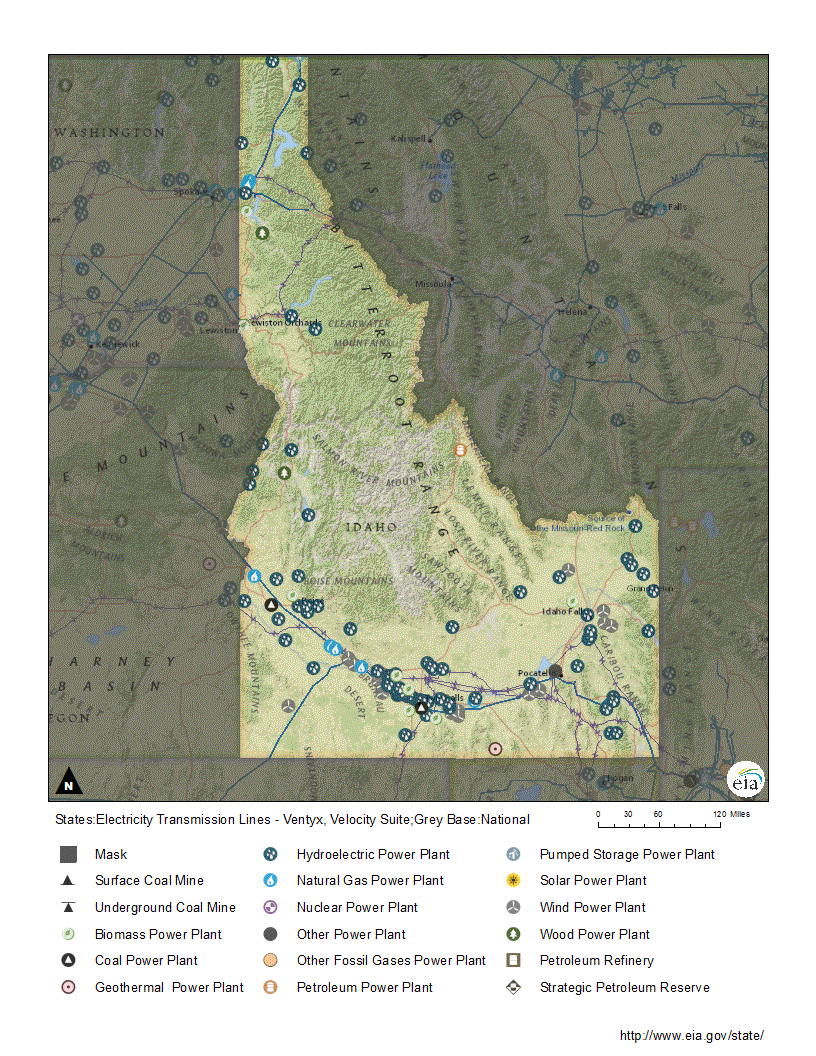
Idaho Quick Facts
- In 2022, renewable energy sources accounted for 75% of the total electricity generated in Idaho, the fourth-highest share of renewable electricity for any state after Vermont, South Dakota, and Washington.
- Idaho has the third-lowest average electricity price among the states, in part because of the large amount of the state's generation that comes from relatively inexpensive hydropower, which accounted for 51% of the state's generation in 2022.
- Idaho’s ninth-largest power plant, based on annual generation, is fueled with wood. Biomass, mainly wood waste, provided about 3% of the state's total electricity generation in 2022.
- Per capita natural gas consumption in Idaho ranks among the lowest one-third of the states, despite half of Idaho households using natural gas as their primary energy source for heating.
- Idaho consumes almost four times more energy than it produces, although its total energy use is among the 10 lowest states.
Last Updated: April 20, 2023
Data
Last Update: April 18, 2024 | Next Update: May 16, 2024
| Prices | |||||
|---|---|---|---|---|---|
| Petroleum | Idaho | U.S. Average | Period | find more | |
| Domestic Crude Oil First Purchase | -- | $ 72.26 /barrel | Jan-24 | ||
| Natural Gas | Idaho | U.S. Average | Period | find more | |
| City Gate | $ 3.61 /thousand cu ft | $ 4.76 /thousand cu ft | Jan-24 | find more | |
| Residential | $ 8.03 /thousand cu ft | $ 11.82 /thousand cu ft | Jan-24 | find more | |
| Coal | Idaho | U.S. Average | Period | find more | |
| Average Sales Price | -- | $ 54.46 /short ton | 2022 | ||
| Delivered to Electric Power Sector | -- | $ 2.48 /million Btu | Jan-24 | ||
| Electricity | Idaho | U.S. Average | Period | find more | |
| Residential | 10.79 cents/kWh | 15.45 cents/kWh | Jan-24 | find more | |
| Commercial | 8.64 cents/kWh | 12.68 cents/kWh | Jan-24 | find more | |
| Industrial | 6.78 cents/kWh | 8.10 cents/kWh | Jan-24 | find more | |
| Reserves | |||||
|---|---|---|---|---|---|
| Reserves | Idaho | Share of U.S. | Period | find more | |
| Crude Oil (as of Dec. 31) | -- | -- | 2021 | find more | |
| Expected Future Production of Dry Natural Gas (as of Dec. 31) | -- | -- | 2021 | find more | |
| Expected Future Production of Natural Gas Plant Liquids | -- | -- | 2021 | find more | |
| Recoverable Coal at Producing Mines | -- | -- | 2022 | find more | |
| Rotary Rigs & Wells | Idaho | Share of U.S. | Period | find more | |
| Natural Gas Producing Wells | -- | -- | 2020 | find more | |
| Capacity | Idaho | Share of U.S. | Period | ||
| Crude Oil Refinery Capacity (as of Jan. 1) | -- | -- | 2023 | ||
| Electric Power Industry Net Summer Capacity | 5,256 MW | 0.4% | Jan-24 | ||
| Supply & Distribution | |||||
|---|---|---|---|---|---|
| Production | Idaho | Share of U.S. | Period | find more | |
| Total Energy | 141 trillion Btu | 0.1% | 2021 | find more | |
| Crude Oil | 0 thousand barrels per day | 0.0% | Jan-24 | find more | |
| Natural Gas - Marketed | 2,580 million cu ft | * | 2022 | find more | |
| Coal | -- | -- | 2022 | find more | |
| Total Utility-Scale Net Electricity Generation | Idaho | Share of U.S. | Period | find more | |
| Total Net Electricity Generation | 1,397 thousand MWh | 0.4% | Jan-24 | ||
| Utility-Scale Net Electricity Generation (share of total) | Idaho | U.S. Average | Period | ||
| Petroleum-Fired | 0.0 % | 0.4 % | Jan-24 | find more | |
| Natural Gas-Fired | 39.7 % | 42.2 % | Jan-24 | find more | |
| Coal-Fired | 0.0 % | 19.9 % | Jan-24 | find more | |
| Nuclear | 0.0 % | 18.2 % | Jan-24 | find more | |
| Renewables | 59.8 % | 18.8 % | Jan-24 | ||
| Stocks | Idaho | Share of U.S. | Period | find more | |
| Motor Gasoline (Excludes Pipelines) | 11 thousand barrels | 0.1% | Jan-24 | ||
| Distillate Fuel Oil (Excludes Pipelines) | 260 thousand barrels | 0.3% | Jan-24 | find more | |
| Natural Gas in Underground Storage | -- | -- | Jan-24 | find more | |
| Petroleum Stocks at Electric Power Producers | 0 thousand barrels | 0.0% | Jan-24 | find more | |
| Coal Stocks at Electric Power Producers | 0 thousand tons | 0.0% | Jan-24 | find more | |
| Fueling Stations | Idaho | Share of U.S. | Period | ||
| Motor Gasoline | 652 stations | 0.6% | 2021 | ||
| Propane | 17 stations | 0.7% | Mar-24 | ||
| Electric Vehicle Charging Locations | 177 stations | 0.3% | Mar-24 | ||
| E85 | 3 stations | 0.1% | Mar-24 | ||
| Biodiesel, Compressed Natural Gas, and Other Alternative Fuels | 3 stations | 0.1% | Mar-24 | ||
| Consumption & Expenditures | |||||
|---|---|---|---|---|---|
| Summary | Idaho | U.S. Rank | Period | ||
| Total Consumption | 574 trillion Btu | 41 | 2021 | find more | |
| Total Consumption per Capita | 301 million Btu | 23 | 2021 | find more | |
| Total Expenditures | $ 7,725 million | 39 | 2021 | find more | |
| Total Expenditures per Capita | $ 4,057 | 24 | 2021 | find more | |
| by End-Use Sector | Idaho | Share of U.S. | Period | ||
| Consumption | |||||
| » Residential | 140 trillion Btu | 0.7% | 2021 | find more | |
| » Commercial | 92 trillion Btu | 0.5% | 2021 | find more | |
| » Industrial | 172 trillion Btu | 0.5% | 2021 | find more | |
| » Transportation | 170 trillion Btu | 0.6% | 2021 | find more | |
| Expenditures | |||||
| » Residential | $ 1,366 million | 0.5% | 2021 | find more | |
| » Commercial | $ 776 million | 0.4% | 2021 | find more | |
| » Industrial | $ 1,236 million | 0.5% | 2021 | find more | |
| » Transportation | $ 4,346 million | 0.7% | 2021 | find more | |
| by Source | Idaho | Share of U.S. | Period | ||
| Consumption | |||||
| » Petroleum | 37 million barrels | 0.5% | 2021 | find more | |
| » Natural Gas | 139 billion cu ft | 0.4% | 2022 | find more | |
| » Coal | 76 thousand short tons | * | 2022 | find more | |
| Expenditures | |||||
| » Petroleum | $ 5,047 million | 0.7% | 2021 | find more | |
| » Natural Gas | $ 983 million | 0.4% | 2022 | find more | |
| » Coal | $ 14 million | 0.1% | 2022 | find more | |
| Consumption for Electricity Generation | Idaho | Share of U.S. | Period | find more | |
| Petroleum | 0 thousand barrels | 0.0% | Jan-24 | find more | |
| Natural Gas | 4,299 million cu ft | 0.4% | Jan-24 | find more | |
| Coal | NM | NM | Jan-24 | find more | |
| Energy Source Used for Home Heating (share of households) | Idaho | U.S. Average | Period | ||
| Natural Gas | 51.4 % | 46.2 % | 2022 | ||
| Fuel Oil | 1.3 % | 3.9 % | 2022 | ||
| Electricity | 35.4 % | 41.3 % | 2022 | ||
| Propane | 5.1 % | 5.0 % | 2022 | ||
| Other/None | 6.8 % | 3.5 % | 2022 | ||
| Environment | |||||
|---|---|---|---|---|---|
| Renewable Energy Capacity | Idaho | Share of U.S. | Period | find more | |
| Total Renewable Energy Electricity Net Summer Capacity | 4,096 MW | 1.2% | Jan-24 | ||
| Ethanol Plant Nameplate Capacity | 60 million gal/year | 0.3% | 2023 | ||
| Renewable Energy Production | Idaho | Share of U.S. | Period | find more | |
| Utility-Scale Hydroelectric Net Electricity Generation | 562 thousand MWh | 2.6% | Jan-24 | ||
| Utility-Scale Solar, Wind, and Geothermal Net Electricity Generation | 243 thousand MWh | 0.5% | Jan-24 | ||
| Utility-Scale Biomass Net Electricity Generation | 24 thousand MWh | 0.6% | Jan-24 | ||
| Small-Scale Solar Photovoltaic Generation | 11 thousand MWh | 0.2% | Jan-24 | ||
| Fuel Ethanol Production | 242 thousand barrels | 0.1% | 2021 | ||
| Renewable Energy Consumption | Idaho | U.S. Rank | Period | find more | |
| Renewable Energy Consumption as a Share of State Total | 25.5 % | 10 | 2021 | ||
| Fuel Ethanol Consumption | 1,964 thousand barrels | 38 | 2021 | ||
| Total Emissions | Idaho | Share of U.S. | Period | find more | |
| Carbon Dioxide | 20.5 million metric tons | 0.4% | 2021 | ||
| Electric Power Industry Emissions | Idaho | Share of U.S. | Period | find more | |
| Carbon Dioxide | 2,287 thousand metric tons | 0.1% | 2022 | ||
| Sulfur Dioxide | 3 thousand metric tons | 0.3% | 2022 | ||
| Nitrogen Oxide | 4 thousand metric tons | 0.3% | 2022 | ||
Analysis
Last Updated: April 20, 2023
Overview
Idaho has many renewable energy resources, but few fossil fuel reserves.
Idaho, known as the Gem State, is rich in silver, phosphate, gold, cobalt, and many other minerals, but the state has few fossil fuel reserves.1,2,3,4 Idaho's energy potential lies in its substantial renewable energy resources, including hydropower, wind, solar, biomass, and geothermal.5 Because of the state's northerly latitude and its location in the interior of North America far from large bodies of water, Idaho has large seasonal temperature swings and cold winters and warm summers.6 Mountains cover much of Idaho from its border with Canada in the north to Nevada and Utah in the south. The mountains capture moisture-laden clouds that move east from the Pacific Ocean, and produce deep mountain snowfalls that feed the state's fast-running rivers.7 Idaho's river valleys, which offered passage through the rugged mountains for early pioneer settlers, today give the state a wealth of hydroelectric and wind energy resources.8,9,10 The plains flanking Idaho's Snake River stretch in an arc all the way across the southern part of the state from the Teton Mountains on the Wyoming border to Hells Canyon at the Oregon border.11 The valleys of the Snake River and its tributaries are home to most of Idaho's small population, more than two-fifths of whom live in the Boise area. Vast stretches of Idaho remain wilderness.12,13,14
Idaho consumes almost four times more energy than it produces.15 Its total energy consumption is among the 10 lowest states, but it per capita use ranks near the middle of the 50 states. The energy intensity of Idaho's economy—the amount of energy used to produce each dollar of GDP—is near the top one-third of the states.16,17 The industrial sector accounts for 31% of the state's total energy use, followed by the transportation sector at 29%, the residential sector at 24%, and the commercial sector at 16%.18 Real estate, manufacturing, healthcare, and construction are among the largest contributors to Idaho's GDP. Other contributors to the state's economy are the energy-intensive agriculture, food processing, pulp and paper, and mining sectors.19,20
Renewable energy
In 2022, renewable energy generated 75% of Idaho's total in-state electricity, including from customer-sited small-scale solar panel generating systems (less than 1 megawatt capacity), which is the fourth-highest share for any state, after Vermont, South Dakota, and Washington. Most of Idaho's renewable electricity comes from hydropower.21,22 Hydropower and wind energy fuel 5 of Idaho's 10 largest generating facilities by capacity. Based on actual generation, 7 of the largest 10 power plants produce electricity from renewable resources.23
In 2022, Idaho ranked fourth among the states in the share of total electricity generated from renewable energy.
In 2022, hydropower provided 51% of Idaho's total in-state electricity generation.24 Half of Idaho's utility-scale (1 megawatt or larger) electricity generating capacity is at hydroelectric power plants, and 5 of the state's 10 largest power plants ranked by the actual amount of electricity generated are hydroelectric facilities.25,26 The nation's largest privately-owned conventional hydroelectric generating facility, the Brownlee plant, is on the Idaho-Oregon border. The three-dam complex, owned by Idaho Power, is on the Snake River in Hells Canyon, which is the deepest river gorge in North America.27,28
Although only a small amount of the state's land area is suitable for wind power development, Idaho has substantial wind energy potential in the southern half of the state along the Snake River and on mountain ridges across the state.29 In 2022, about 17% of the state's total in-state electricity net generation came from wind facilities, whose total combined generating capacity was nearly 1,000 megawatts. Idaho's electricity generation from utility-scale wind power farms began in 2005. The state's 10th-largest electricity generating facility by capacity is a 125-megawatt wind farm with 83 turbines. A new 160-megawatt wind farm, which will be the state's largest wind farm, is scheduled to come online in mid-2024.30,31,32,33 Idaho's wind farms are located on the Snake River Plain.34
Idaho's first utility-scale solar photovoltaic (PV) electricity generation began in 2016, when three solar power generating facilities came online.35,36 The largest solar farm by capacity, with 120 megawatts of generating capacity, began operating at the end of 2022. Solar heating and small-scale, customer-sited solar panel generating systems can be found in the state's cities and rural areas. About 75% of Idaho's solar PV electricity generation came from utility-scale facilities in 2022, when total solar power accounted for 4% of the state's net generation.37,38
About two-fifths of Idaho is covered by forests.39 Biomass, primarily wood waste from those forests, provided about 3% of the state's total electricity generation in 2022. Other waste biomass and landfill gas also generate electricity in the state.40,41 Idaho's ninth-largest power plant, based on annual generation, is fueled with wood.42 The state's biomass resources also provide feedstock for Idaho's three wood pellet manufacturing plants, which have a combined production capacity of 74,000 tons per year.43
In 2022, Idaho was one of seven states with utility-scale electricity generation from geothermal energy.44 Although geothermal energy provides less than 1% of the state's total generation, Idaho's volcanic landscape has some of the best geothermal potential in the nation.45 The state has many hot springs and other geothermal resources that have long been used as direct heat sources for aquaculture, greenhouses, spas, resorts, and city district heating. In 2008, the first commercial geothermal power plant in the U.S. Northwest came online in south-central Idaho. The 10-megawatt capacity facility is the state's only geothermal power plant.46,47,48
Idaho does not have a renewable portfolio standard (RPS) that requires a specific amount of electricity be generated from renewable sources of energy by a certain date.49 However, the state offers low-interest loans for energy efficiency and renewable energy projects and tax deductions for small-scale renewable energy-fueled devices used for residential heating or electricity generation.50,51 While there is no statewide net metering policy, each of Idaho's three investor-owned electric utilities offers net metering programs for small-scale, customer-sited renewable generation. Idaho's commercial, residential, and agricultural customers are all eligible for net metering.52,53,54
Electricity
Hydroelectric power plants typically supplied more than two-thirds of Idaho's total in-state electricity generation until 2012. However, in the past decade, drought and increased generation from other renewables have reduced hydropower's share of the state's total annual generation to slightly more than half. The balance of Idaho's in-state generation is supplied mostly by natural gas and wind power. In 2022, natural gas fueled about 25% of Idaho's electricity generation and wind accounted for 17%. Solar power, biomass-fueled facilities, and geothermal energy collectively provided about 7% of the state's generation.55
Three large investor-owned electric utilities supply about four-fifths of the state's electricity. About two dozen municipal utilities and rural electric cooperatives provide the rest. They buy almost all of their electricity from the Bonneville Power Administration (BPA), which markets power mainly from hydroelectric facilities at federal dams and other facilities in the Pacific Northwest.56,57 Almost one-third of the electricity consumed in Idaho arrives over interstate transmission lines from out-of-state generating facilities owned by Idaho utilities and from the BPA.58,59,60
Idaho's only coal-fired power plant is a small industrial combined-heat-and-power (CHP) facility with 5 megawatts of generating capacity.61 Although in-state coal-fired electricity generation is minimal, Idaho's utilities bring in electricity from coal-fired power plants in neighboring states.62,63,64 A coal-fired power plant in Oregon that supplied electricity to Idaho closed in 2020, and other coal-fired generation in neighboring states are set to shut down over the next several years. Idaho's largest electric utility plans to end its coal-fired power generation purchases by 2028.65,66,67
The state has no commercial nuclear power plants, but the Idaho National Laboratory (INL), a federal nuclear energy research center and one of the state's largest employers, was the site of the nation's first nuclear power plant. It first generated electricity in 1951.68,69,70 Currently, plans are underway to build on the INL site the first power plant with six small modular nuclear reactors—each with 77 megawatts of generating capacity. The power plant, which is scheduled to be fully online by 2030, will be a smaller, scalable version of the widely-used light water reactor technology.71,72,73,74,75
The region's transmission lines are increasingly congested, and projects are under way to expand capacity both to supply Idaho with electricity and to transport power among several western states including Wyoming, Idaho, and Oregon. In the near term, most new generating capacity planned in the region will be fueled by renewable energy sources. New transmission projects will also enable development of the region's remote renewable resources.76,77
Idaho has the third-lowest average electricity price of any state.
Idaho has the nation's third-lowest average electricity price, after Wyoming and North Dakota, in part because of the large amount of the state's generation that comes from relatively inexpensive hydropower.78 In 2022, the largest share of Idaho's electricity sales went to the residential sector—which accounted for 38% of the state's total—followed closely by the industrial sector at almost 36% and the commercial sector at 26%.79 About one-third of Idaho households use electricity as their primary energy source for home heating.80
Petroleum
Idaho does not have significant proved crude oil reserves.81 It produces a very small amount of crude oil.82 Exploration for crude oil in Idaho began in 1903, but despite promising geology in the state's southeast and southwest, no commercial reserves were discovered or produced until the past decade.83 Since 2015, the small amounts of crude oil that are produced come from wells drilled primarily for natural gas.84,85
Idaho has no petroleum refineries.86 Refined petroleum products come from nearby states. Two major petroleum product pipelines cross the state. One pipeline in southern Idaho runs west through the Snake River Valley from refineries in Utah and another pipeline crosses the northern part of the state from refineries in Montana. Only the southern pipeline system delivers refined products to terminals in Idaho.87 The fuel in the northern pipeline is shipped to terminals in Spokane, Washington, and then trucked back to northern Idaho.88
Idaho’s total petroleum consumption is among the lowest 10 states, but its per capita petroleum use is near the national average.
In part because of its small population, Idaho's total petroleum consumption is among the lowest 10 states, but its per capita petroleum use is near the national average.89 The transportation sector uses more than four-fifths of the petroleum consumed in the state, the industrial sector uses about one-tenth, and the residential and commercial sectors consume the rest.90 About 7 in 100 Idaho households use fuel oil, kerosene, or propane for home heating.91 Conventional motor gasoline without ethanol can be sold statewide, but as is the case in most states, almost all the motor gasoline sold in Idaho contains at least 10% ethanol.92,93 The state has one ethanol plant with a production capacity of about 60 million gallons per year, which is less than Idaho's annual ethanol consumption of about 82 million gallons.94,95,96
Natural gas
Idaho does not have any significant natural gas reserves.97 Natural gas discoveries in 2010 led to the state's first commercial natural gas production in 2015.98,99 Output so far is modest and fell sharply in 2020, down about 90% from 2019, due in part to a decline in drilling activity during the COVID-19 pandemic. However, the state's natural gas production increased in 2021 and was 13 times greater than in 2020.100,101 Idaho consumers receive most of their natural gas supply by interstate pipeline, primarily from Canada and Utah, and nearly 90% of the natural gas that enters Idaho leaves, with most of it going to Washington.102 One pipeline system enters Idaho at its northern border with Canada, crosses the state's panhandle, and continues to Washington, Oregon, and California. Another pipeline system runs from the San Juan Basin in southwestern Colorado across Idaho's Snake River Plain on its way to the Pacific Northwest and Canada. That system is bi-directional, so it can supply natural gas to Idaho either from Canada or from Wyoming and Colorado.103,104,105 Idaho has no natural gas underground storage sites.106
Idaho's per capita natural gas consumption ranks among the lowest one-third of the states, despite the prevalence of natural gas use for heating during the state's extremely cold winters.107 The industrial sector is the largest natural gas consumer in Idaho, making up about three-tenths of the state's gas use. The electric power sector is the second-largest gas consuming sector, accounting for slightly more than one-fourth of the state total. The residential sector makes up one-fourth of the state's natural gas use, as half of Idaho households use natural gas as their primary energy source for heating. The commercial sector accounts for about one-sixth of the state's natural gas consumption.108,109
Coal
Idaho has a small amount of estimated recoverable coal reserves, but the state does not have any coal production.110,111 There are no utility-owned coal-fired power plants in Idaho, but there is one coal-fueled electricity generating unit with 5 megawatts of capacity at a processing plant in Twin Falls that produces sugar from sugar beets.112 Small amounts of coal are shipped to Idaho's industrial users by rail and truck from Utah and Pennsylvania.113
Endnotes
1 Idaho State University, Idaho Museum of Natural History, Mining in Idaho, accessed March 2, 2023.
2 Holtz, Michael, "Idaho is sitting on One of the Most Important Elements on Earth," The Atlantic (January 24, 2022).
3 U.S. Energy Information Administration (EIA), Annual Coal Report 2021 (October 18, 2022), Table 15, Recoverable Coal Reserves at Producing Mines, Estimated Recoverable Reserves, and Demonstrated Reserve Base by Mining Method, 2021.
4 U.S. EIA, U.S. Crude Oil and Natural Gas Proved Reserves, Year-end 2021, Tables 7, 10.
5 Idaho Governor's Office of Energy and Mineral Resources, Renewable Energy, accessed March 2, 2023.
6 NOAA National Centers for Environmental Information, State Climate Summaries 2022, Idaho.
7 Qualls, Russell, "Idaho Contrasts from Mountains to Plains," Community Collaborative Rain, Hail and Snow Network, State Climates Series, accessed March 2, 2023.
8 U.S. Department of the Interior, National Park Service, National Historic Trails, Auto Tour Route Interpretive Guide, Along the Snake River Plain Through Idaho, The Tangle of Trails Through Idaho (October 2008), p. 7-10.
9 Idaho Governor's Office of Energy and Mineral Resources, Hydroelectric, accessed March 2, 2023.
10 U.S. Department of Energy, Energy Efficiency and Renewable Energy, WINDExchange, Wind Energy in Idaho, Maps & Data, accessed March 2, 2023.
11 World Atlas, Idaho, accessed March 2, 2023.
12 U.S. Census Bureau, 2020 Census Demographic Data Map Viewer, Idaho, Population Density, Census track boundary.
13 U.S. Census Bureau, American Community Survey, Table B01003, Total Population, 2021: ACS 1-Year Estimates Detailed Tables, Idaho and Boise City, ID Metro Area.
14 Sangres.com, National Wilderness Areas in Idaho, accessed March 2, 2023.
15 U.S. EIA, State Energy Data System, Table P3, Total Primary Energy Production and Total Energy Consumption Estimates in Trillion Btu, 2020.
16 U.S. EIA, State Energy Data System, Table C14, Total Energy Consumption Estimates per Capita by End-Use Sector, Ranked by State, 2020.
17 U.S. EIA, State Energy Data System, Table C10, Total Energy Consumption Estimates, Real Gross Domestic Product (GDP), Energy Consumption Estimates per Real Dollar of GDP, Ranked by State, 2020.
18 U.S. EIA, State Energy Data System, Table C11, Total Energy Consumption Estimates by End Use Sector, Ranked by State, 2020.
19 NETSTATE, Idaho Economy, accessed March 2, 2023.
20 U.S. Bureau of Economic Analysis, Tools, Interactive Data, Regional Data, GDP and Personal Income, Annual Gross Domestic Product (GDP) by State, GDP in current dollars, NAICS, Idaho, All Statistics in Table, Idaho, 2021.
21 U.S. EIA, Electricity Data Browser, net generation for all sectors (thousand megawatthours), 2019-22.
22 U.S. EIA, Electric Power Monthly (February 2023), Tables 1.3.B, 1.10.B, 1.11.B.
23 U.S. EIA, Idaho Electricity Profile 2021, Table 2A, Ten largest plants by capacity, 2021, and Table 2B, Ten largest plants by generation, 2021.
24 U.S. EIA, Electricity Data Browser, net generation for all sectors (thousand megawatthours), 2019-22.
25 U.S. EIA, Preliminary Monthly Electric Generator Inventory (based on Form EIA-860M as a supplement to Form EIA-860), Inventory of Operating Generators as of February 2023, Plant State: Idaho, Technology: All, Conventional Hydroelectric.
26 U.S. EIA, Idaho Electricity Profile 2021, Table 2B, Ten largest plants by generation, 2021.
27 Idaho Power, Hydroelectric, accessed March 3, 2023.
28 U.S. Forest Service, Hells Canyon National Recreation Area, Hells Canyon Overview, accessed March 3, 2023.
29 U.S. Department of Energy, Energy Efficiency and Renewable Energy, WINDExchange, Wind Energy in Idaho, Maps and Data, accessed March 3, 2023.
30 U.S. EIA, Electricity Data Browser, net generation or all sectors (thousand megawatthours), 2019-22.
31 U.S. EIA, Idaho Electricity Profile 2021, Table 2A, Ten largest plants by capacity, 2021.
32 U.S. EIA, Preliminary Monthly Electric Generator Inventory (based on Form EIA-860M as a supplement to Form EIA-860), Inventory of Operating Generators as of February 2023, Plant State: Idaho, Technology: Onshore Wind Turbine; Inventory of Planned Generators as of February 2023, Plant State: Idaho, Technology: Onshore Wind Turbine.
33 Renewable Technology, Goshen North Wind Farm, Idaho, accessed March 3, 2023.
34 U.S. EIA, U.S. Energy Atlas, All Energy Infrastructure and Resources, Idaho, Wind Power Plants, accessed March 3, 2023.
35 U.S. EIA, Electricity Data Browser, net generation for all sectors (thousand megawatthours), 2001-22.
36 U.S. EIA, Preliminary Monthly Electric Generator Inventory (based on Form EIA-860M as a supplement to Form EIA-860), Inventory of Operating Generators as of February 2023, Plant State: Idaho, Technology: Solar Photovoltaic.
37 Idaho Governor's Office of Energy and Mineral Resources, Solar, accessed March 3, 2023.
38 U.S. EIA, Electricity Data Browser, net generation for all sectors (thousand megawatthours), 2019-22.
39 Idaho Forest Products Commission, Forest Information Topic: Idaho's Forests, accessed March 3, 2023.
40 U.S. EIA, Preliminary Monthly Electric Generator Inventory (based on Form EIA-860M as a supplement to Form EIA-860), Inventory of Operating Generators as of February 2023, Plant State: Idaho, Technology: Landfill Gas, Other Waste Biomass, Wood/Wood Waste Biomass.
41 U.S. EIA, Electricity Data Browser, net generation for all sectors (thousand megawatthours), 2019-21.
42 U.S. EIA, Idaho Electricity Profile 2021, Table 2A, Ten largest plants by generation, 2021.
43 U.S. EIA, Monthly Densified Biomass Fuel Report (March 15, 2023), Table 1, Densified biomass fuel manufacturing facilities in the United States by state, region, and capacity, December 2022, Download.
44 U.S. EIA, Electric Power Monthly (February 2023), Table 1.16.B.
45 U.S. EIA, Electricity Data Browser, net generation for all sectors (thousand megawatthours), 2019-22.
46 Idaho Governor's Office of Energy and Mineral Resources, Geothermal, accessed March 3, 2023.
47 Idaho Governor's Office of Energy and Mineral Resources, Idaho Energy Landscape 2021, p. 41-42.
48 U.S. EIA, Preliminary Monthly Electric Generator Inventory (based on Form EIA-860M as a supplement to Form EIA-860), Inventory of Operating Generators as of February 2023, Plant State: Idaho, Technology: Geothermal.
49 National Conference of State Legislatures, State Renewable Portfolio Standards and Goals, updated August 13, 2021.
50 NC Clean Energy Technology Center, DSIRE, Idaho, Low-Interest Energy Loan Programs, updated January 7, 2021.
51 NC Clean Energy Technology Center, DSIRE, Idaho, Residential Alternative Energy Tax Deduction, updated October 3, 2022.
52 NC Clean Energy Technology Center, DSIRE, Idaho Power, Net Metering, updated February 13, 2023.
53 NC Clean Energy Technology Center, DSIRE, Rocky Mountain Power, Net Metering, updated October 27, 2016.
54 NC Clean Energy Technology Center, DSIRE, Avista Utilities, Net Metering, updated October 27, 2016.
55 U.S. EIA, Electricity Data Browser, net generation for all sectors (thousand megawatthours), 2019-22.
56 Idaho Governor's Office of Energy and Mineral Resources, Idaho Energy Landscape 2021, p. 10-15, 63.
57 Bonneville Power Administration, About, accessed March 13, 2023.
58 U.S. EIA, Idaho Electricity Profile 2021, Table 10, Supply and disposition of electricity, 1990 through 2021.
59 Idaho Power, How We Get Electricity to You, accessed March 13, 2023.
60 Idaho Governor's Office of Energy and Mineral Resources, Idaho Energy Landscape 2021, p. 27-28.
61 U.S. EIA, Preliminary Monthly Electric Generator Inventory (based on Form EIA-860M as a supplement to Form EIA-860), Inventory of Operating Generators as of February 2023, Plant State: Idaho, Technology: Conventional Steam Coal.
62 U.S. EIA, Electricity Data Browser, net generation for all sectors (thousand megawatthours), 2019-22.
63 Idaho Coal, Our Pathway Away from Coal, accessed March 13, 2023.
64 Idaho Governor's Office of Energy and Mineral Resources, Coal, accessed March 13, 2023.
65 Idaho Power, Coal, accessed March 13, 2023.
66 U.S. EIA, Preliminary Monthly Electric Generator Inventory (based on Form EIA-860M as a supplement to Form EIA-860), Inventory of Operating Generators as of February 2023, Plant State: Montana, Utah, Washington: Technology: Conventional Steam Coal, planned retirement year.
67 Ridler, Keith, "Idaho Power cuts coal by 2028 in plan to state regulators," Associated Press (January 4, 2022).
68 U.S. EIA, Nuclear Reactor, State, and Net Capacity, accessed March 13, 2023.
69 Idaho National Laboratory, The World's First Nuclear Power Plant, accessed 13, 2023.
70 Idaho National Laboratory, "Idaho National Laboratory a Major Contributor to Idaho's Economy," Press Release (February 26, 2019).
71 Idaho Governor's Office of Energy and Mineral Resources, Nuclear, accessed March 13, 2023.
72 NuScale, "NuScale Reaches Key Milestone in the Development of the Carbon Free Power Project," Press Release (January 9, 2023).
73 U.S. EIA, Preliminary Monthly Electric Generator Inventory (based on Form EIA-860M as a supplement to Form EIA-860), Inventory of Planned Generators as of February 2023, Plant State: Idaho, Technology: All.
74 "Eastern Idaho nuclear project goes from 12 to six reactors," Associated Press (July 19, 2021).
75 Patel, Sonal, "Nuclear Field Activities Completed for Idaho NuScale SMR Project," Power (February 3, 2022).
76 Idaho Governor's Office of Energy Resources, Energy Infrastructure, Transmission Line Projects, accessed March 16, 2023.
77 U.S. EIA, Preliminary Monthly Electric Generator Inventory (based on Form EIA-860M as a supplement to Form EIA-860), Inventory of Planned Generators as of February 2023, Plant State: Idaho, Oregon, Washington, Technology: All.
78 U.S. EIA, Electric Power Monthly (February 2023), Table 5.6.B.
79 U.S. EIA, Electricity Data Browser, Idaho, Retail Sales of Electricity (million kilowatthours), 2019-22.
80 U.S. Census Bureau, House Heating Fuel, Table B25040, 2021 ACS 1-Year Estimates Detailed Tables, Idaho.
81 U.S. EIA, Crude Oil Proved Reserves, Reserves Changes, and Production, Proved Reserves as of December 31, 2021.
82 U.S. EIA, Crude Oil Production, Annual, 2017-22.
83 Barton, Mark, "Idaho Geological Survey Oil & Gas Program," Idaho Geological Survey (November 2019), slide 4.
84 Barker, Rocky, "Idaho Has Become an Oil-Producing State," Idaho Statesman (June 28, 2016).
85 U.S. EIA, Idaho Field Production of Crude Oil, Annual, 2007-2022.
86 U.S. EIA, Refinery Capacity Report (June 21, 2022), Table 3, Capacity of Operable Petroleum Refineries by State as of January 1, 2022.
87 U.S. Department of Energy, Office of Electricity Delivery and Energy Reliability, State of Idaho Energy Sector Risk Profile, Petroleum, p. 4, accessed March 16, 2023.
88 Sowell, John, "In a state without crude oil or refineries, Idahoans are hit hard at the pump," Idaho Statesman (June 20, 2015).
89 U.S. EIA, State Energy Data System, Table C15, Petroleum Consumption, Total and per Capita, Ranked by State, 2020.
90 U.S. EIA, State Energy Data System, Table F16, Total Petroleum Consumption Estimates, 2020.
91 U.S. Census Bureau, House Heating Fuel, Table B25040, 2021 ACS 1-Year Estimates Detailed Tables, Idaho.
92 American Petroleum Institute, U.S. Gasoline Requirements Map, updated January 2018.
93 U.S. EIA, "Almost all U.S. gasoline is blended with 10% ethanol," Today in Energy (May 4, 2016).
94 U.S. EIA, U.S. Fuel Ethanol Plant Production Capacity (August 8, 2022), Detailed annual production capacity by plant is available in XLS file.
95 U.S. EIA, State Energy Data System, Table P1, Primary Energy Production Estimates in Physical Units, 2020.
96 U.S. EIA, State Energy Data System, Table F25, Fuel ethanol consumption estimates, 2021.
97 U.S. EIA, Natural Gas Reserves Summary as of Dec. 31, Dry Natural Gas, Annual, 2016-21.
98 Dunnahoe, Tayvis, "Idaho enters ranks of hydrocarbon producing states," Oil and Gas Journal (February 6, 2017).
99 U.S. EIA, Natural Gas Gross Withdrawals and Production, Idaho Gross Withdrawals of Natural Gas, Annual 2015-21.
100 U.S. EIA, Natural Gas Gross Withdrawals and Production, Idaho, Annual-Million Cubic Feet, 2016-21.
101 U.S. EIA, "U.S. natural gas production decreased by 1% in 2020," Today in Energy (March 2, 2021).
102 U.S. EIA, International and Interstate Movements of Natural Gas by State, Idaho, 2016-21.
103 Idaho Public Utilities Commission, Major Natural Gas Pipelines and Local Gas Distribution Companies, accessed March 16, 2023.
104 Idaho Governor's Office of Energy and Mineral Resources, Idaho Energy Landscape 2021, p. 16-18.
105 Williams, Operations, Transmission & Gulf of Mexico, Overview, accessed March 16, 2023.
106 U.S. EIA, Underground Natural Gas Storage Capacity, 2016-21.
107 U.S. EIA, State Energy Data System, Table C16, Natural Gas Consumption, Total and per Capita, Ranked by State, 2020.
108 U.S. EIA, Natural Gas Consumption by End Use, Idaho, Annual, 2017-22.
109 U.S. Census Bureau, House Heating Fuel, Table B25040, 2021 ACS 1-Year Estimates Detailed Tables, Idaho.
110 U.S. EIA, Annual Coal Report 2021 (October 18, 2022), Table 15, Recoverable Coal Reserves at Producing Mines, Estimated Recoverable Reserves, and Demonstrated Reserve Base by Mining Method, 2021.
111 U.S. EIA, Annual Coal Report 2021 (October 18, 2022), Table 1, Coal Production and Number of Mines by State and Mine Type, 2021 and 2020.
112 U.S. EIA, Preliminary Monthly Electric Generator Inventory (based on Form EIA-860M as a supplement to Form EIA-860), Inventory of Operating Generators as of February 2023, Plant State: Idaho, Technology: Conventional Steam Coal.
113 U.S. EIA, Annual Coal Distribution Report 2021 (October 18, 2022), Domestic distribution of U.S. coal by destination State, consumer, destination and method of transportation, Idaho, Table DS-10, Domestic Coal Distribution, by Destination State, 2021.
Other Resources
Energy-Related Regions and Organizations
- Petroleum Administration for Defense District (PADD): 4
- North American Electric Reliability Corporation (NERC) ERO Enterprise: Regional Entities: Western Electricity Coordinating Council (WECC)
Other Websites
- Idaho Governor's Office of Energy and Mineral Resources
- Idaho Public Utilities Commission
- Idaho Department of Lands, Oil and Gas Conservation Commission
- Idaho Department of Lands, Oil & Gas Leasing
- EIA Idaho Flickr Album
- Idaho Department of Heath & Welfare, Heating Assistance (Seasonal & Crisis)
- Idaho Department of Heath & Welfare, Weatherize Home
- Idaho Geological Survey, Geothermal Resources
- Idaho National Laboratory
- Idaho Leadership in Nuclear Energy Commission
- Idaho Governor's Office of Energy and Mineral Resources, State Energy Loan Program
- Northwest Power and Conservation Council, Power Supply
- Alternative Fuels Data Center, Federal and State Laws and Incentives
- Benefits.Gov, Housing and Public Utilities
- NC Clean Energy Technology Center, Database of State Incentives for Renewables and Efficiency (DSIRE)
- National Association of Regulatory Utility Commissioners (NARUC)
- National Association of State Energy Officials (NASEO)
- National Conference of State Legislatures (NCSL), Research and Policy
- National Renewable Energy Laboratory (NREL), Geospatial Data Science Data and Tools
- U.S. Geological Survey (USGS), Publications
- Interstate Oil and Gas Compact Commission
- Western Interstate Energy Board
- Bonneville Power Administration
- U.S. Department of Health and Human Services, Administration for Children and Families, Office of Community Services, Low Income Home Energy Assistance Program (LIHEAP)
- U.S. Geological Survey, Maps
- Lawrence Livermore National Laboratory, Energy Flow Charts
- National Renewable Energy Laboratory, State and Local Planning for Energy (SLOPE)
- EIA Natural Gas Storage Dashboard
- EIA Energy Disruptions
- U.S. Department of Agriculture (USDA), Rural Development, Energy Programs